

Here's The Average Number Of Seeds In A Pomegranate
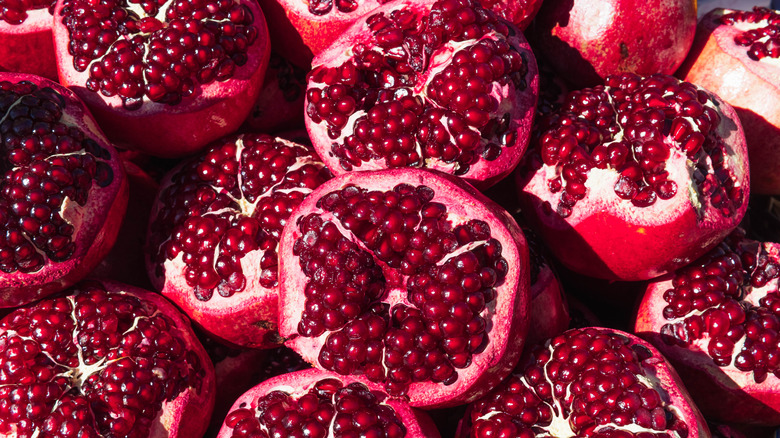
The pomegranate, Punica granatum, a juicy Autumnal treat. A symbol of beauty and love, the pomegranate is one of humanity's earliest known fruits. Instead of housing a meaty texture, like an apple or orange, the pomegranate contains a white pulp and hundreds of red seeds, the treasure within the husk. The approximate number of seeds varies by each individual pomegranate, with an average range of 400 to 1,200 seeds. There is some debate over whether or not a bigger pomegranate will ultimately yield more seeds than a smaller one.
Pomegranates, which are technically a type of berry, are a labor of love. They grow on small trees or shrubs and produce red-orange funnel-shaped flowers, which form into the pomegranate after six to seven months. As it is very drought tolerant, it can be grown in a variety of climates, like humid or subtropic, but prefers a Mediterranean environment.
The history of the pomegranate

The pomegranate's origins date back to Persia, which is Iran in the modern day. It was suited for traveling, given its leathery exterior, and eventually made its way to China, the Roman Empire, and India. They were introduced to Indonesia, Central America, and South America between the 15th and 17th centuries and were being grown in Florida and Georgia in the United States by the early 18th century.
The pomegranate has rich symbolism in many cultures. While being associated with love and beauty, it is also linked to fertility and reproduction. An example of this can be found in the Greek myth of Persephone, where Persephone eats six seeds of a pomegranate given to her by Hades, the lord of the Underworld, which forces her to give half of her year to him. Her return from the Underworld is considered to be a new beginning for the Earth: spring.