

The Coffee Shop Red Flag That Instantly Makes Us Leave

There's a reason many of us choose to go to the same coffee shops over and over — there are too many coffee shops that give off signs that they're going to be bad. From an off-putting ambiance to a messy coffee machine area, there are some pretty obvious things to avoid when searching for a good spot. Some red flags are less obvious right away — but one to keep an eye out for is when a coffee shop doesn't offer traditional sizes for espresso drinks like a cappuccino, flat white, and cortado.
All three of these drinks have less milk than a latte, but often, coffee shops ignore tradition and basically turn these drinks into lattes. For example, I recently went to Starbucks and ordered a flat white without naming a size, and the barista didn't ask me what size I wanted. This could normally be considered a signal that the coffee order was going to be wrong, but flat whites are always one size: 5 to 6 ounces.
Flat whites do not (or should not) have multiple sizes — yet the assumption that all coffee shops follow this standard (I am not a Starbucks regular) was my mistake. I was served a grande, a 16-ounce "flat white" that tasted like warm milk, and I will never go to Starbucks for that same drink again.
Why proper drink sizes matter at a coffee shop
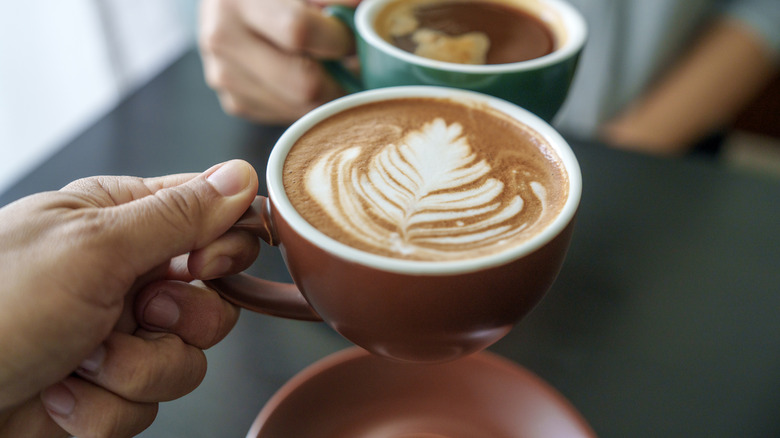
Not using the correct amount of milk in a flat white or serving up far too large cappuccinos is a definite red flag for passionate coffee aficionados. For those who like a "large" 16-ounce cappuccino with a lot of foam and milk, or a cortado that tastes more like milk than espresso — that's fine. Many people are satisfied with a drink as long as it has milk and coffee; we all have our coffee preferences.
However, if a coffee shop doesn't even have the correct-sized cups to hold a traditional drink on the menu, that may be grounds for walking away. Just as customers have the right to enjoy a big and milky or sugary coffee drink, those of us who want to order a drink that allows us to taste the flavor of the espresso (without having to order just plain espresso) should be able to. This oversight also demonstrates that a coffee shop is out of touch with coffee culture and tradition, and the baristas working there likely weren't trained to make these drinks in their intended proportions. Milk can make bad coffee taste better, so even if a coffee shop has espresso or coffee that might not taste good on its own, adding milk will make a somewhat decent cappuccino or flat white.
How to avoid this red flag on your next coffee run
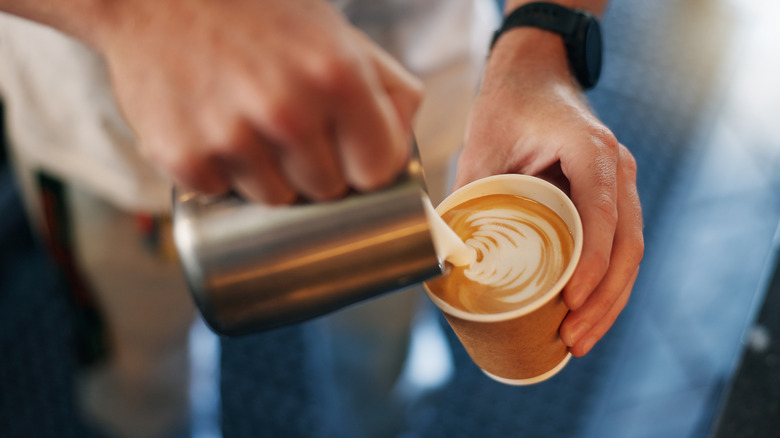
To find out whether a coffee shop is guilty of this red flag, check out the menu. If a menu doesn't list fluid ounces next to items like cappuccinos, cortados, and flat whites, this may actually be a good thing because it often indicates that there is only one size for these types of drinks. If fluid ounces are listed, keep in mind that a standard cappuccino should be 5 ounces (including milk, foam, and espresso), a cortado 4 to 5 ounces, and a flat white, 5 to 6 ounces. You can also ask the barista how many ounces the cappuccino, cortado, or flat white you're ordering has. If they don't know or say something along the lines of, "The same amount as a latte, but just with more foam," these are red flags.
Another red flag detector: Instead of fluid ounces, the menu lists "small," "medium," and "large" for these drinks. While small seems like it would be the best bet, this could still mean that the drink will have a total of up to 12 ounces, which is double the amount they should have! Be sure to clarify how much milk is used for the sizes — the small size could end up being fine, but medium and large are likely going to be diluted and milky. If you're having doubts at the coffee shop you're currently at, some of the best coffee shops in the country are small chains, and there might be a location nearby.