

What People Get Wrong About Airplane Food
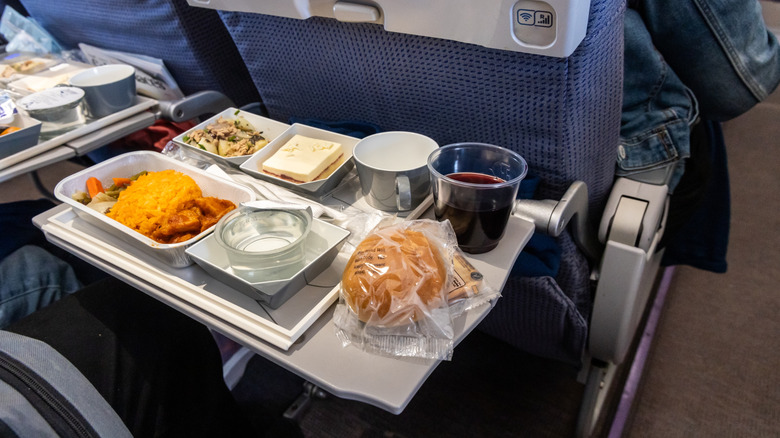
Airplane food isn't usually known as fine cuisine. It just doesn't taste good sometimes, though it can be jazzed up with a little citrus. There's enough bland, mushy airplane food out there that it's easy to assume the meals are made long in advance and then frozen until the flight. But actually, that's not how it's usually done.
Cooked airplane food isn't made more than 24 hours before the flight, said Kimberly Plaskett, LSG Group's Director of Marketing and Communications for the Americas. (The company makes meals that are served on airplanes.) "Our cooked meals are freshly prepared either the day of or less than a day before each flight and then blast-chilled to an almost frozen state," she said in an interview with sister publication Chowhound. The blast-chilling keeps the food fresh and safe while in transit.
There's a lot the average airline passenger doesn't think about when it comes to feeding a plane full of hungry travelers. Plaskett said it involves a lot of moving parts all coming together. "We work with flight tracking software so we know when we need to pull the meals for final flight prep," she explained.
Here's the full journey of airplane food, from kitchen to tray table
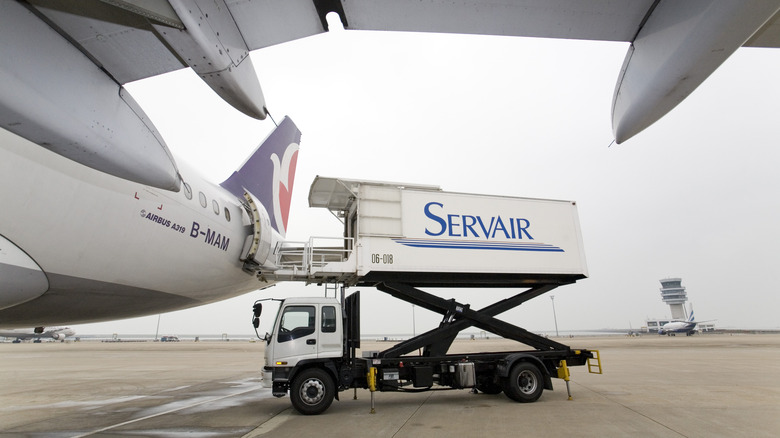
Safety regulations prohibit cooking on board an airplane (that's no surprise, since fire and airplanes don't exactly go together). But it's usually not traveling far — often, the food production facilities are very close to the airports. LSG's airline division, LSG Sky Chefs, has 36 production facilities near airports across the country. For passengers flying out of Boston's Logan Airport, for instance, the airplane food was made in a facility just about half a mile from the nearest terminal.
At every point in the transportation process, the food has to be kept below 41 degrees Fahrenheit, a standard food safety measure. Once the food is made at the production facility, it's loaded onto a special refrigerated truck. The storage area of these trucks actually can lift up to the level of the airplane's service door. And the highest-tech trucks can be run entirely by one person thanks to automation and built-in sensors.
Once the food is on the plane, they're loaded onto racks for storage, then placed in a convection oven for heating. The convection oven circulates very hot air quickly, meaning that the food only needs to be warmed for about 20 minutes to get from the almost-frozen state to a hot, ready-to-eat meal. It's a remarkable process to go from raw ingredients to hot and served to a passenger in a matter of hours — though that doesn't mean everything on the airplane is going to be delicious. There's still some foods you should never get on an airplane.