

How Buffalo Wild Wings Handles Its Leftover Food
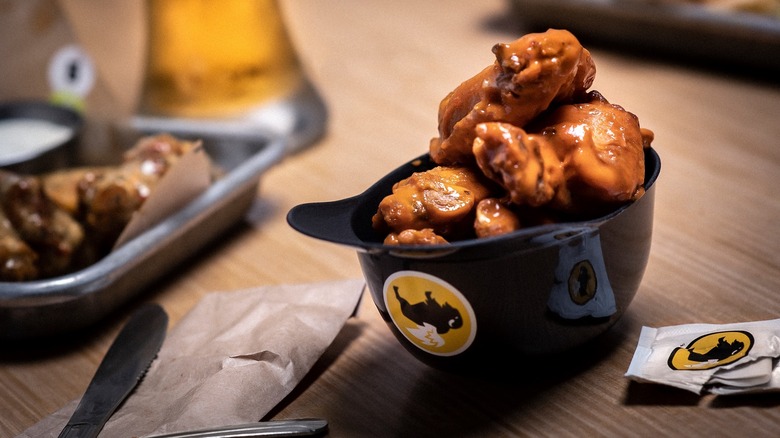
If you fancy yourself a chicken wing enthusiast, chances are you've tasted the fare at Buffalo Wild Wings. Maybe you're a Parmesan Garlic fan, or perhaps you prefer Mango Habanero — the champion of our ranking of Buffalo Wild Wings sauces from worst to first. When it comes to flavor, variety, and entertainment, there's not much we don't love, but when we dove a bit deeper to discover what really happens to the leftover food at Buffalo Wild Wings ... we remained impressed. The chain partners with Quest Resource Holding Corporation to responsibly dispose of leftover food and other materials at its locations across the United States. While corporate policy encourages the donation of edible surplus food to local nonprofits and community organizations, the actual implementation of these programs often varies by individual franchise location, depending on local regulations and community partnerships.
Buffalo Wild Wings is owned by the Atlanta-based holding company Inspire Brands, which also owns Arby's, Jimmy John's, Dunkin', and other chains, totaling more than 33,000 restaurants worldwide. According to its website, Inspire Brands employs a strategy across all of its restaurants that "follows a hierarchy of preventing waste before it occurs, donating edible waste, and responsibly disposing of unavoidable waste."
Exploring Buffalo Wild Wings' policies, practices, and employee feedback
While Inspire Brands claims to prioritize preventing waste before it occurs, what might that look like in practice? While the broad variety of beverages is a key part of what makes Buffalo Wild Wings so successful, the brand manages its packaging footprint by favoring kegs over individual bottles. By relying on draft systems, Inspire Brands notes that it helps significantly reduce the environmental burden of single-use packaging; in fact, it estimates that Buffalo Wild Wing's volume of keg usage removes approximately "6 billion single-use containers from the waste stream every year."
When it comes to food production, the company claims to have performance metrics that incentivize team members to prepare ingredients and fulfill orders with minimal waste. But conversations on social media suggest that these low-waste standards might not always be met.
For example, on Reddit, one user identifying as a Buffalo Wild Wings employee shared a photo of food they had taken home after a shift and described how they prepared the surplus. This sparked a debate: one commenter suggested the chicken appeared to have been fried before an order was placed, which would contradict "made-to-order" protocols. The original poster countered this by explaining that chicken is stored in pre-portioned bags and only fried as orders arrive, arguing that any food staff take home at the end of the night consists strictly of imperfect pieces that did not meet quality standards for customers.