

If You're Looking For The Tenderest Cut Of Steak Then This Should Be Your Choice
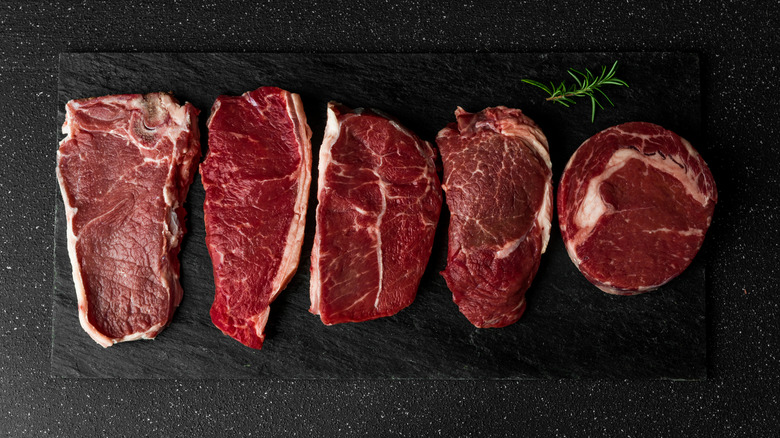
Steak preference is a very personal choice for a lot of people. It's sort of like how you take your coffee, or how you like your eggs prepared, in that people tend to stick with one, tried and true method and order the same way time and time again. With steak, many are die-hard ribeye fans for its beefy rich flavor. Others go for New York strips which offer a good balance of flavor and tenderness. But if buttery-soft texture is your preference in beef, you can't get a more tender cut than the filet mignon.
The filet is cut from the beef tenderloin, a long, lean muscle that runs along the length of a steer's spine. Unlike, say, the shoulder or chest muscles, this muscle does little to no work so it is extremely tender yet has very little fat. You won't get as much beef flavor as something like the ribeye, but this also makes the filet mignon an excellent cut for pairing with rich sauces like bearnaise or peppercorn.
At home, if you don't want to make your own fancy French sauce you should, at the very least, top your filet with butter and herbs, the one trick you need for better filet mignon. And, while grilling steak is a classic cooking method, for filets, you'll probably get superior results when you cook it the right way, in other words, sear it on the stove (with herbed butter, of course), and finish it in the oven.
If filet mignon is too expensive then try these other tender cuts
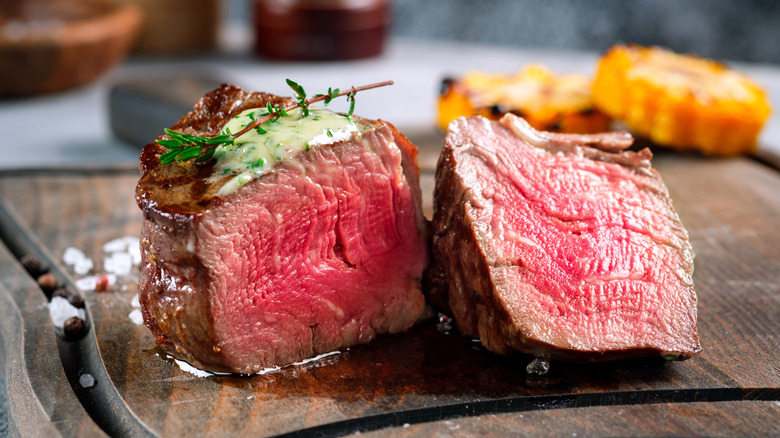
With such tenderness as the filet mignon comes a price; the reason this cut is so expensive is because it's sort of sparse. The tenderloin muscle itself makes up less than 1% of a cow's meat, so if you want such a rarity, you'll have to pay for it. If the price is too steep, there are some other steak choices that are considered tender, just not as succulent as the filet. The T-bone and porterhouse cuts both contain a bone that separates a portion of the filet and a piece of the strip steak. On the porterhouse, the filet is much larger than it is on the T-bone, so naturally, the T-bone is less costly than the former.
A lesser-known cut called the flat iron is also a tasty choice. It has some fat marbling which helps give it richness and tenderness. It looks similar to a flank steak, but is very different. The flat iron comes from the cow's shoulder while the flank comes from the animal's belly section, close to the hind legs. Another good and extremely flavorful steak cut is called the hanger, or butcher's cut. It's not as easy to find as filets, ribeyes, or strips, but it's worth seeking out because it's tender, juicy and pretty affordable, even though there is only one small steak on each cow. Top sirloin and strip steaks are generally easy to find and on the tender side as well, but nowhere near as lush as the mighty-fine filet.