

Where Are Green Chiles Grown Around The Globe?
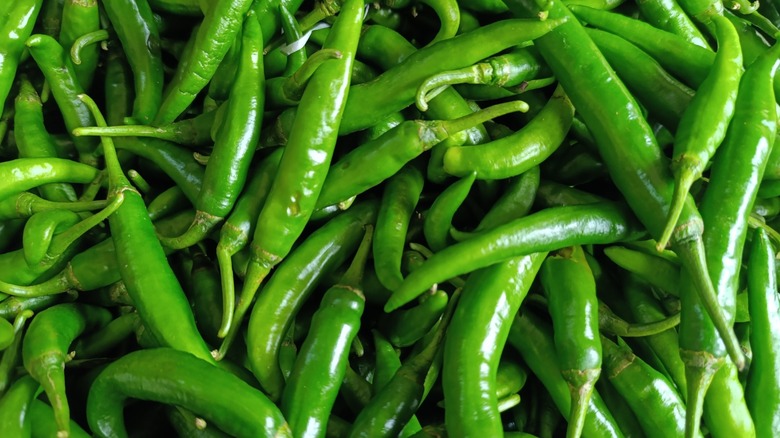
Green chiles are a staple in Mexican cuisine, and adjacent cuisines, like Tex-Mex. Perhaps you've seen them fresh, or perhaps you've grabbed a can of green chiles off the shelf to add to your burrito or a green chili chicken stew. But, have you ever wondered where those chiles come from, or how they're grown? The answer is actually more complicated than it seems, and depends on the specific type of green chile you're referring to.
When you think of green chiles, you're likely thinking of the a Hatch chile, which is very regionally specific. As its name suggests, the Hatch chile's home is New Mexico's Hatch Valley, a small swath of land that sits alongside the Rio Grande River. The chiles were first grown and cultivated by Austrian immigrants to the region, specifically a man named Joseph Franzoy, over 100 years ago.
Hatch chiles thrive in this environment because of its really unique climate. The close-by Rio Grande River is perfect for lending irrigation to farms, including a unique composition of minerals that benefit the soil. Additionally, the soil itself is lush with minerals, like selenium, which enhance the chiles' flavor. Climate is important too, and Hatch chiles enjoy over 300 days of sunshine per year. Additionally, the temperature changes that the region experiences on a day-to-day basis (from over 100 degrees Fahrenheit during the day to as low as 60 degrees Fahrenheit at night), cause the plants to concentrate their sugars and capsaicinoids (the compounds that make peppers spicy).
Beyond the Hatch chile
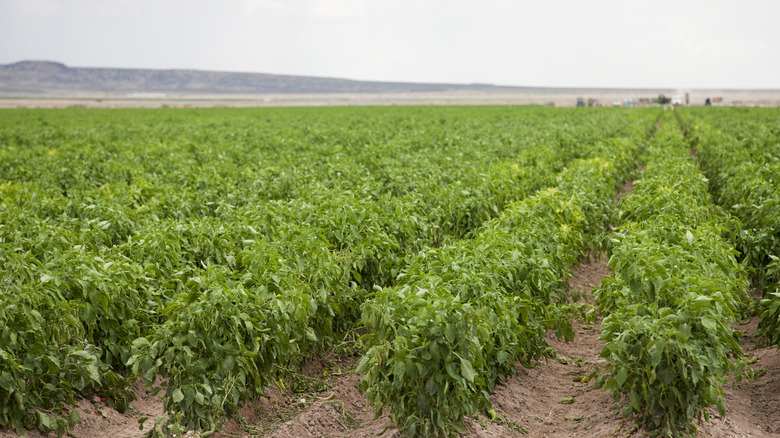
Despite its popularity, the Hatch isn't the only kind of green chili out there. Much like the Hatch, Anaheim chiles are grown and cultivated exactly where their name suggests: Anaheim, California. (It's kind of like how champagne can only earn that title if it's made in Champagne, France). Anaheim chiles are a bit milder than the Hatch variety, but are grown in a similar environment — they are light and heat-loving plants. There's also the Poblano green chile, named after the Puebla village in Mexico. Puebla is also home to the spicy Serrano pepper, and both the Poblano and the Serrano thrive in similar climates as the Hatch and Anaheim.
Additionally, technically, pepper varieties, like bell peppers and jalapeños, are considered chili peppers. Both varieties fall under the genus Capsicum, meaning they are closely related. Although chili implies some level of spice in colloquial language, bell peppers are just a variety of chili peppers lacking that heat. Unlike the ultra-specific climate needed to grow Hatch and Anaheim chiles, bell peppers can be cultivated in a variety of locations. While they are grown in California and Central and South America, the majority of the world's bell peppers are actually produced in Asia. Bell peppers still need sun, but prefer slightly milder temperatures than their Southwestern counterparts. Similarly, jalapeños like sandy soil and sun, but prefer growing temperatures between 65 and 80 degrees Fahrenheit. Most of these small green chiles are grown in New Mexico, Texas, and California.