

The Country That Produces Significantly More Cocoa Beans Than Any Other
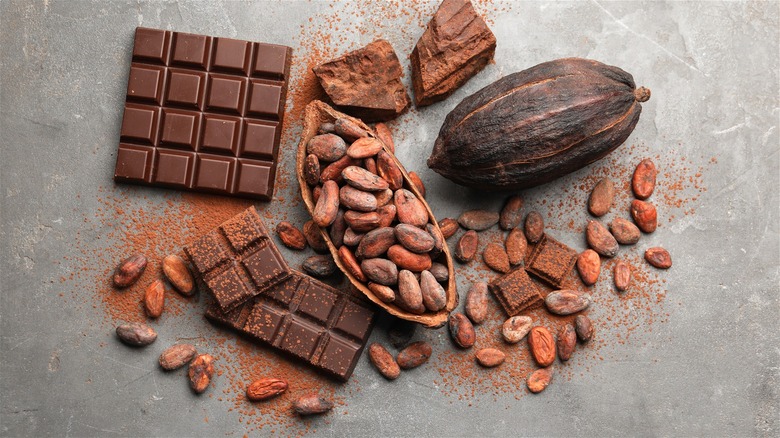
Few foods on the planet share a rich or complicated untold truth like chocolate. Throughout the centuries, chocolate has been used as currency by the Aztecs, turned into a pariah by the Catholic Church, and contributed to countless cavities among kids. It's as influential as a treat can get, and based on numbers, one country in Africa makes significantly more of it than any other.
According to 2024 data from the Food and Agriculture Organization of the United Nations (FAO), Ivory Coast produced 1,890,422 metric tons of cocoa beans that year. This puts it well above the production of second-ranked Indonesia, which produced 632,702 metric tons. In fact, if you added the output of Indonesia with that of the next two highest-producing countries — Ghana and Ecuador — Ivory Coast still outpaces all three combined by more than 320,000 metric tons.
FAO estimates total global production of cocoa beans at 5,223,196 metric tons, which means Ivory Coast supplies about 36% of the world's beans. Ivory Coast's geographical neighbor, Ghana, produces 530,000 metric tons of cocoa beans a year, meaning the two are responsible for roughly 46% of global cocoa bean production.
How Ivory Coast became the world leader in cocoa production
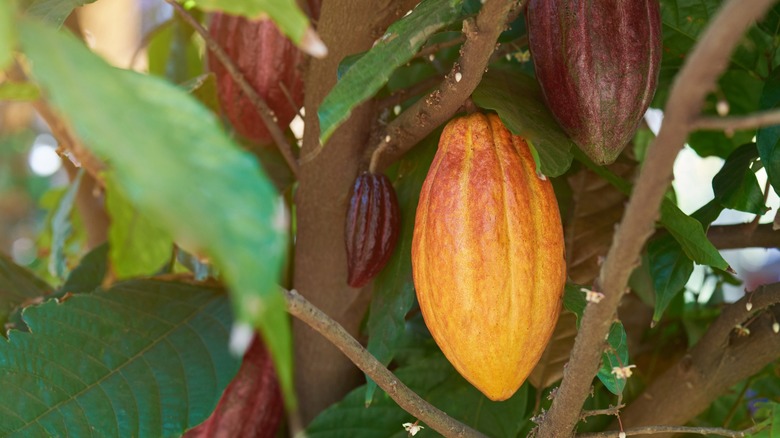
What makes Ivory Coast's cocoa industry all the more impressive is that it's still relatively young. The country only started seriously producing cocoa beans in the early 1900s; prior to that, its chief products were rubber and palm oil. French colonists recognized Ivory Coast's climate was ideal for growing cocoa, and by the 1930s, the colonial government began ramping up the industry after seeing its impact on the economy through exports.
Aggressive growth policies led to Ivory Coast officially outdoing Ghana in terms of cocoa bean production in 1978, and it has consistently held that position ever since. According to figures from Observatory of Economic Complexity, this explosive growth resulted in the cocoa industry generating $4.87 billion through exports in 2024, with the Netherlands buying just short of 25% of that supply.
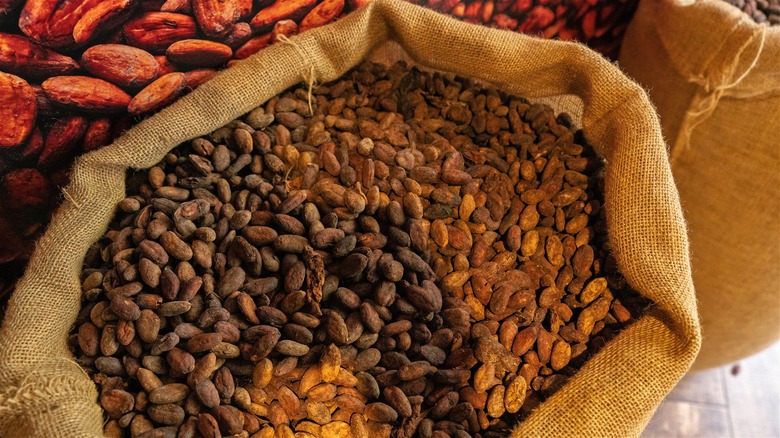
The single-minded focus on expanding Ivory Coast's production capacity, however, meant little was done to strengthen the country's ability to process cocoa beans into actual chocolate. According to a 2025 report by Africa's Institute for Security Studies, less than 3% of Ivory Coast's exports represent finished chocolate products, despite the beans themselves accounting for about 30% of all exports. In 2014, Dutch journalistic program VPRO Metropolis encountered Ivorian cocoa farmers who had never even tasted the chocolate they'd worked their lives growing the raw materials for (via NPR).
Ivory Coast cocoa's checkered history led to ethical reform
The rapid expansion of Ivory Coast's cocoa industry went relatively unchecked, and many problematic practices continued long after the French ended their colonial rule back in 1960. Reports of child and slave labor arose in the 2000s, causing significant alarm among international human rights organizations. A 2018 report by the Child Labor Cocoa Coordinating Group estimated 2.1 million children in Ivory Coast and Ghana are put to work on cocoa farms. It was a horrifying situation, and one that resulted in three major chocolate companies facing legal action in the U.S. in 2021 — Mars, Nestle, and Hershey. All three were found not liable for the crime in 2025.
In 2001, efforts were made to find ways to end child labor in Ivory Coast over subsequent decades, with the ratification of the Harkin-Engel Protocol, an international agreement to reduce child labor in the cocoa industry by 70% by 2020. While the program didn't reach its goals, it paved the way for future efforts to continue the work.
To help in this regard, the Food Empowerment Project (FEP) put together a Chocolate List, which names chocolate manufacturers, confirmed via independent research, that source chocolate ethically and without the use of child labor or slavery. Some of the best fair trade chocolate you can buy is on the list of manufacturers the FEP feels comfortable recommending, so you can rest assured it comes from a producer committed to upholding human rights.