

Does Food Taste Different In Space?
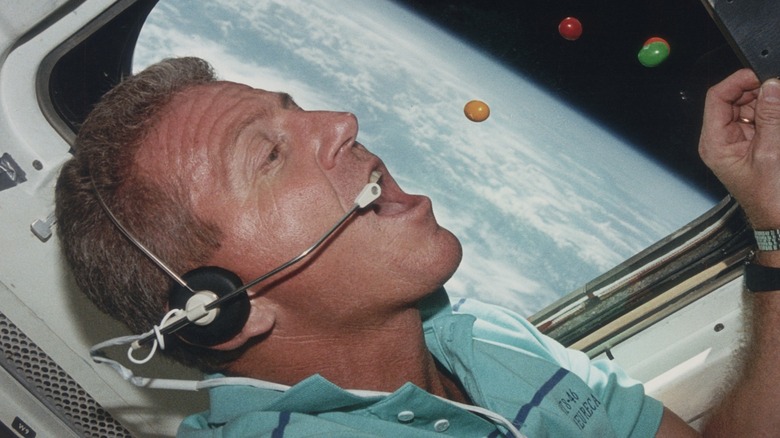
Imagine taking a bite of your favorite food only for it to taste bland or different from how you remember it. Well, that's reality astronauts often face when getting to space. Canadian astronaut Chris Hadfield described the experience in 2013 in a video from Canadian Space Agency and NASA. "When you first get to space, within a little while, you're all clogged up, and sinus plugged up, so you can't even taste your food. And that lasts several days," Hadfield explained. The lack of gravity is mostly to blame since gravity pulls fluid down to lower extremities away from the head. In space, however, fluid is not being pushed downward, which forces fluid to the head and nasal cavities. The result is like eating with a head cold.
According to Hadfield, food starts to taste better again after your body acclimates to the lack of gravity. But other factors can influence how food tastes in space. Because most space food is processed and shelf-stable, processing methods can affect taste, texture, and visual appeal. Sense of smell is an important part of tasting food, too. While we can smell food externally by breathing in, we also smell it once it's in our mouths, known as retronasal smell. As a result, other odors inside a shuttle or space station can compete with food while eating, impacting taste. Interestingly, even feeling lonely can affect sense of smell and, therefore, the taste of food, according to research conducted at the Royal Melbourne Institute of Technology (via Space).
What do astronauts actually eat in space?
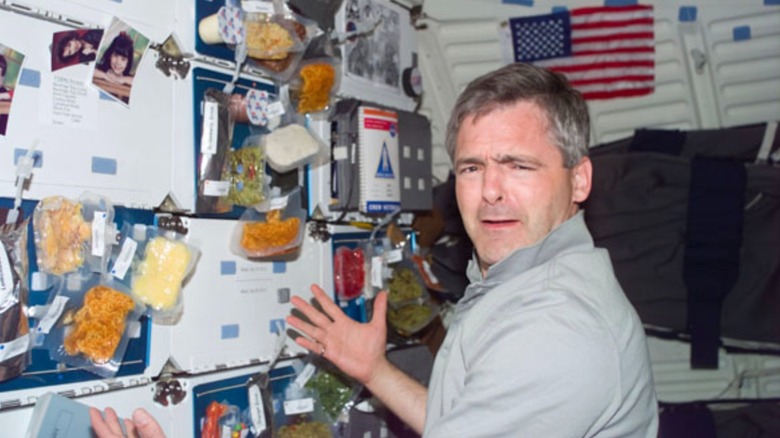
Early iterations of astronaut food were largely dehydrated or in paste form, referred to as the "tube and cube days" by NASA food scientist Takiyah Sirmons in Houston, We Have a Podcast (via NASA). Yuri Gagarin, the first astronaut, famously ate a meal in space of beef and liver paste with chocolate sauce for dessert. Powdered orange drink Tang was also common during the space race of the 1960s and became synonymous with space food. Luckily, astronauts have much more appetizing and varied options these days: around 200 different meals.
Meals range from mac and cheese to chili to international foods, like sushi and satay brought from other space-faring nations. Tortillas are another common food on the ISS and are used for space tacos (a major first for NASA), sandwiches, and hamburgers. Condiments like hot sauce are also extremely popular for reviving dulled flavor. Most NASA-prepared meals are thermostabilized or freeze-dried, processes that make food shelf-stable. Dedicated food refrigeration isn't available due to limited power onboard, although occasionally fresh fruits and vegetables, or refrigerated and frozen foods like ice cream, are sent up with freezers meant for experiments (via NASA).
While your kitchen can't recreate the effects of microgravity on how food tastes, you can still whip up some out-of-this-world meals. If you want to eat like an astronaut, try this seven-ingredient space salad developed by the University of Adelaide or bake some DoubleTree cookies, like astronauts Luca Parmitano and Christina Koch did back in 2019 (via BBC). Chances are you'll enjoy them more anyway, thanks to our old pal gravity.