

Why Black Currants Were Banned In The US For Over Half A Century
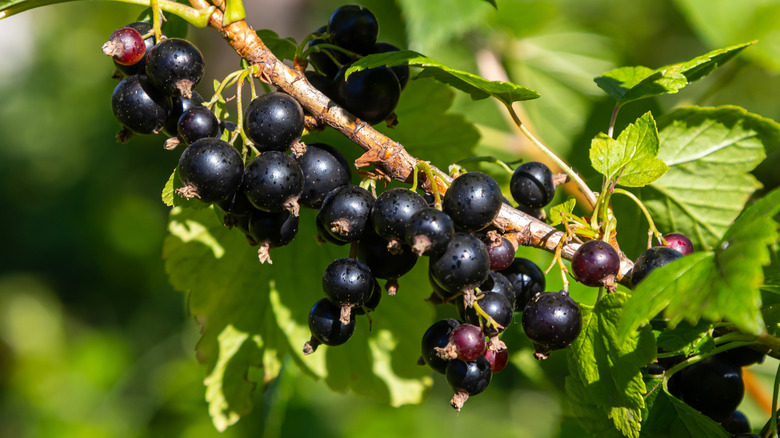
While Americans are intimately familiar with different types of berries, like strawberries, blueberries, and blackberries, there's another berry that was common in the U.S. until the turn of the 20th century. Black currants are small, dark berries with a strong, tart flavor that are native to Northern Europe, Asia, and North America. European black currants were brought over to the U.S. in the 1800s, and the fruit was regularly used to make jellies, along with more familiar fruits like strawberries and grapes.
All that stopped in the early 1900s, however, with the discovery that red and black currants and gooseberries (part of the Ribes genus) were helping spread a fungus that was damaging white pine trees. The fungus, white pine blister rust, doesn't harm currants or gooseberries but uses plants in the Ribes genus to complete its lifecycle, spreading to nearby trees. Since white pines were essential to the logging and Christmas tree industries at the time, the U.S. government stepped in. The American timber industry was already vulnerable from the chestnut blight that tore through the northeastern states in the 19th century. As a result, the USDA issued a ban on commercial cultivation of currants and gooseberries in 1909.
Unfortunately for black currant lovers in the U.S., the effort essentially wiped out an emerging agricultural product and food source for decades. As the functional value of the five needled pine tree industry was hundreds of times greater than that of black-currant plants, priority went to the pine trees (via USDA). While the decision made economic sense at the time, it turned black currants into a forgotten fruit for generations of Americans.
When and where was the black currant ban lifted?
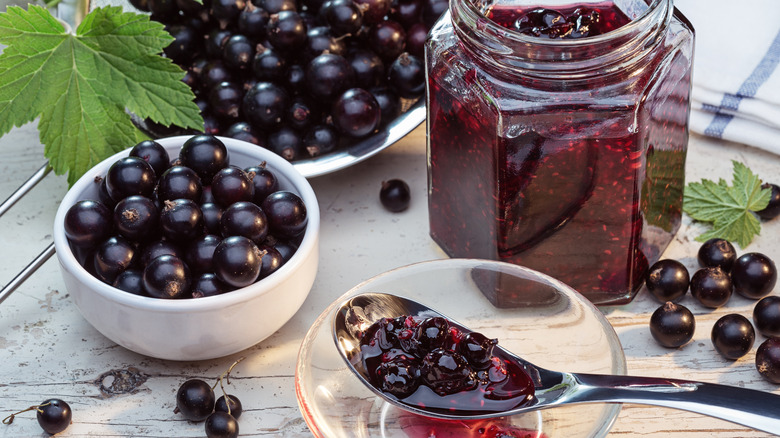
Thankfully, black currants eventually got somewhat of a reprieve. In 1966, the federal government repealed its currant and gooseberry ban as scientists developed new varieties resistant to white pine blister rust. Left to the states to regulate, the fruit entered a legal gray area. Surprisingly, some states still have laws around black currants. Massachusetts has upheld its ban, while states like Michigan and New Hampshire require a permit. Even in states that allow black currants, growers must plant rust-resistant varieties like Crandall and Willoughby.
Today, growers in parts of the Northeastern U.S. and Canada have begun planting black currant again. Its surprisingly prolific, with one bush producing between five and 10 pounds of fruit, according to Offrange. Additionally, currant bushes don't need to be sprayed, they propagate well, and are deer-resistant, a triple-win for farmers. One New York farmer, in particular, took it upon himself to reverse his state's black currant ban. He succeeded in 2003 and now owns one of the leading black currant farms in the U.S. (via CurrentC).
Meanwhile, Europe never broke up with black currants. The fruit has long been an economically important crop in countries like Poland, Russia, Germany, Scandinavia, and the U.K. Black currants are mostly eaten as jams, jellies, and bakery fillings where its tartness is offset by added sugar, in addition to being drunk in beverages like Ribena in the U.K. and crème de cassis cocktails in France. So while the U.S. chose to sacrifice the berry to protect its timber industry, Europe had no issue with its crops, and the black currant endured as a staple of its many countries' food cultures.