

Why Induction Stovetops Can Make Wok Cooking More Difficult
We may receive a commission on purchases made from links.
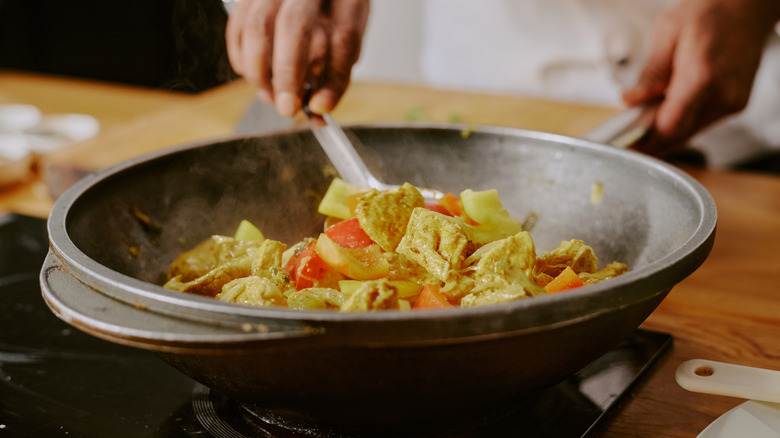
As the market for induction stovetops continues to grow, this shiny kitchen appliance has both fans and detractors. One of the main complaints from opponents of induction stovetops is their inferior ability to handle wok cooking. Historically, woks have a rounded base, meant to sit on a trivet atop a live fire. Whether this fire is fueled by charcoal or gas, round-bottomed woks are designed to allow flames to come up the sides of the pan. This characteristic heat gradient is so beloved by wok cooks, it's hard for them to leave gas stovetops behind. Since an induction stovetop is flat by default, only a small part of a traditional wok makes contact with its surface, rendering it inefficient for the conduction necessary to transfer heat.
You can purchase a flat-bottomed wok to overcome this hurdle, but the heat still won't travel up the sides of the pan efficiently. An induction stovetop heats the part of the pan it comes into contact with, and it does so well. While you could get the base of your flat-bottomed wok up to high heat, you would have to rely on the pan itself to conduct heat from the base up the sides, as opposed to heating the sides by fire. Using a flat-bottomed wok with a base that fits your induction burner is paramount to achieving the best cooking results possible.
You would have to change how you use your wok
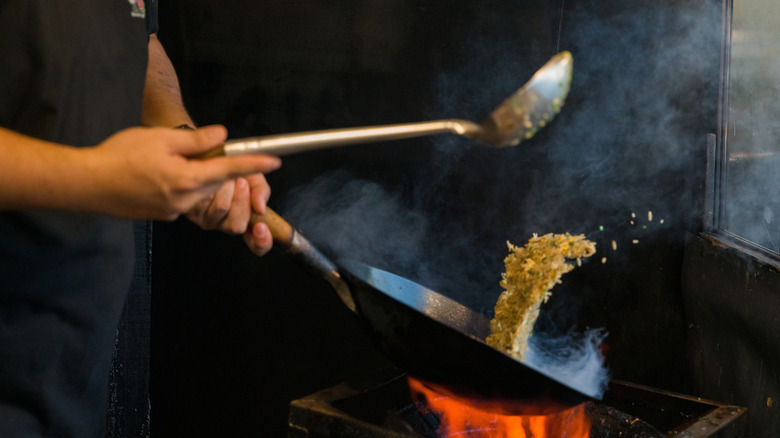
When you watch a seasoned cook use a wok over a live fire, certain characteristics become immediately apparent. The cook is lifting and tossing the pan, which sometimes exposes the ingredients directly to the heat source below (more on this in a moment). Lifting a pan from an induction stovetop breaks contact with the electromagnetic field, instantly stopping the transfer of heat. If you're thinking: Surely the wok holds on to some heat even when taken off the stovetop? Woks heat up and cool down quickly due to the thin, reactive metals they are made of. Holding it up and away from an induction stovetop for even a moment creates inconsistent heat. To prevent this disruption, you have to keep the bottom of the pan in contact with the stovetop at all times, and rely on your cooking spatula to vigorously move the ingredients around.
If you have eaten stir-fried dishes from P.F. Chang's or other restaurants, you probably noticed their smokiness. This is called "wok hei", Cantonese for "breath of the wok". Wok hei is achieved when aerosolized cooking oil is ignited by the flame of an open fire. Without fire, induction stovetops do not have the ability to impart this "breath," resulting in dishes that are still delicious, yet missing that smoky quality. It's not a huge mistake to use a wok on an induction stovetop, but it is a less-than-ideal heat source for developing the optimum flavors you love from wok-cooking.