

What's The Difference Between Cognac And Armagnac?
Cognac and Armagnac are two types of brandy from France. Their production methods are governed by strict AOC (Appellation d'Origine Contrôlée) laws, which establish standards that protect the integrity of certain regional foods and beverages. Although these two drinks share some similarities, their own unique geographical origins and distillation processes make them plenty different from each other.
Cognac dates back to the 1600s and is named for a town located north of the Bordeaux wine region. The vineyards which produce the grapes and distill the liquor itself (called crus) surround the town. They are part of the Charente and Charente-Maritime areas. Cognac is distilled twice in copper pot stills, resulting in a liquor known for being very clean, smooth, and light.
Armagnac is purportedly the oldest brandy variety on record, having first appeared in print in 1411. It comes from a landlocked region situated south of Cognac in the larger area of Gascony. It isn't as renowned as Cognac and is made in much smaller amounts, but this has helped make it a favorite among brandy connoisseurs. Armagnac is distilled once, giving it a bolder, fuller-bodied character.
Cognac
There are six crus surrounding the town of Cognac that produce the grapes which are made into the spirit: Grande Champagne (which is different from the region that makes expensive Champagne), Petite Champagne, Borderies, Fins Bois, Bons Bois, and Bois Ordinaires. Despite them all primarily growing the same varieties of grapes, the resulting Cognacs can taste very different because the regions have their own unique soils. For example, the brandies made from Fins Bois grapes tend to be more fruity, while those from Borderies are nutty. The grape primarily grown and used in each region is called Ugni Blanc, but varieties called Folle Blanche, Colombard, Jurançon, Belzac Blanc, Blanc Ramé, Bouilleaux, and Chalosse are also allowed in the making of Cognac.
Technically, Cognac begins its life as wine; once the grapes are harvested, they are pressed, and the juice is fermented. There is no additional sugar added, so the finished spirit overall tends to be less sweet and have a very nuanced taste. Once the alcohol level reaches 9%, it is distilled in a copper pot still twice, and finally placed in oak barrels where it ages.
When you see a bottle of Cognac designated as "V.S.," this stands for "Very Special" and it has been aged for at least two years. "V.S.O.P." stands for "Very Superior Old Pale" and has been aged for at least four years; "X.O" means "Extra Old" and denotes at least a decade of aging, and a Cognac labeled "Napoléon" means it has aged at least six years.
Armagnac
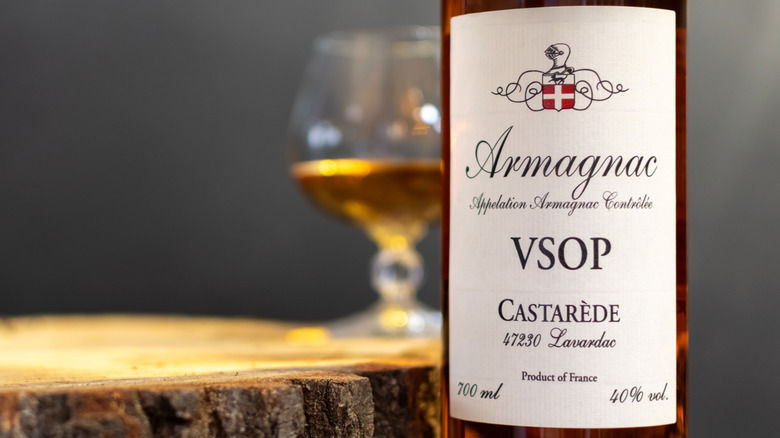
For the most part, Armagnac is made from a blend of four types of grapes: Folle Blanche, Ugni Blanc, Colombard, and Bacco. However, production may involve up to 10 varietals. These grapes are grown in three regions that are designated for making Armagnac: Bas-Armagnac (known for fruitier spirits), Argagnac-Ténarèze (stronger, full-bodied), and Haut-Armagnac (delicate, highly sought after).
Like Cognac, the spirit technically begins as a wine. The vino is fermented until the alcohol level sits between 7% and 12%. It is then distilled one time in a continuous column still called an alembic armagnaçaise, where it becomes what is known as "eau-de-vie." It is then aged in French oak barrels for at least six months, during which it develops a huge amount of its character and flavor. Armagnac shares some acronym designations with Cognac including "V.S.", "V.S.O.P", "Napoléon", and "X.O." although the minimum aging time is slightly different. It also includes two additional designations: "Hors d'âge" is aged over 10 years. "Vintage" is aged at least 10 years, but the brandy must be made from a single harvest.
Additives are allowed in the making of Armagnac to achieve different flavors and colors. These include boisé (a type of wood extract), water, sugar, and caramel. Armagnac has a reputation for being a less smooth but more complex and exciting spirit than Cognac. Much of its appeal arguably lies in the fact that it's still relatively little-known, compared to its younger sibling. In the end, the two are unique types of brandy, and are absolutely worth seeking out and sampling.