

5 Tips For Buying The Best Chicken Breast At The Grocery Store
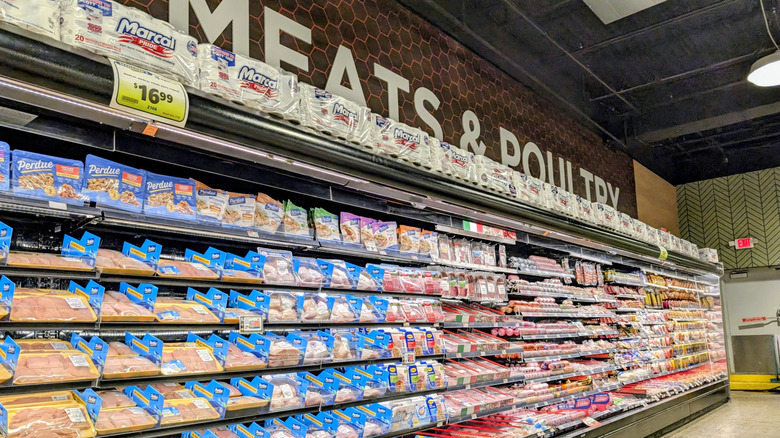
Chicken breast is one of the most common and popular cuts of meat, and for good reason: It's a simple, versatile food for which the possible recipes are almost endless. You're probably familiar with wandering through your local supermarket's meat department and picking up a package of boneless, skinless chicken breasts, but how do you know before buying it if that package will be any good?
To find out, Mashed consulted chef Chris Valdes, a Florida-based cookbook author and food TV host. In addition to his catering career, he's appeared on "Good Morning America," "Chopped," and "Access Hollywood." He now hosts "Qué Delicioso," a Spanish-language cooking program. When it comes to chicken breasts, he doesn't swear by any specific brand. Instead, he told us, "I generally focus more on the quality, appearance, and labeling of the chicken."
In particular, he recommended buying the right type of chicken breast based on your cooking approach. Then, find chicken that looks fresh and is roughly medium-sized. Pay attention to the ingredients, because some products contain salt solutions, chicken broth, or other additives. Finally, Valdes said, keep the chicken fresh by making sure it stays cold and properly packaged.
Match the cut to the cooking technique
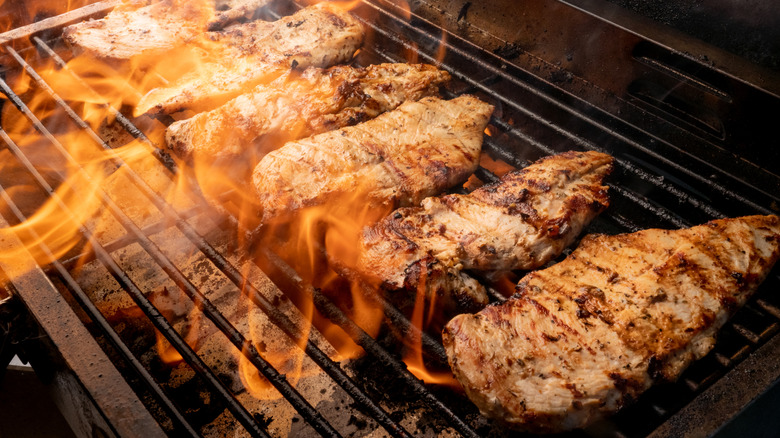
Not all chicken breasts are the same. In fact, your first task when choosing chicken breasts is figuring out what kind you need for the recipe you intend to cook. When you browse the options at your local butcher or grocer, you'll probably see two variables: skinless or skin-on, and boneless or bone-in. As a general rule, dry heat makes chicken skin crispy while cooking it in liquid can make it rubbery or chewy. On the other side, leaving the bone in during cooking distributes heat more evenly during low-and-slow cooking methods.
What does all this mean for your favorite recipes? Chef Chris Valdes shared some recommendations. "For grilling, I prefer evenly sized boneless, skinless breasts that I can pound to a uniform thickness," he told Mashed. "For roasting, bone-in, skin-on chicken breasts can be a fantastic option because the skin helps protect the meat during cooking and adds flavor. And when preparing chicken for salads, sandwiches, or meal prep, I look for breasts of similar size so everything cooks consistently."
If, by chance, you buy a bone-in chicken breast when a boneless one would be better, no big deal — it's easy to debone it at home (ideally with a sharp boning knife, which has a narrow blade). Use the knife to slice the two halves of the breast away from the breast bone, then cut along the bone to remove the meat from the ribs. Finish by trimming off any remaining tendons and fat.
The chicken should look fresh and vibrant
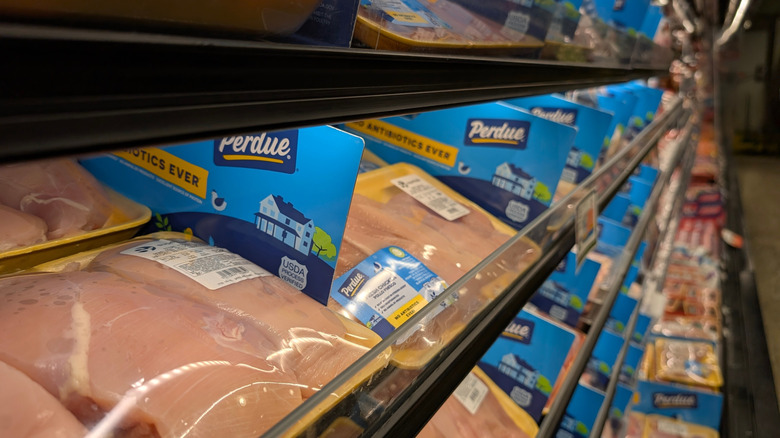
"We eat with our eyes first," said chef Chris Valdes, "and that starts at the grocery store." Chicken should look moist and light pink, with a color Valdes described as "natural." It follows, of course, that the best way to choose a good chicken breast is by selecting one you can see. You simply have less control over opaque packages that don't let you inspect each piece individually.
Color variations in raw chicken are normal. Natural reactions — like oxygen interacting with the meat's surface during processing, as well as differences in diet or age of the bird — can result in slight color differences in a chicken breast that's ready for sale. Conventional chickens often have a subtle beige or yellow tinge, while organic or pasture-raised chickens tend to be slightly pink.
Any other coloration on the meat, however, can be a sign of spoilage or other unwanted characteristics. "Avoid packages with grayish discoloration," said Valdes. The USDA says that "With spoilage there can be a change in color — often a fading or darkening," but that color change alone isn't always a sure sign that the chicken has gone bad. Valdes said other clues can include excessive moisture inside the package, sliminess on the meat itself, or visible damage to the chicken.
Skip the oversized chicken breasts
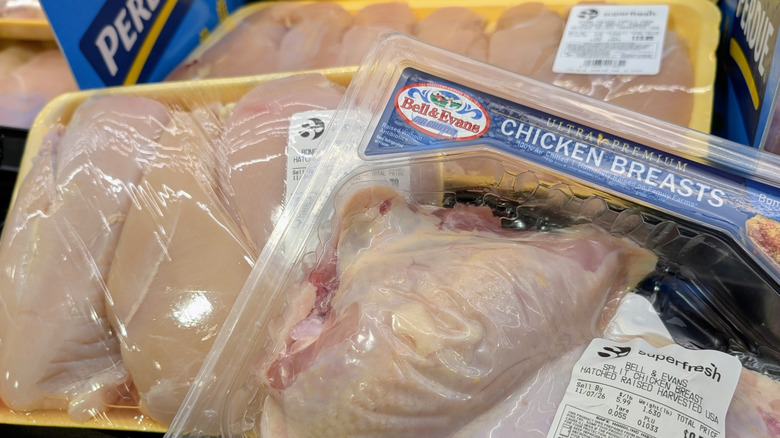
It can be tempting to reach for the package with the largest chicken breasts — after all, it means you're getting more meat per breast, which might sound appealing. But chef Chris Valdes said not so fast. "Avoid unusually large chicken breasts," he advised, "especially those with visible white striping running through the meat." It's no secret that chickens have gotten larger in recent decades; in fact, their weight today can be up to four times that of commercially farmed chickens of the 1950s.
How big should the chicken breast be, then? A boneless, skinless breast could weigh anywhere from 5 to 8 ounces raw. Sizes will vary, but Valdes recommended medium-sized breasts roughly in the middle of that range. He said it's important to browse all the options to make an informed decision. "I appreciate being able to compare different cuts and package sizes," he told Mashed, saying he likes checking out the chicken options at stores like Publix.
Larger chicken breasts, Valdes said, won't cook as well because they can hide unpleasant textures. "White striping [in a large chicken breast] can indicate changes in the muscle that may affect texture and cooking quality," he told Mashed. "Some oversized breasts can also develop a condition known as 'woody breast,' which creates an unpleasant, tough texture."
Check the ingredients list
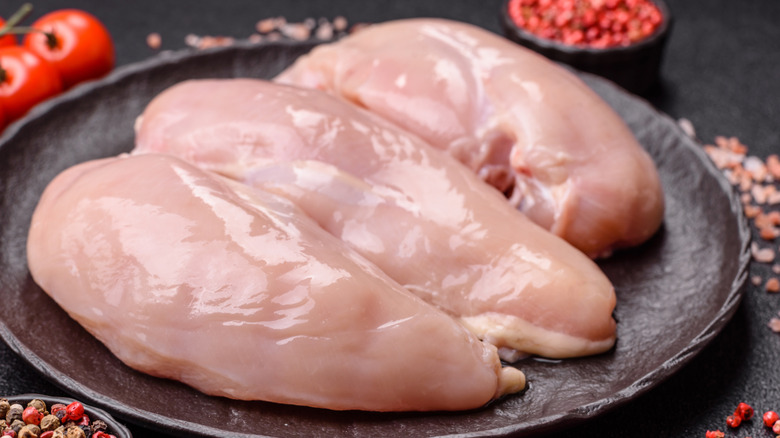
You've spotted the ideal package of chicken. The breasts look nicely colored, healthy, moist, and medium-sized. You're ready to put them in your shopping cart. But did you read the label? Chef Chris Valdes noted that some packaged chicken sold in stores isn't simply chicken — it also contains water, broth, a salt solution, or other additives. In the U.S., chicken producers and retailers are required to disclose on the label if anything (even just salt water) has been added to the chicken, so take a moment to peruse the ingredients list.
If your chicken breasts do contain some additives, it's not necessarily a bad thing. These common additions aren't harmful or unhealthy, but there's still a reason to skip them. "Added solutions can affect the flavor, texture, and amount of moisture released during cooking," said Valdes. "Personally, I prefer chicken breast without added solutions because it gives me more control over the seasoning and final result."
For a shortcut to determine if your chicken contains added water or salt solutions, figure out which part of the store it's in. Fresh chicken breasts in the meat department (especially if they're cut or packed in-store) tend to have no salt added, but they might feature a disclaimer like "May contain retained water," meaning there's water in the meat that will cook out. Over in the freezer aisle, you're more likely to see a package of frozen chicken breasts that has been seasoned with chicken broth, salt, or other flavorings.
To make sure it's fresh, check the date (and store it well)
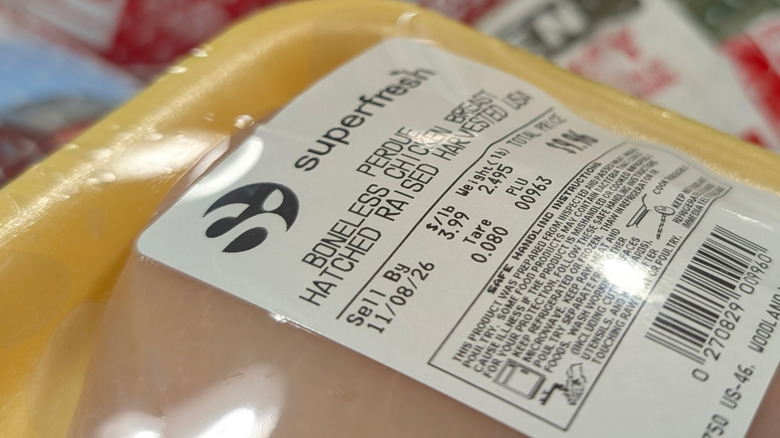
For the longest shelf life at home and the best flavor, you want the freshest chicken you can find. Use-by (or sell-by) dates can be a good indicator of that. You'll want to look for chicken with the most distant date on the shelf, as that generally indicates that it was packed or put on display quite recently. But while the use-by date is a good marker of quality, which declines as the product ages, it's not necessarily a safety guarantee.
You can't control how the packers, distributors, or retailers have stored and handled your chicken, but you can look for some signs that it's been handled properly throughout the process. "Make sure the packaging is completely sealed, and choose chicken from a properly refrigerated display," said chef Chris Valdes, adding that chicken is best chosen at the end of your shopping trip so it spends less time outside of refrigeration. "A great piece of chicken can quickly become a food safety concern if it isn't handled properly," he explained.
What about once you get home? Fresh, raw chicken should be refrigerated immediately and kept under refrigeration for one to two days at most. If you won't be using it within that time frame, freeze it; raw chicken will last up to nine months in the freezer at or below zero degrees Fahrenheit.