

The Rise And Fall Of Smokey Bones BBQ
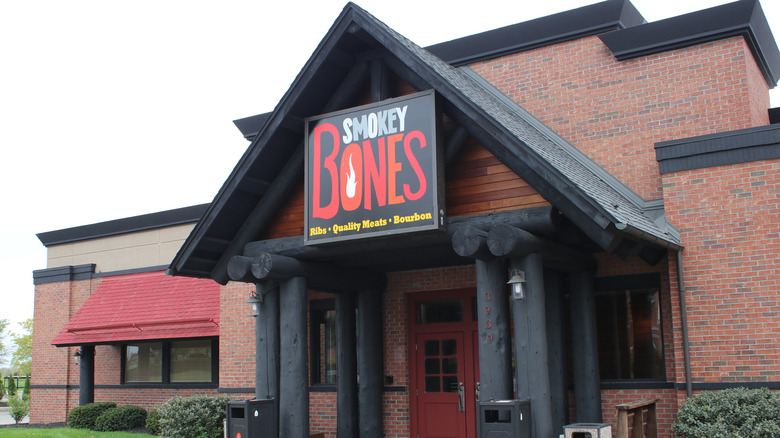
For over 20 years, Smokey Bones delivered all the cozy vibes that come with slow-cooked barbecue dishes and mountain lodge decor, plus enough television screens to watch the top games of the day. But behind the scenes, the barbecue chain restaurant struggled with too-fast expansion, multiple ownership changes, and an ultimately dramatic demise that left customers and employees wondering what happened.
Here's the full story of what really went down with Smokey Bones, from its 1999 origin story in Florida to desperate attempts at adapting to changing consumer demands and a national rollout that eventually left the owners bankrupt. Throughout the years, the restaurant had ups and downs, comebacks and falters. But sadly, the final chapter ended in April 2026 when the remaining locations were suddenly and unceremoniously closed in one fell swoop without much advance notice, much to the chagrin of comfort-food-loving customers. Keep reading for the complete rise and fall of Smokey Bones.
Smokey Bones BBQ Sports Bar opens its doors in 1999
The story of Smokey Bones began in 1999, when the restaurant first opened as a sports bar in Orlando, Florida. It was owned by Darden Restaurants, Inc., the same company that owned popular restaurants like Red Lobster, Olive Garden, and Bahama Breeze at the time. Today, they still own Olive Garden, as well as LongHorn Steakhouse, Yard House, Ruth's Chris Steak House, and others.
Called Smokey Bones BBQ Sports Bar at the time, it was a casual restaurant with a mountain lodge theme. One little known fact about the restaurant is that Darden Restaurants created a backstory about a 1960s ironworker named Duke who made his own smoker to create the barbecue fueling Smokey Bones. It was a vague piece of Americana-inspired fiction that may have helped propel the restaurant forward, even if the story wasn't accurate.
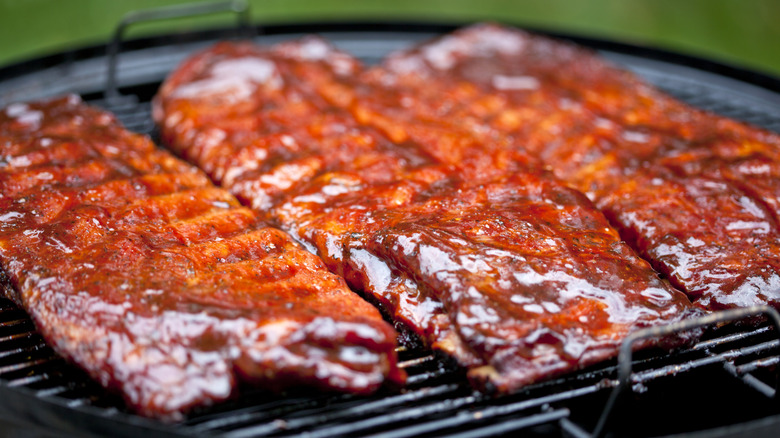
In those early days, popular menu items included pulled pork, baby back ribs, chicken, beef brisket, and St. Louis style ribs. On top of the expansive menu, the restaurant featured 40 televisions and 30 types of beer. That makes sense considering the average square footage was 8,000 square feet and had the ability to serve as many as 250 customers.
National expansion begins
The growing restaurant was a hit in Orlando. In 2001, just two years after opening, Smokey Bones BBQ began to test out additional locations, totaling nine restaurants spread throughout Florida, the Midwest, and Northeast. Opening crowds were large and enthusiastic, confirming the idea that the sports-barbecue theme was a winning combination.
The numbers supported the anecdotal evidence of Smokey Bones' success. Darden's CEO noted that sales continually exceeded expectations and Smokey Bones even earned a "Hot Concept" award in 2003 from Nation's Restaurant News.
Darden was betting big on Smokey Bones. After all, the company was the largest casual dining restaurant company in the entire world. By 2004, the Smokey Bones chain jumped from nine to 59 locations, consistently doubling its footprint each year. The company aimed to launch up to 30 new locations annually. Ultimately, the chain grew to nearly 130 locations by 2007, primarily clustered on the East Coast.
Darden expected Smokey Bones to become as large a brand as two of its most popular restaurant chains, Red Lobster and Olive Garden. And at the time, it seemed as though the same level of incredible growth was in the cards for the barbecue sports bar.
Success starts to falter
The national expansion of Smokey Bones didn't go as planned. In 2007, just eight years after opening the first location in Orlando, Darden closed 54 of its 127 Smokey Bones restaurants. This impacted 4,000 employees across the country, though they were supposedly offered jobs at other Darden-owned restaurants.
The company also began to look for a buyer on which to offload the remaining 73 locations. Even though there were some successful restaurants, Smokey Bones struggled to gain national appeal. That didn't sit well with Darden, which as a company preferred to focus on brands that can successfully scale nationwide. This simply didn't happen with Smokey Bones.
Why wasn't there a broader geographic appeal outside of the eastern U.S.? Darden said the issue wasn't the locations, but the barbecue. Customers just weren't showing up consistently compared to other types of restaurants, particularly outside of Smokey Bones' original geographic footprint. That was meant to appeal to potential buyers: The underperforming restaurants were gone and the remaining locations were performing well for a restaurant portfolio company that preferred a regional brand. For Darden, the parent company was hoping to unload a restaurant chain that ultimately couldn't reach the scale of its star player, Olive Garden.
Darden says goodbye to Smokey Bones
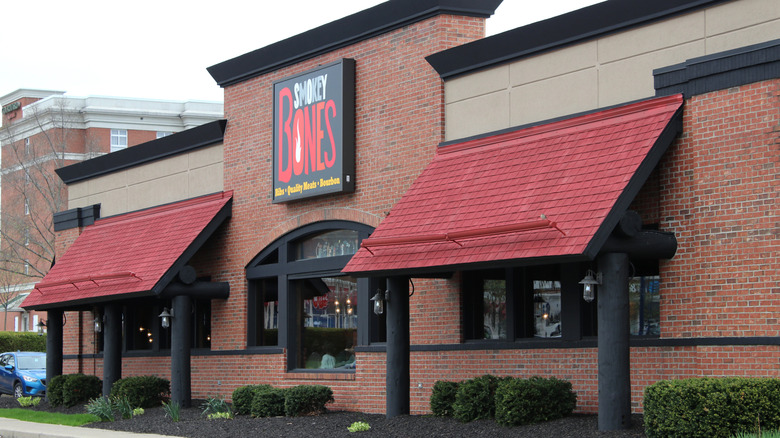
In December 2007, just seven months after announcing that it was looking for a buyer, Darden found the deal it was looking for: $80 million in exchange for the remaining Smokey Bones locations. The buyer was Sun Capital Partners, Inc. a private investment firm that bought the brand through a newly created affiliate, Barbeque Integrated Inc. Other restaurant brands under the group's ownership included Boston Market, Bruegger's, and Friendly Ice Cream.
Darden assisted with the transition and Smokey Bones management remained in Florida. No further closures were expected as part of the deal. What did change, however, was a slight generalization of the Smokey Bones BBQ brand.
Sun Capital Partners slightly revamped the restaurant name. Instead of Smokey Bones BBQ Sports Bar, it became Smokey Bones Bar & Fire Grill, presumably to broaden the focus away from just barbecue. It kept the ribs and pulled pork on the menu, but also added grilled sandwiches, steak, plus some lighter chicken and fish dishes. Since many of the closed restaurants couldn't sustain ongoing demand for barbecue, adding more diversity to the menu was likely a strategic move aimed to get more customers in the door.
Smokey Bones tries to meet new consumer demand

Smokey Bones continued under Sun Capital Partners for the next several years. But the brand continued to struggle. Meat prices rose, margins were thin due to long cooking processes, and casual dining continued to grow — meaning more competition for Smokey Bones. A renewed interest in supporting local restaurants also hurt national and regional chain restaurants like Smokey Bones.
But the brand didn't take the hits lying down. Instead, leadership began investing in multiple new initiatives to address shifting consumer trends. For instance, takeout and delivery started to grow in popularity, which hurt places like Smokey Bones that focus on an in-restaurant dining experience. This was simply magnified when the pandemic either shut down or enforced new restrictions on in-person activities, which was particularly brutal on the restaurant industry.
Because takeout remained popular even as people started going out to eat again, Smokey Bones leaned into the delivery driver niche. It began redesigning restaurants so that in-person diners didn't see delivery drivers picking up to-go orders. It also started testing out smaller restaurant sizes. Instead of the original 8,000 square foot floor plan, new prototypes were scaled down to under 6,000 square feet.
Yet another change of hands takes place
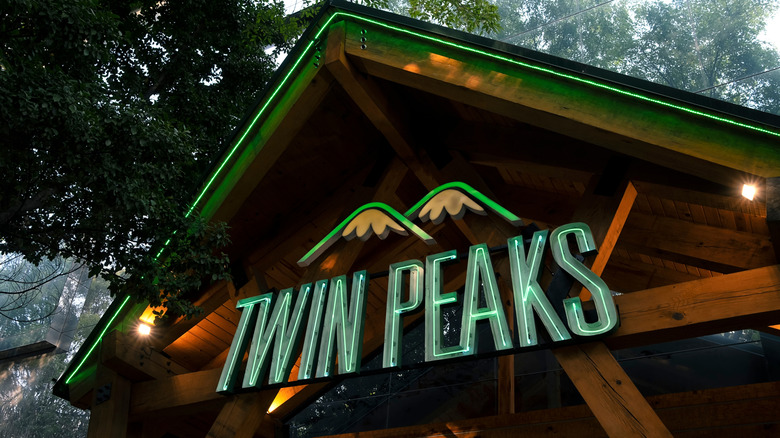
By 2023, however, Sun Capital Partners was ready to offload Smokey Bones to yet another buyer. This time, the brand was purchased by FAT Brands, which also owned chains like Fatburger and Johnny Rockets. The sales price was $30 million, a substantial drop from the $80 million Sun Capital paid for the brand in 2007. Although FAT Brands had experience in the sports bar industry, this was its first time entering the world of barbecue.
Unlike previous owners, who kept Smokey Bones as a corporate brand, its new owner planned to franchise out new locations to help expedite growth. In fact, across brands in its portfolio, FAT Brands opened 142 restaurants in 2022 and expected to reach 175 in 2023.
One of the primary drivers of that growth was another newly acquired restaurant brand, the somewhat salacious Twin Peaks, which joined the roster in 2021 for $300 million. This well-performing sports bar, along with the 60 Smokey Bones locations, both fell under the management of a new subsidiary called Twin Hospitality Group. FAT Brand's plan was to eventually launch an IPO for Twin Peaks at a $1 billion+ valuation to help pay for its fast-paced acquisitions. Before that happened, however, the company closed 15 Smokey Bones locations and turned another 19 into Twin Peaks.
FAT Brands debt gets called in

Acquiring so many restaurant brands in such a short period of time turned out to be risky business for FAT Brands. By 2025, the parent company of Smokey Bones carried a total of $1.26 billion in debt and its cash flow wasn't enough to cover payments. In October of the same year, FAT Brands had insufficient funds and didn't pay its lender. It initially received default notices after missing those payments and the bank subsequently called in the loan to be paid in full immediately. Unsurprisingly, the company did not have nearly $1.3 billion on hand to cover the bill.
Instead, the company began to explore different ways to restructure its debt and keep the brands alive. It hoped to raise as much as $100 million in equity for the Twin Peaks brand to help cover its major purchases from the previous years. Before this financial turmoil began, FAT Brands acquired nine restaurant chains in just a year and a half. The total spend was just under $920 million. While Twin Peaks was eventually IPO'ed in 2025, it wasn't enough to keep FAT Brands — and Smokey Bones — out of hot water.
Owners file for bankruptcy in January 2026

At the beginning of 2026, what seemed inevitable finally happened. Both FAT Brands and its subsidiary, Twin Hospitality Group (which owned Smokey Bones) filed for Chapter 11 bankruptcy in January. At that time, over 12 restaurants across different brands were closed, with the hope that getting rid of underperforming locations would improve profitability. The restructuring affected 2,200 restaurants across 18 different brands and caused significant uncertainty for franchise owners under the FAT Brands umbrella.
Filing for Chapter 11 didn't close down Smokey Bones or the other restaurants under corporate ownership. The goal during the bankruptcy process was to restructure the company's debt and improve its balance sheet. That seemed like good news for the remaining Smokey Bones locations, each of which had positive cash flow. Overall, though, Twin Hospitality reported a net loss of $57.4 million in just three quarters in 2025, signaling continued trouble for the barbecue brand.
As industry professionals discussed potential outcomes of the bankruptcy, many of the restaurant brands were viewed in a favorable light, and that included Smokey Bones. It was assumed that selling off the successful brands would help cover the debts owed by the parent company.
The search for a new owner is underway

After filing for bankruptcy, FAT Brands tried to find a buyer for its portfolio of restaurants, reaching out to 120 buyers through a court-approved process. After bankruptcy was filed in January, the timeline for action quickly accelerated. Bids were due by April 3 and any transactions were set to close by May 4, indicating that Smokey Bones could be under new ownership by the summer.
CEO Andrew Wiederhorn was also forced to take a leave of absence during the negotiation period and was not allowed to access any non-public information about the bids. A special committee was created to find a new CEO. Removing a CEO isn't standard practice during bankruptcy proceedings, but Wiederhorn found himself in hot water after sanctioning the sale of $3 million in Twin Hospitality stock without getting court approval.
In the meantime, FAT Brands was able to receive debtor-in-possession (DIP) financing, which is designed to keep companies operating while navigating Chapter 11. Because of this, Smokey Bones and other restaurants could continue to operate by paying vendors, employees, and others while waiting on the auction timeline to play out.
Smokey Bones is left without a home
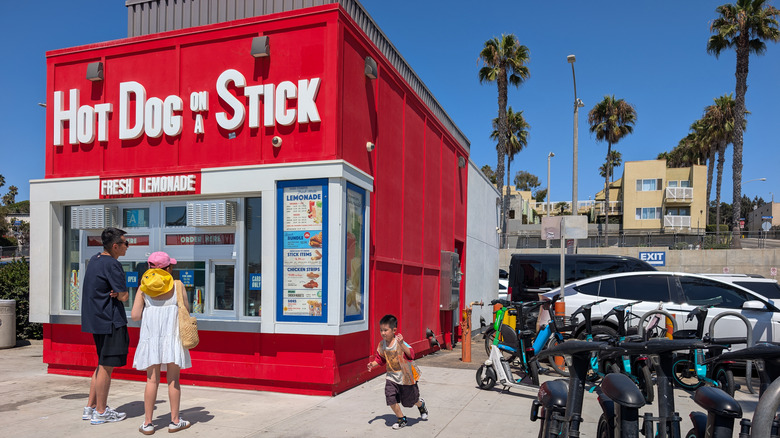
The May 2026 deadline for bids arrived and wound up delivering four separate buyers to split up the FAT Brand portfolio. The bad news? Smokey Bones didn't make it into any of the deals. Here's what happened.
Hot Dog on a Stick was bought for $8 million in cash, while Elevate Burger brought in $2.5 million. Twin Peaks sold to a lender for nearly $360 million, and the remaining FAT Brands sold for $595 million. This part of the deal included Round Table Pizza, John Rocket's, Fazoli's, Great American Cookies, Marble Slab Creamery, and others.
But despite being FAT Brand's most recent acquisition before entering bankruptcy. Smokey Bones did not earn a spot in any of the new spin-off portfolios. Six locations had already closed in 2024 and 10 in 2025, resulting in a total footprint of just 45 locations. Considering that at its peak, Smokey Bones had nearly 130 restaurants, this 65% decrease was substantial. All in all, the sale of FAT Brands and Twin Hospitality Group restaurants brought in around $955 million to put towards the $1.3 billion in debt owed by the two companies.
All locations close in a single blow
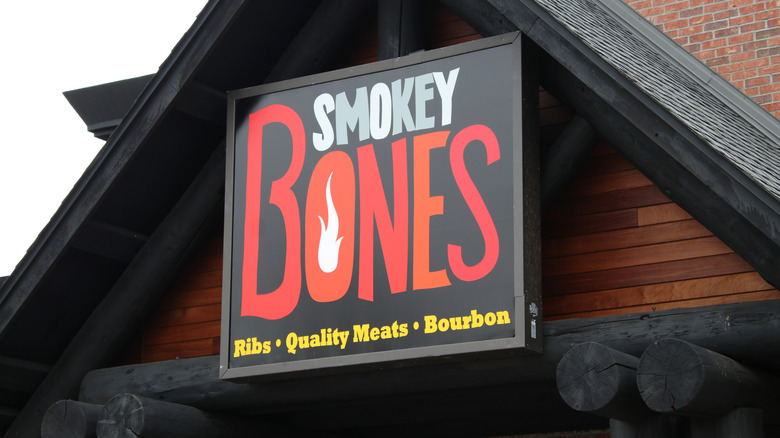
While other restaurants made it out of the FAT Brands bankruptcy alive, Smokey Bones was not so lucky. All remaining restaurants were closed in late April 2026 across 10 states, all with little notice. Employees received no advance warning and customers were notified by signs taped to the doors. Local reports revealed that many employees received same-day notice that their restaurant was closing and they were out of jobs.
The website listed all Smokey Bones restaurants as closed and online ordering was no longer available as of April 28. One strange part of the story is that Smokey Bones social media posts from just a few days prior to shuttering talked about a new menu on the horizon. Clearly, there was little advance notice for all levels of employees. A statement from FAT Brands confirmed the closure of Smokey Bones, but didn't give any details when asked about how it handled staff communications.
It was a sudden end to the story of Smokey Bones. A successful barbecue sports bar in Orlando fell prey to quick growth schemes manufactured by large restaurant investment companies. But the menu and the vibe just didn't have enough national appeal to justify such dramatic expansion over the years. Perhaps Smokey Bones could have found its footing once more, but it wasn't given the chance once it was bought by an aggressively mismanaged restaurant group.