

The Backstory Behind This Creamy Chicken Diner Classic
We may receive a commission on purchases made from links.
Menu preferences can fluctuate drastically, and sometimes quite quickly, over the years. No matter where you'd previously found yourself on the city streets or backroads of the United States, you may wake up one day and find that your go-to order has disappeared. Something that was once considered conventional, traditional even, can suddenly become old-fashioned.
Chicken à la King is a perfect example. This creamy classic, which easily makes the list of ubiquitous diner foods of yesteryear, is one of those old-school chicken dishes that was incredibly popular throughout much of the 20th century. These days, it's downright difficult to find on diner menus. For some, chicken à la king may harken back to the days when American diners loved to eat cream-heavy, khaki-colored meals, but this retro recipe can actually be quite delicious and refined. It may strike you as a quaint throwback, but it's not unlike the Alfredo sauce recipe from Olive Garden that's still a menu staple today.
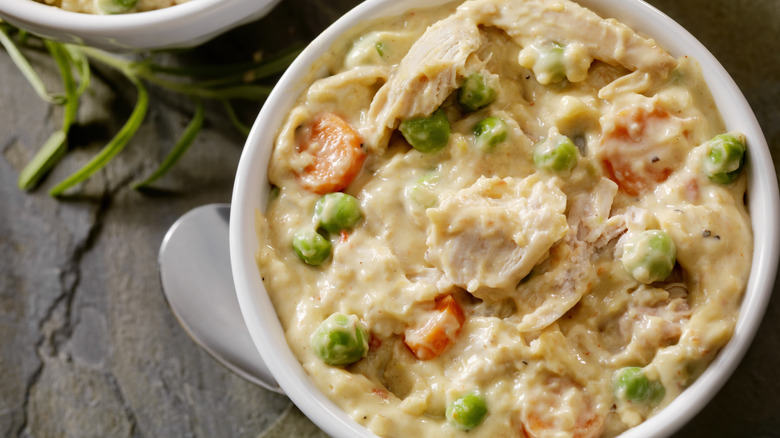
The history of chicken à la king is disputed. Its supposed birthplace has been cited as being anywhere from Brighton Beach, Brooklyn, to Manhattan, to Philadelphia, and all the way across the Atlantic to London. For the uninitiated, chicken à la king is sort of like a creamier sherry-based chicken pot pie filling, usually served over pasta or toast. The compulsory ingredients are heavy cream, pimentos, wine, and mushrooms. Many recipes also include green peas, carrots, bell peppers, celery, and onions — possibly with a dash of nutmeg and/or cayenne pepper. The result is a velvety sauce with earthy undertones and a bit of a sharp kick from the sherry.
The history of chicken à la king: a creamy diner favorite fallen from grace
Not only is chicken à la king a rarity on modern menus, but no one can seem to agree on where it came from. One of the most commonly shared histories, and the one supported by "Craig Claiborne's The New York Times Food Encyclopedia," says that George Greenwald, chef at the Brighton Beach Hotel in Brooklyn, NY, created it in the 1890s and asked hotel owner E. Clark King II and his wife to try it. They loved it, and chicken à la king became a $1.25 menu special the very next day.
Another story credits Delmonico's restaurant in Manhattan with creating the historic creamy diner item in the 1880s, when Foxhall P. Keene, son of wealthy Wall Street trader and horse breeder Jame R. Keene, told Delmonico's chef that he'd been musing about a cream and pimento dish. The chef composed the dish at his request, originally calling it chicken à la Keene. A second story, also tied to the Keenes, says it was named after James R. Keene, but at the London restaurant Claridge's in celebration of his horse's (curiously, also called Foxhall) win of the Grand Prix de Paris in 1881. As time went on, the recipe's fine dining roots eventually trickled into more humble, diner-style cuisine.
Finally, a 1915 obituary in the New York Times called William King, a cook at Philadelphia's Bellevue Hotel in the 1890s, the creator of the historic dish. An article in the Baltimore Sun from March 7, 1915 backs this up, stating, "[I]t is a pretty safe guess that in the Elysian fields, [Chef William King] surrounded by his peers among the great discoverers of the ages ... he will find that the far-famed ambrosia of the gods is no more worthy of praise than his own glorious contribution to the dietary needs of the world," (via Homestead Museum).