

5 Costco Kirkland Dried Fruits, Ranked
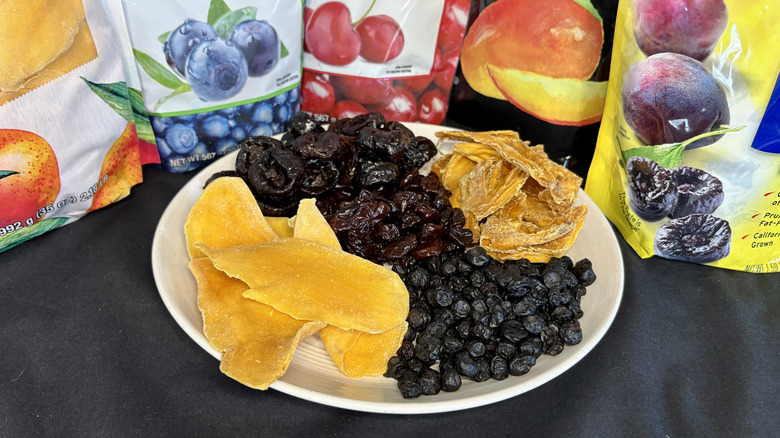
For thousands of years, finding the next meal was the first priority for people across the globe. After securing food became less of a chore — yay for farming — the question became how to store it in an age before refrigeration. Smoking, and salting, were popular methods, but few things were quite as simple, and effective, as drying a food until its moisture content was low enough to significantly slow decay.
Today, we still dry plenty of foods, but rather than laying a handful of grapes out on the back patio for a few days, most of us pick up a package of raisins from the store. From snacking to baking, there are dozens of delicious uses for dried fruit, and if you're a dried fruit enthusiast — I'm sure there are a few out there — then Costco is the place to snag a wide variety of options for a good price. On my most recent trip, I counted over a dozen different selections, but today, we're focusing only on the Kirkland brand of dried fruits, which come in five varieties. I taste tested every one to find out which dried sweet treat is worthy of a spot in your oversized cart, and which should be left on the pallet.
5. Organic Dried Blueberries
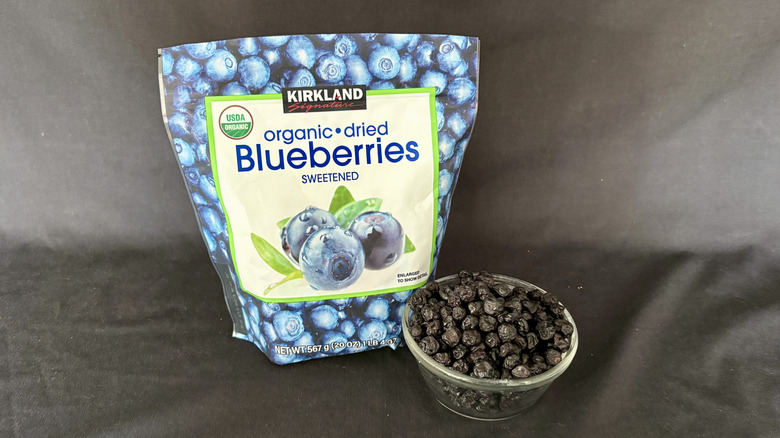
A 1-pound, 4-ounce package of Kirkland Organic Dried Blueberries costs $10.99, making it the second most expensive dried fruit, but not by much. Most options are only a dollar less, while the most expensive fruit is nearly twice the price.
Some fruits are simply better for drying than others. Grapes, for instance, have a high moisture content, so even when dry, they retain enough of that liquid to stay chewy. Blueberries, unfortunately, can't claim the same. Each berry looks like one you'd want to avoid in a fresh container — but looks aren't everything, right? Sadly, the dried blueberry is also lacking in the texture department. This isn't a chewy dried fruit like some we'll get to later, but instead one that wants to fall apart in your mouth. The tiny seeds become almost crunchy, leaving the dried blueberry with a rather sad texture.
From a flavor perspective, this one is confusing. Obviously, the classic blueberry flavor is still present, but for some reason, Kirkland has sweetened this fruit. A 40-gram serving – about ⅓ of a cup – contains 140 calories, and 29 grams of sugar, a whopping 16 grams of which are added sugars. I've never eaten a blueberry, and thought, "Gosh, this isn't sweet enough," but apparently someone at Costco did. These dried blueberries aren't terrible, they're just confusing.
4. Organic Dried Mangoes
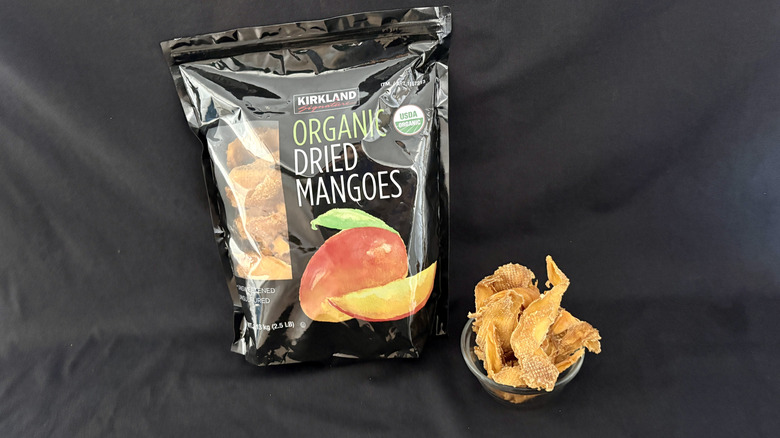
With a 2 ½-pound bag priced at $18.99, a bag of Kirkland Organic Dried Mangoes is the most expensive bag of dried fruit that Costco sells. At a per-pound breakdown, it's still a better deal than the blueberries, but nowhere near the value of the other mango option that'll show up much, much later on this list. A 40-gram serving – again, ⅓ of a cup – contains 140 calories, and 24 grams of all-natural sugar.
As for the taste, these are sweet, and mango-y. So, what lands them so low on the list? It's all about the texture. Mango leather would be a more apt name for this product. The strips are far from uniform in size, which means that some are close to tender, and meaty, while others are extremely thin, and just plain chewy. Like a bag of chips, the first two thirds are full-sized, snackable pieces, while the final third is filled with dehydrated mango crumbs. Add in a texture reminiscent of a tire track, and it's hard to say that the Kirkland Organic Dried Mangoes are the best option, especially compared to the other mango variety yet to come.
3. Sunsweet Dried Plums
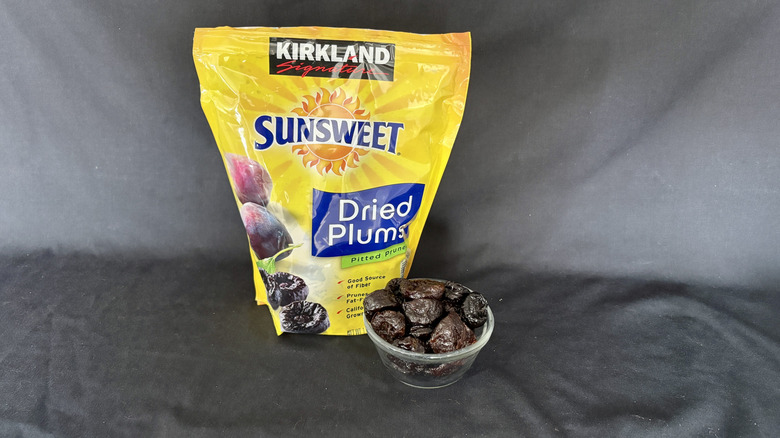
While Sunsweet is its own brand, these plums are jointly labeled Kirkland, and Sunsweet, earning them a spot on this list. If you're wondering why these dried plums aren't labeled as prunes, don't fret, we have a full plum vs. prune breakdown to explain the difference. An impressive 3 ½-pound bag costs $9.99, and contains 100 calories, and 14 grams of natural sugar per 40-gram serving. From a value standpoint, it's hard to beat these plums, and thankfully, they also hold up in terms of quality.
While the first two fruits on this list have leaned heavily into the "dry" portion of their name, these plums are hardly dry; in fact, they're slimy to the touch. Generally speaking, slimy is not a word you want associated with food, but here, it works. The plums are the largest of Kirkland's dried fruits, and as a result, a few could stand as a substantial snack. Each bite is sweet, and gummy, and with no added sugar, this is a great wintertime option when fresh fruits become more expensive, and variable.
2. Whole Dried Tart Montmorency Cherries
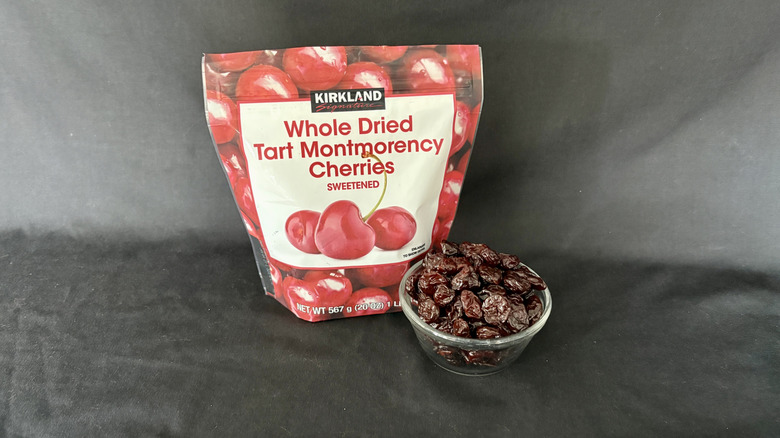
Packaged similarly to the blueberries, Kirkland's Whole Dried Tart Montmorency Cherries are $9.99 for a 1-pound, 4-ounce bag. A 40-gram serving contains 132 calories, and 26 grams of sugar, 7 of which are added. While I'm not sure these cherries need added sugar, Montmorency is one of the tartest of the many varieties of cherries, so the sweetener does help to balance the flavor nicely. If you don't like tart flavor profiles, then you won't like these cherries, but if you do, then this is the fruit for you.
Not unlike the plums on this list, these cherries are bordering on juicy. Of all the options to this point, the cherries are easily the ones I could casually munch on. The flavor is robust, and full, and the size of each individual cherry makes it the perfect snack. I can also see using these cherries in any number of cherry desserts, including baked goods that call for dried cherries, and even a few that call for fresh ones. I tossed some, along with the blueberries, into a quick homemade granola, and the cherries were the star of a very tasty breakfast.
1. Dried Mangoes
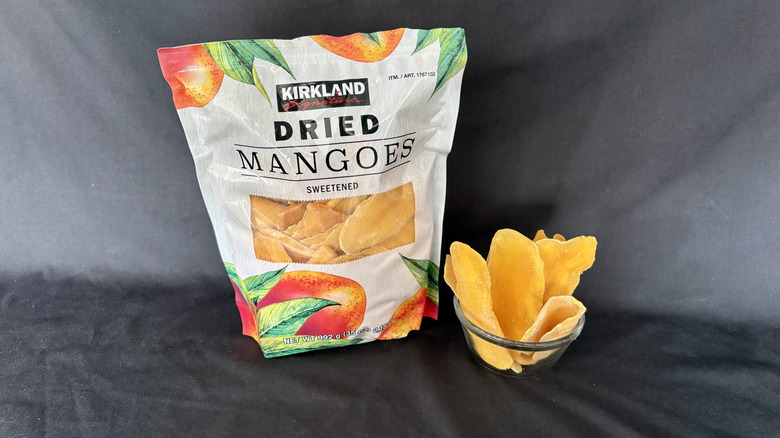
It's almost startling to see the difference between Kirkland's Organic Dried Mangoes, and these sweetened Dried Mangoes. At 2.18 pounds, the package is slightly smaller, but at only $9.99, it's half the cost of the organic version. A 42-gram serving contains 140 calories (identical to the organic ones) and 27 grams of sugar (three more than the organic have), eight of which are added. So while these are sweetened, it's not an over-the-top amount of sugar added per serving.
Visually, the two mangoes could hardly be further apart. The strips in this package are far more uniform, and consistent. Each bite is tender, with a light dusting of sugar on the outside that pairs well with the fruit's natural sweetness. The smooth texture is also far more reminiscent of a bite of fresh mango than the oddly rough organic strips. I'll eat the organic mango if it's there, but I'll seek out these sweetened dried mangoes any chance I get.
Final thoughts and methodology
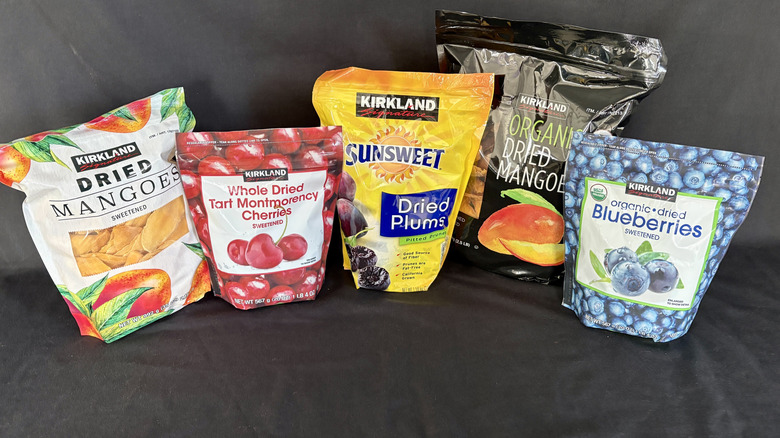
The middle of winter is a good time to evaluate dried fruits. No matter how much you may enjoy them, few hold a candle to the fresh version, but the best don't stray terribly far from their original state. Kirkland's dried plums and cherries are moist, and gummy, unlike the overly dry, chewy blueberries, and organic mango. Still, nothing holds a candle to the sweetened dried mango, which is basically candy. Ultimately, there are plenty of solid options, but if none of these sound appealing, there are plenty of non-Kirkland-branded options on the Costco shelves to try out.
I purchased all of the dried fruit at Costco, and brought it home to photograph. I tasted everything, and evaluated it on taste, texture, and appearance. The dried fruits in this piece are ranked in order according to my personal preferences, based on those attributes. Costco did not contribute to this piece.