

The Optimal Temperature To Store Beer At For A Crisp Taste
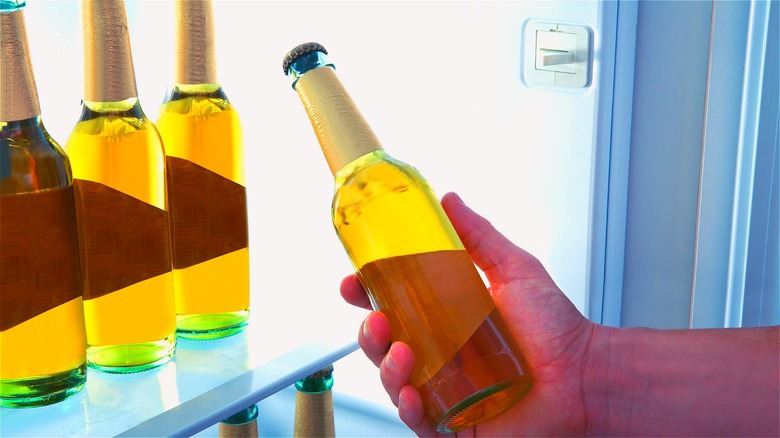
There's nothing more disappointing than reaching into your fridge for a crisp beer only to end up sipping a flat, stale brew. While a number of factors could have ruined your drink during storage, there's a good chance it was caused by one of beer's biggest enemies: temperature. If you don't store your brew at an optimal temperature, it could lose a lot of its flavor and crispness. The question is, what exactly is that ideal temperature?
The tricky part is there are many types of beer, and each style has its own ideal storage temperature. However, there appears to be a loose consensus among some breweries, stores, and fridge manufacturers about the ideal ranges for storing the major styles. Based on these ranges, the sweet spot for storing the most popular styles of beer in the U.S. should be around 45 degrees Fahrenheit.
According to a 2023 study by Statista, America's four favorite beer styles are lagers, pale ales, pilsners, and wheat beers. Multiple sources online say lagers do well at around 32 to 45 degrees Fahrenheit, pilsners at 37 to 45 degrees, pale ales at 45 to 50 degrees, and wheat beers at 39 to 52 degrees. While other styles should ideally be stored at different temperatures, the fact that the four most commonly bought beers can all be kept at 45 degrees Fahrenheit makes it the safest storage temperature to go with.
Store beer at the right temperature to preserve its carbonation
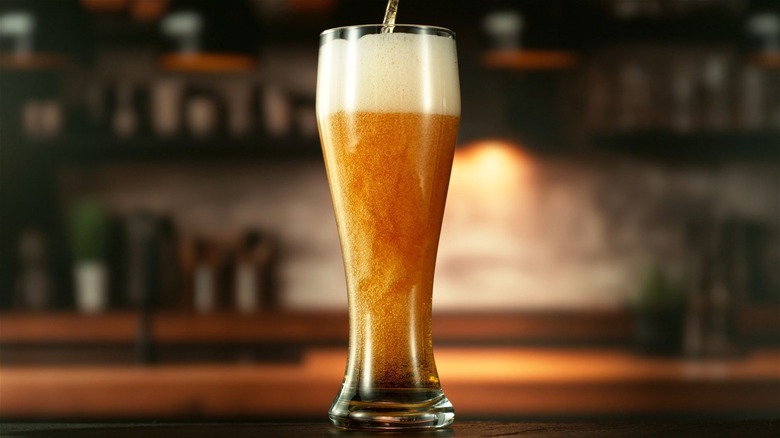
A lot of what we perceive as "crispness" in a beer comes from its carbonation. That fizzy bite comes from dissolved CO2 gas molecules in the liquid beer. At higher temperatures, those molecules move more rapidly and eventually escape the beer, leaving you with a flat drink. Temperature also plays a role in how we perceive carbonation. A 1991 study published in Chemical Senses found people feel the fizz less intensely the warmer a drink gets, even if the carbonation levels remain the same between temperatures.
You don't want to store your beer too cold, either. In fact, "colder is better" is one of the biggest myths about beer we need to shake off. When a beer goes below its freezing point, CO2 gets forced out as the liquid molecules contract, making your drink go flat. On top of that, all the gas released by this reaction tends to accumulate in the empty space inside the bottle, and continuously builds pressure. This is why a too-cold beer gushes out when you open it, or worse, explodes in the freezer altogether. To play it safe, avoid storing beer at temperatures lower than 28 degrees Fahrenheit, which is the freezing point of most beers.
How storage temperature affects a beer's crisp flavors, according to science
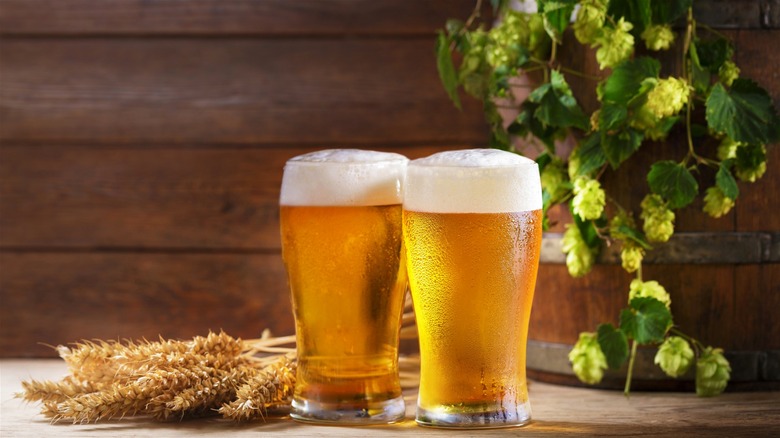
Flavor also plays a huge role in how we perceive a beer's crispness and freshness. Crisp beers tend to have balanced flavor profiles, with no overpowering notes that stick to your palate. Several studies found that higher storage temperatures trigger chemical changes in beer that not only throw that balance off, but also make it taste staler.
A 2009 study published in the Journal of Agricultural and Food Chemistry found that iso-α-acids, which give beer the bitterness it needs to balance other flavors, degraded much more rapidly in beer stored at 98.6 degrees Fahrenheit than at 42.8 degrees. A 2018 study published in the Journal of the Institute of Brewing also found that aldehydes, which contribute a number of off-flavors, such as cardboard, increased significantly in beer stored at 86 degrees Fahrenheit compared to 32 degrees. Furanic compounds and esters — both considered to be staling compounds in beers — increased at a higher rate at higher storage temperatures, according to a 2022 study published in LWT.
If you want to avoid ruining your beer, but don't have the cash for a specialized beer fridge, any regular refrigerator works for storage. Since the recommended temperature for food refrigeration is 40 degrees Fahrenheit or lower, you can stick close to the ideal ranges for most popular beer styles. Just pull your bottles out a few minutes before drinking so they can warm up to the optimal 45 degrees.