

What Does 'Free-Range Chicken' Actually Mean?
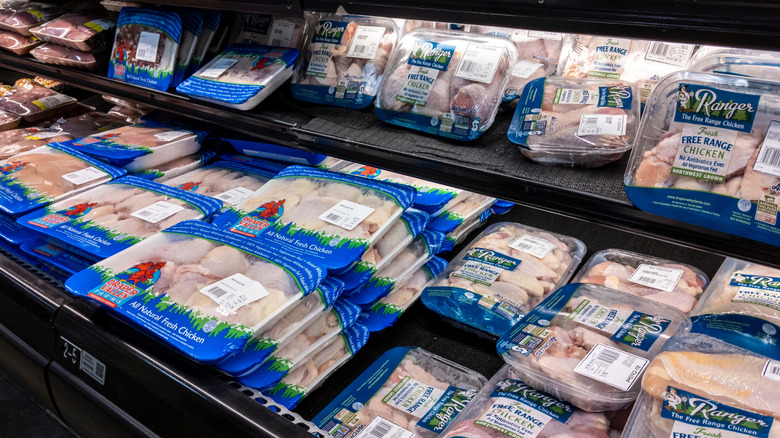
Believe it or not, it's becoming increasingly common for morally conscious consumers to seek out food producers who value animal welfare. To navigate these decisions when choosing a family pack of chicken thighs, consumers rely on the food labels like "free range" and "organic" in the grocery aisles. While labeling something free range paints a picture of animals roaming in vast, grassy spaces, the free range qualifications only cover some of the housing and outdoor time requirements. Additionally, as the terms get lumped together often, it's important to know the differences between free range, organic, and pasture-raised products, so you don't make mistakes when reading food labels.
In the U.S., the Department of Agriculture's Food Safety and Inspection Service (FSIS) oversees the safety and proper labeling of free range food claims. Though it may be easy to assume that FSIS would have in-depth rules covering food labeling, it only requires producers to report their birds' housing conditions and confirm that they have continuous, free access to the outdoors throughout their normal growing cycle and grazing season. FSIS evaluates these on a case-by-case basis, and, despite consumer requests to prescribe regulations on coop size and time outside, encourages getting certified through third-party programs.
Among the various agencies, Certified Humane sets the majority tone, requiring at least 2 square feet of outdoor space per free-range chicken, a minimum of six hours of access a day, and shelter from predators and inclement weather. However, even its regulations leave the type and condition of outdoor space up in the air. This leads to the possibility of qualifying, even if the space is unkept and has dirt or gravel.
For those looking for free-range, organic or pasture-raised may be the way to go
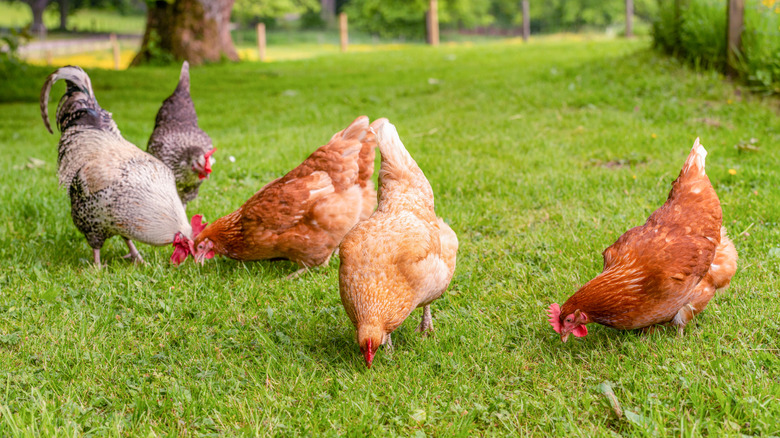
The differences between food labels like free range, organic, and pasture-raised chicken can be understandably confusing. This is partially due to some crossover between the qualifications of organic food and free range, albeit limited. Here, the biggest point to know is that while organic chickens can essentially qualify as free-range chickens due to their outdoor access requirements, strictly free-range chickens won't qualify as organic due to being less regulated.
Concerning pasture-raised animals, this may be what free-range consumers want to seek out due to its updated qualifiers. As of 2025, FSIS expanded upon what pasture-raised chicken means. Now, the animals must spend the majority of their life on pasture and the ground needs to be with rooted vegetative cover, grasses, or plants (per WATTPoultry). This is in addition to requiring larger living quarters of 108 square feet per chicken for those wishing to be verified by Certified Humane.
Of course, it's always important to do deeper research and know the brand you're buying from. Ultimately, there are plenty of ways to meet your food values both online and in the grocery store. Perdue Farms offers a wide selection of organic and free-range chicken, which can be bought directly from its site. Additionally, Whole Foods offers both organic and pasture-raised poultry from both major brands, like Bell & Evans, and its own Whole Foods Market line. Pasturebird is another reputable brand that qualifies as pasture-raised; ittakes great care of its chickens, and is available either online or at Sprouts.