

12 Traditional Easter Foods From Around The World
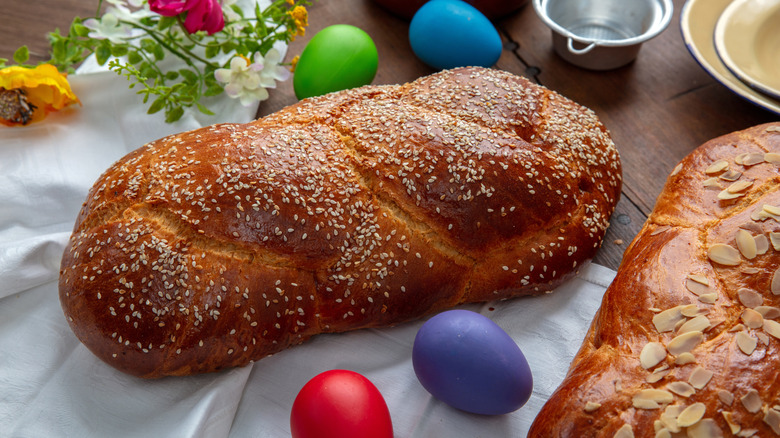
When you think of Easter foods, let's face it, your mind probably goes to chocolate eggs. We don't blame you, they're one of the best parts of the whole celebration. But there are all kinds of traditional Easter foods from around the world that are ripe for exploring. You might learn something new about food traditions or even discover a new favorite.
Lent is the lead-up to Easter Sunday, which historically has involved fasting. In some religious traditions, past and present, Lent means no animal products of any kind, including meat, eggs, and dairy. So, effectively, going vegan for 40 days. And that's probably why Easter foods are often sweet treats. After over a month without our typical fare, it seems pretty clear why people often made cakes, cookies, or enriched breads. Of course, today, there are many amazing vegan foods, and most people don't fast during Lent. Nevertheless, these Easter traditions remain.
We're going to explore some traditional Easter foods from across the globe, looking at their significance, what they taste like, and how they're made. You've come to the right place if you're preparing for an Easter feast, whether you want to draw inspiration from Italy, Lebanon, Ukraine, or elsewhere.
United Kingdom: Hot cross buns
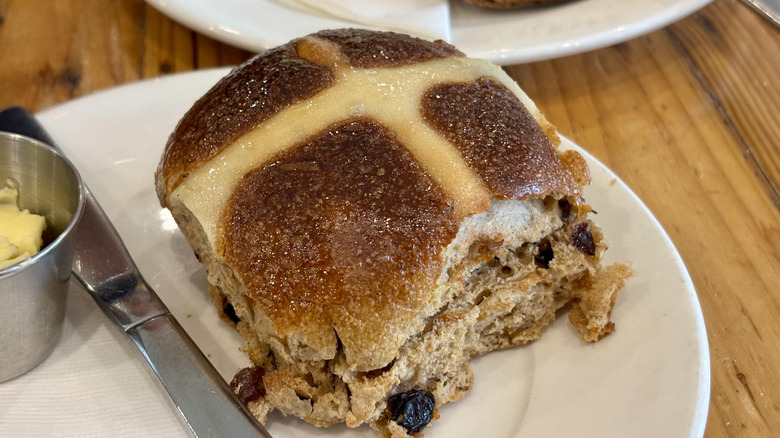
Hot cross buns are practically a national food in the U.K. While these Easter treats have made it across the pond, they're serious business in Britain. Although they're traditionally an Easter food, these days they're available year-round in U.K. supermarkets. That said, once Easter eggs start to hit the aisles, you'll find a wider variety of flavors, including chocolate chip and even tiramisu (though if we're sticking to tradition, we wouldn't recommend these).
Traditional hot cross buns are made from a yeasted dough, enriched with milk and butter. They contain dried fruit, such as raisins and mixed peel, along with fragrant spices. In the U.K., mixed spice is often used, which contains a combination of allspice, cinnamon, cloves, coriander, ginger, nutmeg, and mace. They're baked and left to cool, but are often served toasted and buttered.
Still, you might be wondering why people eat hot cross buns on Easter. For one, the enriched bread marked the end of Lenten fasting, as people were allowed to use milk and butter again. The cross on top represents the crucifixion of Jesus, although the symbolism likely goes back to pagan times, when cakes or breads with crosses on top may have been served at spring festivals. Back then, the crosses represented the four seasons. Whatever the history, they've truly cemented their place as an Easter food.
Italy: Colomba di Pasqua
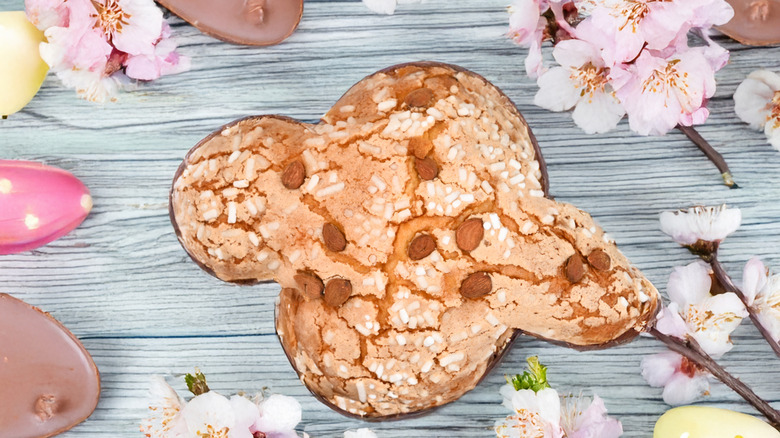
At first glance, you might think that Italy's traditional Easter cake, colomba di Pasqua (often shortened to just "colomba"), continues the theme of cross-shaped treats. But the clue is in the name. Colomba di Pasqua means "Easter dove," and with that in mind, you can see that it's loosely dove-shaped. Colomba is made with an enriched dough that includes eggs and butter to make it tastier and more cake-like. It's similar to panettone but contains only candied orange peel and no raisins. The top has a crust of sugar and almonds. It's made using a slow-rise method that takes over 30 hours, so it's typically bought in most households, rather than made from scratch.
What you might not know about Italian Easter bread is that it hosts numerous origin stories. Some say dove-shaped cakes have been eaten at Easter since the sixth century, when Saint Columbanus had a vision of a dove flying down from heaven and was moved to bake a cake in its form to celebrate the holiday. Another story says that in 1176, when Lombardy successfully overthrew Emperor Frederick Barbarossa, two doves appeared on the battleground, inspiring the creation of the bread.
What we know for sure is that the cake was either invented or commercialized in the 1930s by Dino Villani for the company Motta. Already famous for its panettone, Motta now had a new way to use its signature dough beyond Christmas. Colomba took off and is now enjoyed in most Italian households at Easter.
Ukraine: Paska
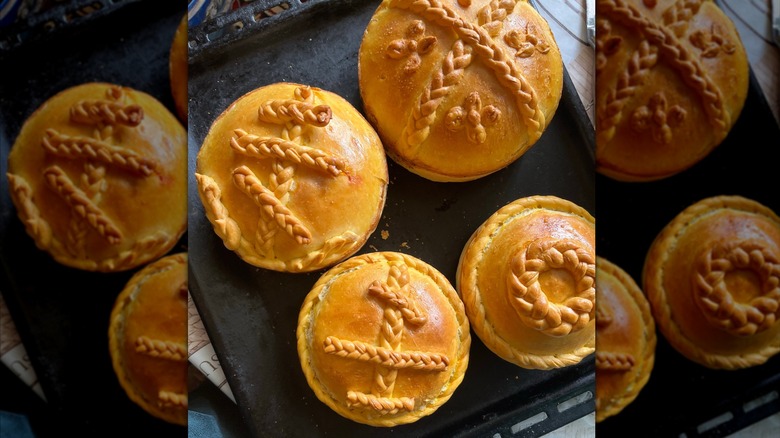
Paska is the traditional bread found on many Ukrainian tables during Easter. It's traditionally baked during Holy Week, leading up to Easter Sunday, and can take several days to prepare. It's made with an enriched yeasted dough, and each ingredient bears its symbolism. The eggs represent new life, the flour symbolizes the earth, and the sugar is for the sweetness life can bring. Although it's an Easter bread today, the tradition may date back to pagan times, when paska was baked to honor the sun's ability to bring life back to earth after winter.
The bread varies by region, too. For instance, in Eastern Ukraine, it has a tall shape, while in Western Ukraine, it takes on a lower form. Plus, every family incorporates its own variations. Some paska contains raisins, others candied fruit. Some are spiced, while others are enlivened with vanilla. Decorations can be elaborate, with loaves covered in symbols made from dough, including crosses, spirals, stars, and oak leaves. Some modern-day recipes don't include decorations, and instead top the bread with icing and sprinkles.
Mexico: Capirotada
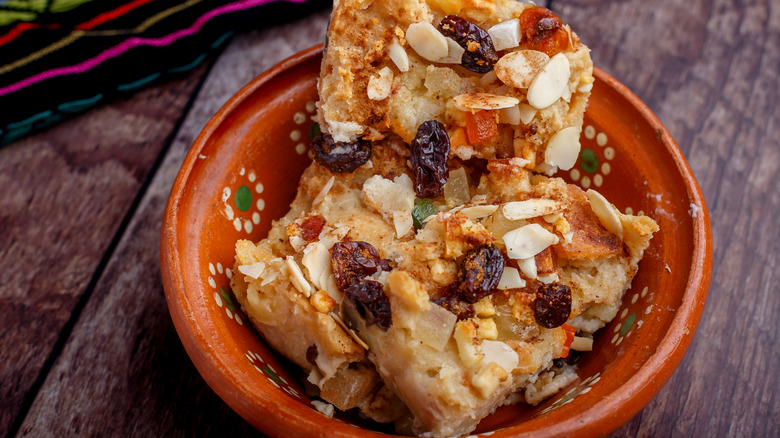
Capirotada is one of many must-try Mexican foods. It's a dessert traditionally eaten on Good Friday, at the start of the Easter weekend, when people would have been breaking their Lenten fasts. In Catholic tradition, people still abstained from meat on Good Friday, so capirotada made for a filling dessert to enjoy after a lighter evening meal.
This sweet treat is a type of bread pudding, relying on typical Mexican ingredients and often baked in a flavorful syrup rather than a custard. Capirotada should be made with fresh bolillos, if possible. These are small, crusty loaves of bread that are staple fare in Mexican families. However, a good-quality baguette is a reasonable substitution for those who can't get their hands on bolillos. It also uses piloncillo, an unrefined cane sugar popular in Mexico.
There are lots of variations of this dish, with many families having their own go-to recipes and additions. There's usually some fruit in there, from dried fruits like raisins and prunes to fresh bananas, which is a common addition. Other ingredients you might find include tomatillos, peanuts, and shredded coconut. Cinnamon sticks and whole cloves are usually infused into the soaking syrup, bringing loads of flavor. The dish is often, but not always, topped with cheese to bring some salty contrast.
Greece: Tsoureki
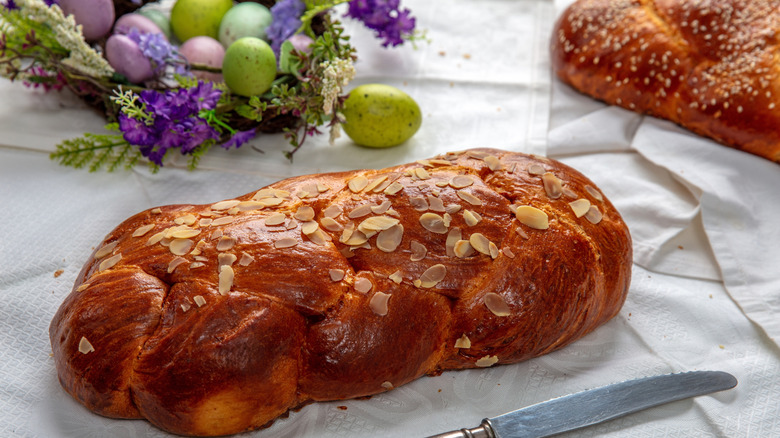
Tsoureki is a traditional Greek Easter bread, continuing the holiday tradition of enriched yeasted doughs that seems to span many nations. The dough is enriched with eggs, butter, milk, and sugar, giving it a rich flavor and similar texture to brioche. But that's where the comparisons end. It has traditional Greek ingredients and flavors that set it apart from similar breads.
It's flavored with orange zest, mahlab, and mastic. If you're unfamiliar with the last two ingredients, mahlab is made from the ground pits of the St. Lucy's cherry and has notes of cherries, almonds, rose, and vanilla. Mastic is made from the resin of the gum mastic tree and has a piney, herbal flavor. Combined, these spices make the bread aromatic and slightly floral.
After the first proofing, the dough is split into three and braided. The three strands are said to represent the Holy Trinity. Before baking, traditional tsoureki is topped with hard-boiled eggs dyed bright red, although some contemporary recipes leave them out. They are said to represent the blood of Christ. As it's quite an involved recipe, many people choose to buy tsoureki these days instead of making it from scratch, but it's still a major Easter tradition all over Greece.
Poland: Babka Wielkanocna
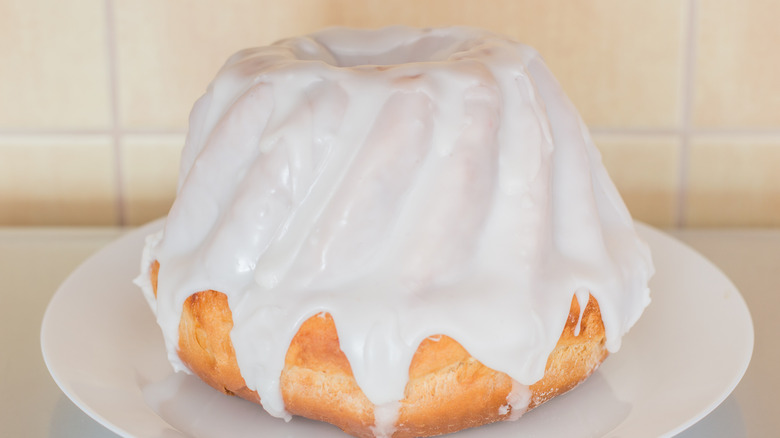
Babka Wielkanocna — or Easter babka — is a traditional holiday recipe in Poland. There are several versions of this dish. Most are yeasted cakes, not dissimilar to enriched breads, but some are straight-up cakes risen with baking powder or bicarb soda. These latter additions are less traditional, however, as the cakes date back to medieval times when modern leavening agents weren't available, and yeast, eggs, and a lot of elbow grease were how cakes achieved a rise.
Raisins are the most common addition to this bake. But some contain a mixture of raisins, currants, and sultanas, all of which may or may not be soaked in rum. Toasted walnuts or flaked almonds are other possible additions. It's topped with a simple glaze of powdered sugar and lemon juice or rum left over from soaking the raisins. One thing that you can't mess around with is the shape. Babka Wielkanocna must be baked in a Bundt tin or tube pan. Babka means grandmother, and the circular shape is said to represent an older woman's skirt.
Argentina: Rosca de Pascua
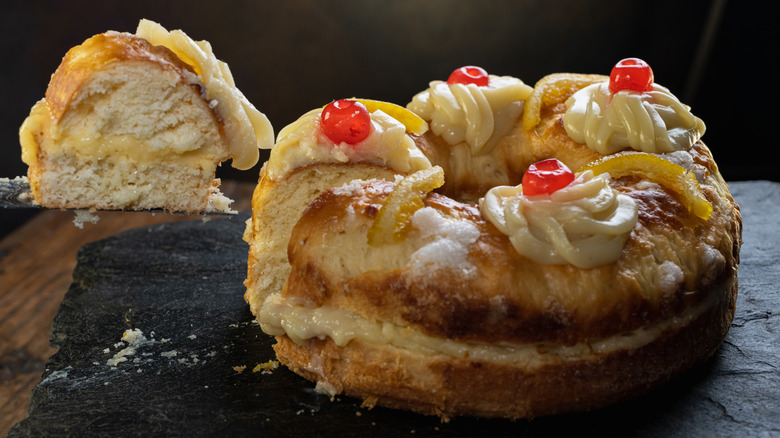
When Easter comes around in Argentina, rosca de Pascua is the food that's on everyone's holiday table. Continuing the tradition of eating sweet breads to celebrate the holiday, rosca de Pascua may date back to a time when cakes were yeasted, before modern leavening agents were available.
This Easter treat consists of a ring of light, sweet dough that's similar to brioche. It's both filled and topped with crème pâtissière — aka pastry cream — a type of custard that's thickened to a pipable consistency. The circular shape is said to represent eternity, which ties to the symbolism of rebirth and new life common at Easter.
The decoration of this holiday dessert doesn't stop with pastry cream. It's also topped with cherries and nuts. In recent years, small chocolate eggs have made their way into the roster of toppings, which we're sure goes down brilliantly with kids. It's time-consuming to make from scratch, with many stages required to bring it all together, but if you're looking for a special Easter treat, rosca de Pascua is well worth the effort.
Portugal: Folar da Páscoa
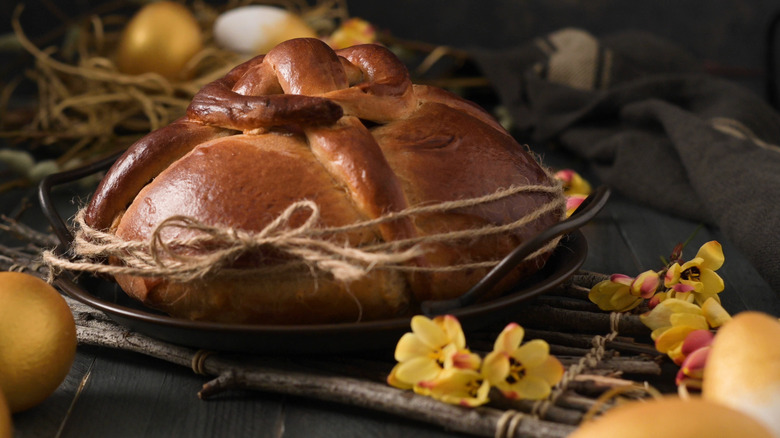
Folar da Páscoa — often shortened just to folar — is a type of Easter bread that's eaten all over Portugal. The interesting thing about this bread is that there are many regional variations with both sweet and savory options. Plus, families have their own traditions. So, you might eat it a dozen times and never find it quite the same.
Arguably the most popular is a sweet type of folar with whole boiled eggs baked in it, still in their shells. The eggs may be eaten separately from the bread, but they're also for decoration, representing new life and rebirth — it's why we eat boiled eggs at Easter, and the same reason why chocolate eggs are traditionally eaten at this time of year. The sweet folar is usually flavored with cinnamon but can include other additions, such as fennel seed or lemon zest. Folar de Olhão is commonly found in the Algarve region and has swirls of cinnamon sugar throughout.
The savory versions usually contain meat. For instance, folar de carnes de chaves contains a variety of smoked or cured meats. While different versions are quite distinct and might not be recognized by an outsider as part of the same tradition, these are all Easter breads.
Lebanon: Ma'amoul
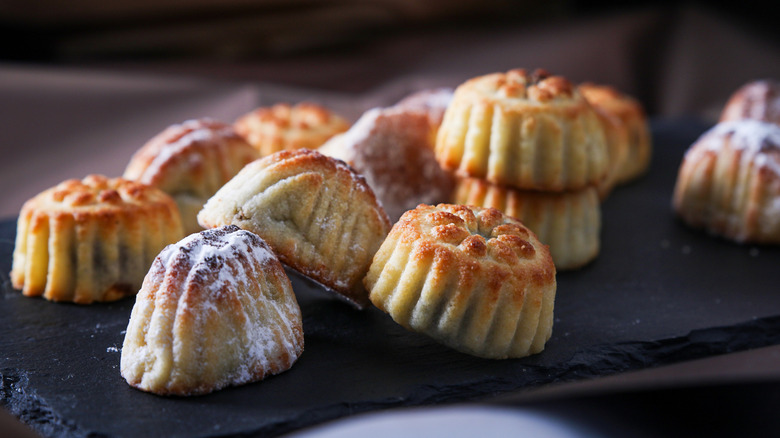
When it's Easter in Lebanon, it's time for ma'amoul — also spelled as mamoul or mamul. These cookies are flavored and stuffed with fillings, bringing extra flavor and texture to the party. Ma'amoul aren't only an Easter food, they're also traditionally enjoyed for a range of special occasions. For instance, they're one of the foods often found at Eid al-Fitr feasts, a holiday that marks the end of Ramadan.
For many, they're seen as more than just a cookie, but an important link to cultural heritage. As with many traditional dishes, there are multiple variations of ma'amoul. Some are made using all-purpose flour, while others have a semolina dough — or they're made from a blend of semolina and AP flour. The dough can be flavored with either orange blossom water or rose water. And various fillings can be stuffed inside. Typical additions include ground walnuts, ground pistachios, and date paste.
These cookies are formed in intricately carved molds, giving them beautiful shapes. Some families may be lucky enough to have antique hand-carved molds passed down through the generations. The shape of the cookie may also tell you what's inside. For instance, in Lebanese tradition, a round cookie with a flat top contains date paste, while an oval one has pistachios.
Sweden: Semla
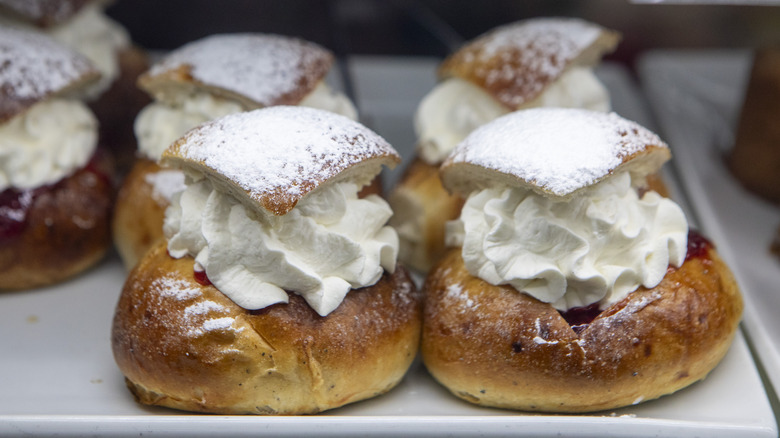
Semla is among the most iconic Swedish foods. Semlor (the plural of semla) are filled buns found in bakeries all over the nation, though keen cooks may also make them at home. They didn't start out as an Easter food, as such, but have always been associated with the period.
In times past, they were eaten on Shrove Tuesday — the day before Lent started — as a way of using up and savoring the ingredients people weren't permitted to eat over the period, like eggs, milk, butter, and cream. However, as Sweden became more secular, citizens weren't satisfied with just eating them on one day. Thus, the tradition began of enjoying them every Tuesday between the beginning of Lent and Easter.
What exactly is a semla? They're sweet buns flavored with cardamom with a rich filling. To make the filling, the centers are scooped from the baked buns and turned into breadcrumbs. The crumbs are mixed with grated marzipan and some milk to form a paste. The paste is stuffed back inside the buns, along with whipped cream. No wonder the people of Sweden weren't content with eating them just once a year.
Croatia: Pinca
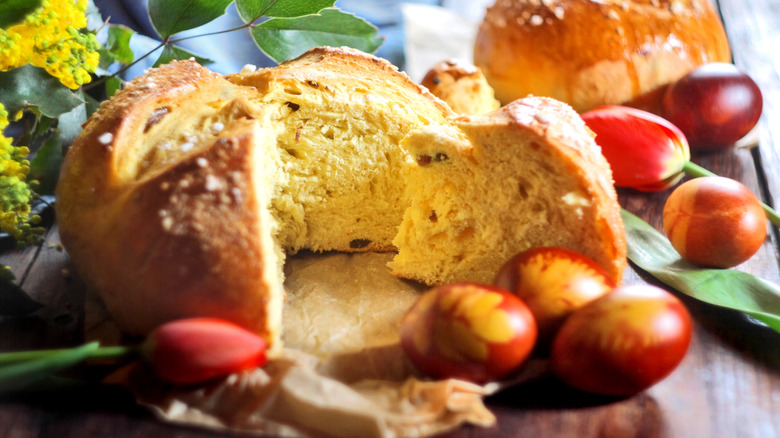
It might look simple, but lots of work goes into making the perfect pinca. This Croatian Easter bread, also known as sirnica, is formed into a round loaf shape and slashed before baking — sometimes with a cross, which has obvious Easter connotations. It takes time to knead, rise, and bake, so traditionally, the dough was made on Saturday and baked on Easter Sunday.
This is another bread that every family has its own recipe for, with subtle but notable variations. Pinca can contain ingredients like orange or lemon zest, rum, rose water, Kirsch liqueur, vanilla sugar, raisins, and candied fruits. These all come in different quantities and combinations, so while the recipes might be similar, each has its own distinct flavor.
Once baked and cooled, it's usually served simply, alongside tea or coffee, or spread with butter. It's one of those dishes that looks fairly unassuming but is packed with flavor.
Greece: Koulourakia
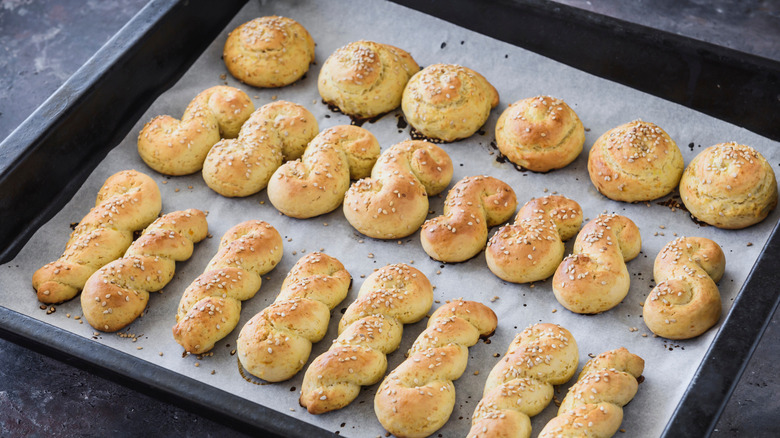
Koulourakia are Easter cookies from Greece. The name simply means "cookies," though they may also be called koulourakia pashalina when made for Easter celebrations. They're commonly eaten on Greek Orthodox Easter (which is celebrated later than Catholic or Protestant Easter because it's calculated using the Julian calendar), but are also made for other celebrations and special occasions.
The dough they're made from is simple, formed with ingredients like butter, sugar, flour, and baking soda, flavored with orange zest and vanilla. The complicated part is getting the dough's texture just right for shaping. The dough should be mixed well to develop gluten so that it's robust enough for shaping, plus chilling time in the fridge is non-negotiable to help it firm up.
Once it's chilled, pieces of dough are rolled into thin ropes, which are then made into distinct forms. Traditional shapes include rings, snails, S-shapes, wreaths, and long braids. Before baking, they're given an egg wash and topped with sesame seeds. People often make several shapes of cookies from the same dough, though this may result in slightly different baking times.