

Why Did Costco Stop Selling Hebrew National Hot Dogs In Its Food Court?
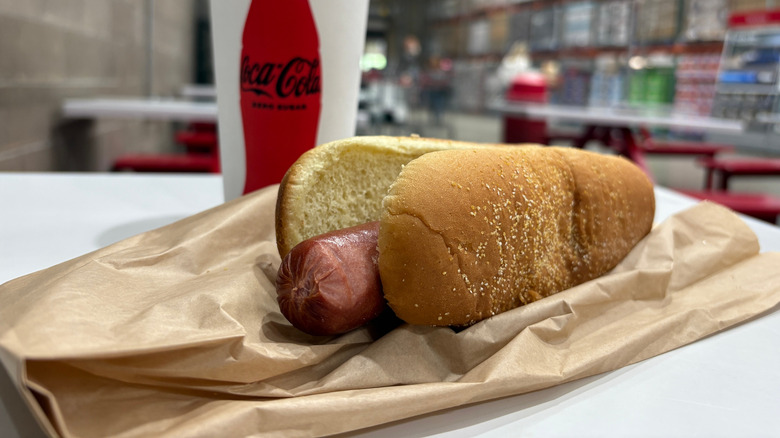
The Costco food court's $1.50 hot dog combo carries a weighty legacy, and much of that legacy has to do with price. The combo hasn't changed since its 1985 debut, even though CNN estimates its present-day cost should be closer to $4.50. While this singular food court item may seem immune to inflation for the buyer, such is not the case for the seller. The Costco co-founder's harsh words at the prospect of a price increase show just how hard the company works to shield that $1.50 price point, either by absorbing rising costs or, when required, taking steps to bring them down. One such step occurred in the late 2000s when Costco shifted away from two of its sausage suppliers, Hebrew National and Sinai 48.
Ironically, the hot dog's popularity inspired the change. Demand for Costco's hot dog combo skyrocketed over the years, putting pressure on the suppliers. "Because of our volume, we were driving up their prices," former Costco CFO Richard Galanti revealed to Stanford Business in 2025.
Hebrew National and Sinai 48 couldn't keep up with Costco's burgeoning demand. Per one commenter posting as "Costco Employee Speaking Privately" on Econlib in 2013, the two suppliers refused to sell Costco more hot dogs despite the retail giant offering long-term contracts to help them raise production capacity. As a result, Costco brought hot dog production in house, initially setting up a factory in Tracy, California — which now makes over 200 million hot dogs a year — followed by another in Illinois.
From Hebrew National to in-house franks: Costco's hot dog journey
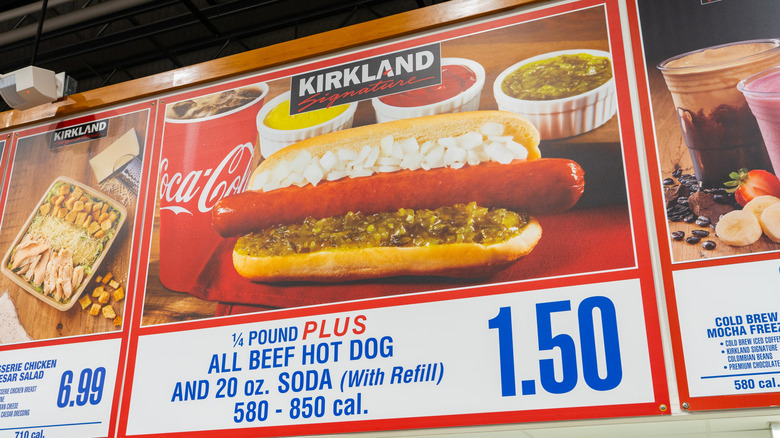
Despite parting ways with Hebrew National as a supplier, Costco's food court roots are inextricably linked to the century-old kosher beef hot dog maker. The precursor to the Costco food court was a hot dog stand outside the San Diego warehouse back in 1984. No prizes for guessing who supplied the hot dogs for that stand (and subsequent stands that cropped up as Costco expanded). In fact, Costco initially called its indoor food courts "Cafe 150" as a nod to the hot dog combo's $1.50 sticker price.
The switch to in-house sausages aimed to do more than just keep the hot dog's price constant; it also aimed to offer customers a higher-quality product. The company doubled down on certain qualities that make the Costco hot dog so delicious, like making the franks larger while keeping the price fixed. Large-scale manufacturing also benefitted the company's bottom line by significantly reducing the cost of hot dogs, leading former Costco CEO Craig Jelinek to call the resulting earnings "a fair return" (via 425 Business).
Hunger for Costco's hot dogs continues to grow, with sales figures for the food court combo hovering at 245 million in 2025 (via USA Today) and even more sold as packaged take-home units. Hot dogs from Kirkland Signature (Costco's in-house label) and Hebrew National do coexist on the warehouse chain's retail shelves, so you can easily recreate the Costo hot dog experience at home. Customers also regularly compare the two sausages (or at least their aftereffects). One Reddit commenter framed their opinion rather eloquently: "I burp less from Hebrew National. Then again I do enjoy those Kirkland burps. The hotdog just keeps giving."