

What Is Bologna Actually Made Of?
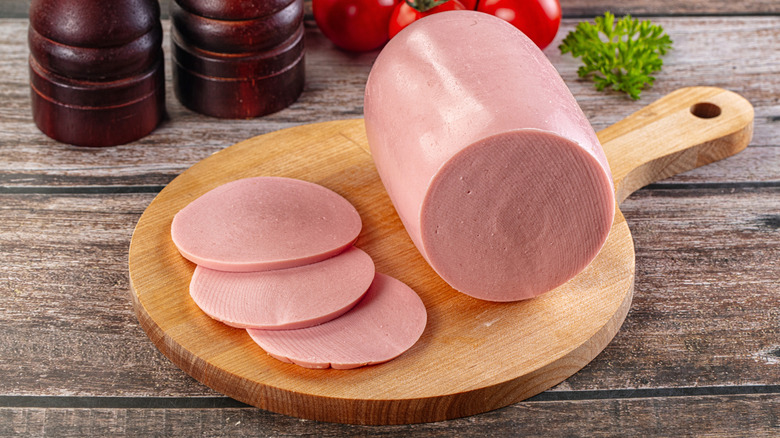
Bologna is one of America's most recognizable lunch meats — but what exactly goes into it? In the U.S., bologna is a a processed and pasteurized mixture of super finely ground meats, generally a blend that could contain pork, turkey, chicken, and beef — plus a mixture of non-meat ingredients like oil, water, spices, and curing agents. The ingredients are emulsified, just like a proper homemade mayonnaise, so that they blend into a solid form when cooked.
If you've ever wondered how bologna is really made, the answer starts with surprisingly tightly regulated processes. The USDA categorizes bologna as a frankfurter — the same classification as hot dogs — so bologna is really just a big hot dog. As such, the maximum allowable fat content is 30%, and the USDA has a mandate that all "cooked" sausages must be "reduced to minute particles," basically becoming meat paste before cooking.
This ultra-ground meat is mixed with other spices — like coriander, celery powder, black pepper, and allspice, plus curing agents (preservatives), like sodium nitrate, and (sometimes) binders and/or fillers, like dextrose, corn syrup, or dry milk. Once cooked in its casing, the result is a massive pink hot dog of uniform consistency. Although essentially a liquid mash of meat and fat, it holds its processed shape beautifully, even when sliced thin.
Where does bologna come from and why is it everywhere?
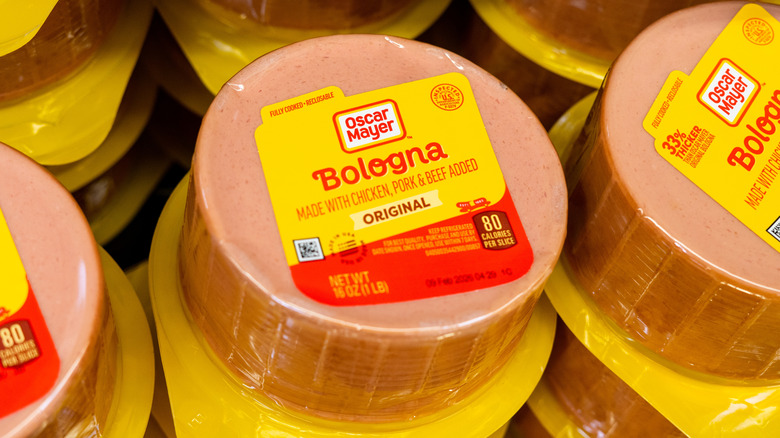
Understanding the truth about bologna meat means going back to its roots. What's become the modern American bologna tradition, while likely coming stateside via Germany, traces its origins to mortadella, a centuries-old Italian sausage made from ground pork with visible cubes of fat, sometimes pistachios, suspended within each slice. One of the first known depictions of the creations of mortadella can be seen at the Archaeological Museum of Bologna — a scene carved in stone showing grazing pigs on one side, with a mortar and pestle on the other — which would have been used to grind pork along with spices to create mortadella.
Although the sausage's name undoubtedly comes from the city of Bologna, it was German immigrants that introduced the much more finely-ground meat processing to the U.S. The German stuff was (and is) a little heavier on the garlic, but it's what gave rise to the American bologna industrial complex.
Today, the bologna industry is huge. The global bologna market reached $7.5 billion in 2023, and is projected to expand at over a 5.1% compound annual growth rate into 2032. The U.S. market alone accounted for around $2 billion in 2023. The reason why bologna is so cheap on store shelves is the same reason it sells so widely and will only continue to grow. It's all about cost-efficiency. It's produced in huge batches, and uses inexpensive cuts of meat. It may have come a long way from the mortar and pestle, but it's still perfectly delicious cooked hot or served cold between a couple slices of bread.