

Where Does Costco Get Its Kirkland Signature Canned Tuna?
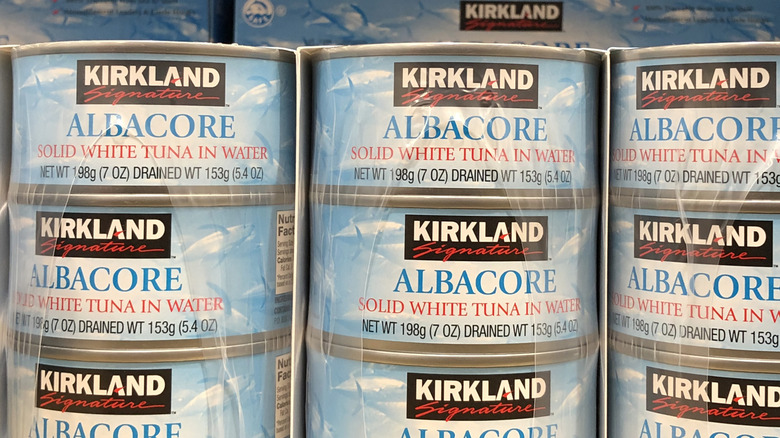
Costco is known for keeping everyday prices cheap for its members via its private brand, Kirkland Signature. This is achieved through partnerships with both independent and major manufacturers for various products, like its Kirkland Signature canned tuna. As it turns out, Bumble Bee Foods is the brand name behind Kirkland's canned tuna. While Costco isn't always forthright about who their private label partners are, there are ways, such as the product's placement and labeling, to uncover the name brands hiding behind Kirkland products.
In 2003, Costco Executive Vice President, Tim Rose, confirmed in an interview with "Money" magazine that Bumble Bee Foods was the warehouse store's major partner behind its Kirkland tuna since 2002. The partnership came from Rose feeling there was a decline in the market's tuna quality. This resulted in Kirkland Signature debuting a meatier, "just like it used to be" alternative to the mainstream brands. Direct confirmation from a Costco executive is more than enough for anyone to end their investigation. However, while the two brands may be placed in different areas within the store, the packaging is another give away that Bumble Bee Foods is behind the warehouse's store-brand tuna. This is evidenced by the 8-count packaging for Kirkland Signature canned tuna, which features the Costco brand's Kirkland Signature logo, word placement, and the white-over-blue color scheme in a similar manner to Bumble Bee's canned tuna packaging.
Bumble Bee is a reputable name but faces some sustainability concerns
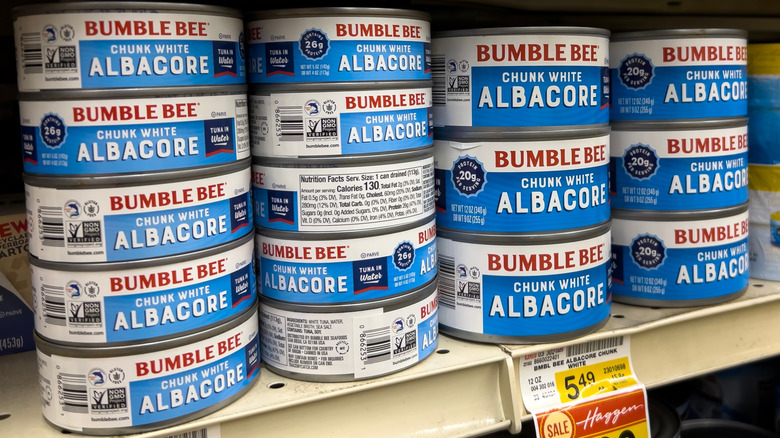
Bumble Bee Foods is the parent of two popular, regional brands. Its New England brand, Snow's, is known for affordable, quality clam products, like chowder and juice. Over in Canada, Bumble Bee produces Brunswick, whose sardines are known for good quality at a budget price, and leading canned seafood brand, Clover Leaf Seafoods. Interestingly, Bumble Bee explored selling Clover Leaf in 2019, as an interim solution to declaring bankruptcy from its legal trouble. This ceased when it was acquired by seafood conglomerate, FCF Co., Ltd in 2020.
Notably, among its legal issues was Bumble Bee's involvement in a 2019 class-action lawsuit. The case alleged Bumble Bee falsely marketed itself as "sustainable" and "dolphin-safe," since it used fishing methods that were harmful or deadly to dolphins. Though this story could count as one of the many ways Big Tuna scams you, that case was voluntarily dismissed without prejudice in 2021— meaning it may reopen after correcting an error in the case or a different one may be filed.
However, in a 2025 first-of-its-kind case, a group of Indonesian fishers claimed to experience human trafficking and forced labor while catching tuna sold by Bumble Bee in the U.S. This preceded another class action sustainability suit, this time towards Bumble Bee mislabeling its tuna and salmon as "sustainable," as it alleges the company's fishing practices are harmful to ocean life and its ecosystem. For clarity, it's important to note that sustainability efforts care for human rights just as much as the planet. Both cases are currently ongoing, so time will tell how these will play out for the beloved tuna brand.