

The State That Produces Nearly All Of The Grapes In The US
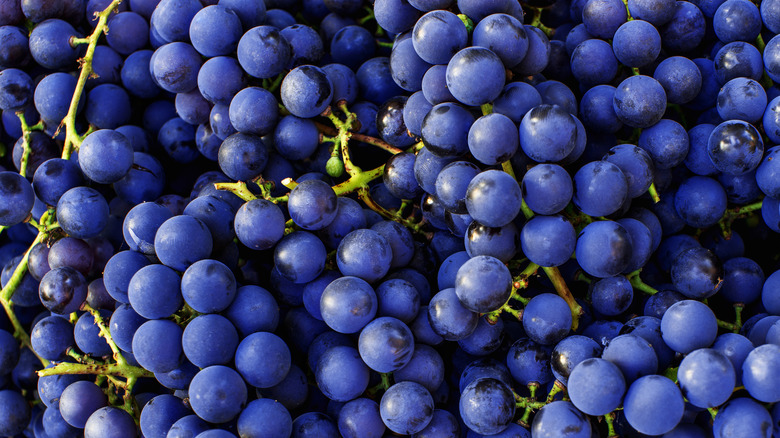
In our modern world of supermarkets serving up fresh produce of all kinds nearly year-round, it's easy to lose sight of the fact that those fruits and vegetables need to be carefully grown somewhere before they hit your store's shelves. For some items, it's hard to guess precisely where it came from. For others, like grapes, it's possible to infer their origin with near-certainty. In the United States, that's extremely likely to be California.
According to the California Table Grape Commission, growers in the Golden State produce a jaw-dropping 99% of the nation's grapes, with more than 80 green, black, and red varieties grown for numerous purposes. Data from the year 2024 shows this amounted to over 93 million boxes of the fruit, valued at more than $2.5 billion. Table grapes are primarily grown in the Coachella Valley of inland Southern California, as well as the San Joaquin Valley in the central part of the state. These areas rarely, if ever, see damaging frosts. Average temperatures are above 80 degrees in the former location and over 70 in the latter.
There's one critical caveat to California's domestic table grape dominance. The fruit's season in the state runs from May through January. Seasonal weather and other factors mean it's unlikely that second-place Washington state or third-place New York are able to completely fill the substantial gap. This means grapes you see in February, March, and April could be accounted for by imports from countries like Chile, Peru, and Mexico.
Generations of grape heritage
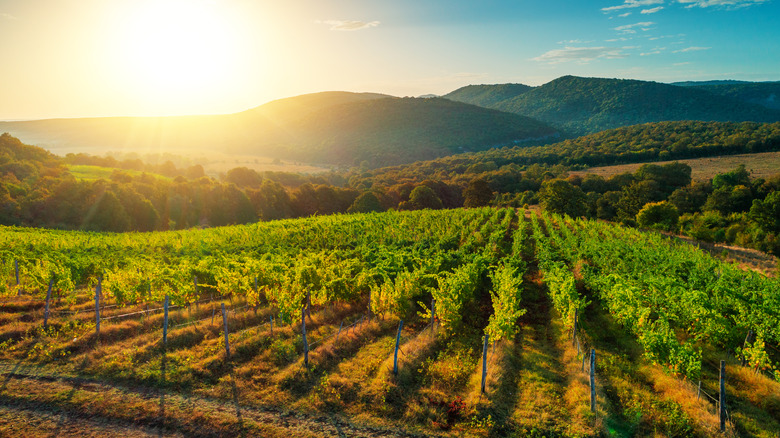
There's also the state's famous wine industry, whose major players grow grapes along the central coast and the famous northern coast. The area is home to world-renowned microclimates like Napa Valley and Sonoma. In fact, despite the many popular uses for this food, an unexpectedly large amount of grapes get turned into vino. (In 2022 alone, wine-type grapes accounted for 70% of acreage devoted to the fruit, per the USDA.)
Table grapes got their start in the Golden State during the late 1830s when William Wolfskill planted a vineyard in what is now Los Angeles. Credit for wine grapes is often given to Father Junipero Serra, an influential early leader of Catholic missions in California who has become the subject of controversy for his treatment of Native Americans. Exportation began in earnest in the 1870s after the Transcontinental Railroad linked farmers and markets on the east and west coasts.
In addition to grapes, California produces the most oranges in the U.S. Its status as an agricultural powerhouse for many crops is one of the primary reasons so many out-of-state fruits and vegetables are banned there: The restrictions protect lucrative crops from potential pests and pathogens. Still, it's hard to get more dominant at food production than growing nearly the entire country's output of grapes.