

5 Ways McDonald's Filet-O-Fish Has Changed Over The Years
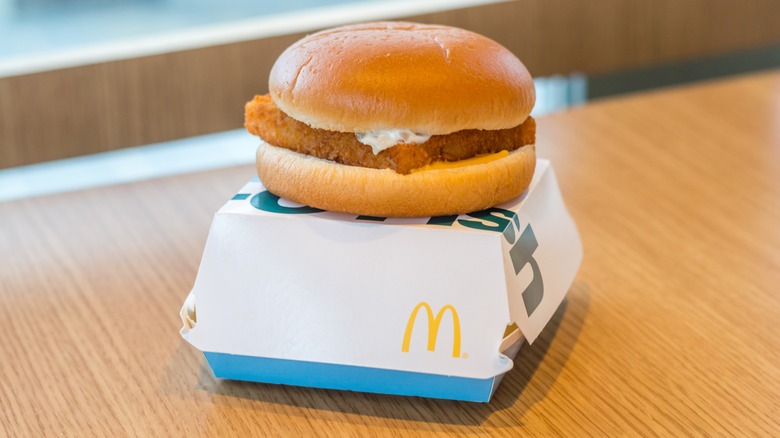
McDonald's Filet-O-Fish packs plenty of interesting trivia between its steamed bun, distinctive square patty, and quirky half-slice of cheese. Introduced in the 1960s as a response to burger sales that dipped during Lent, the fish sandwich was the first addition to McDonald's original menu. Since then, a series of small modifications have made the Filet-O-Fish the iconic fast food fixture it is today.
Changes over time have included the addition of the half cheese slice, swapping halibut for more cost-effective and ecologically sustainable fish options, and updates to the price and packaging. The Filet-O-Fish has also been the subject of some entertaining marketing campaigns, as well as a brief disappearance from the menu in the 1990s, which was soon reversed.
One of the few modifications to McDonald's long-running seafood offering was the limited introduction of a double-patty variation in certain regions, often seen during Lent. However, this is more of an upgrade, and the original single-patty iteration endures. It's unlikely the fast food giant is going to voluntarily tweak a product that has been so successful for so long. Most fans love it as-is, even if Donald Trump wishes the Filet-O-Fish had more tartar sauce.
The Filet-O-Fish didn't always come with a half slice of cheese
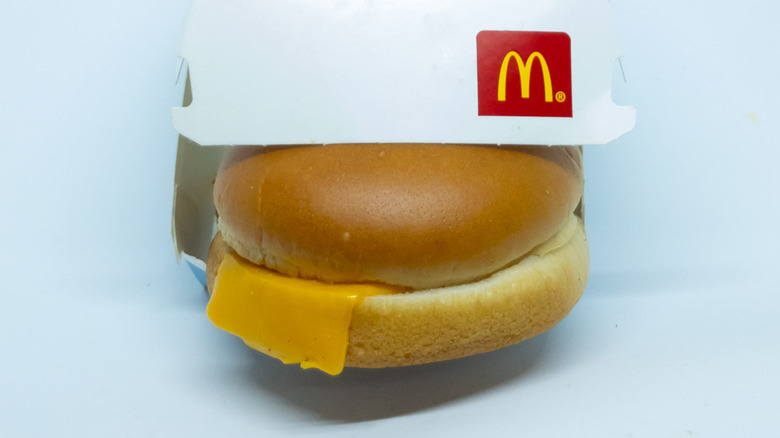
While the glistening yellow ribbon that barely covers half the Filet-O-Fish's patty has led some to accuse McDonald's of stinginess, the incomplete slice of American cheese is for more than just cost-cutting. It adds the right amount of cheesiness without overpowering the delicate fish and tartar sauce flavors. That said, the sandwich's inventor, Lou Groen, did initially add this ingredient to make the Filet-O-Fish economically viable. When he realized he'd have to switch to a cheaper fish from the halibut of his original build, Groen filled in the flavor gap with cheese. "I had to fall back on Atlantic cod, a whitefish, and I added a slice of cheese," he told the Cincinnati Enquirer in 2007 (via USA Today).
Whether Groen first used an entire slice before reducing it by half remains hazy. McDonald's official view on the subject is that the franchisee's original recipe remains unchanged, suggesting that Groen also used half a slice. However, we do know that his initial sandwich, which used halibut, didn't contain cheese. Crux supplied another perspective in its 2025 interview with Groen's granddaughter, Erica Shadoin. The Filet-O-Fish inventor seemingly got the idea when he saw an employee put a slice of cheese on their own fish sandwich.
The fish patty changed from halibut to Atlantic cod to Alaskan pollock
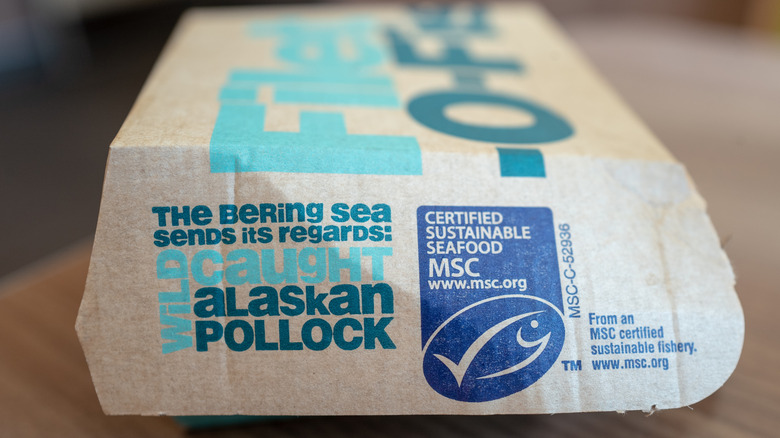
One of Lou Groen's challenges while developing the Filet-O-Fish was to make it cost-effective. With the original halibut, the sandwich cost $0.30 to make, but McDonald's executives wanted to charge customers $0.25. Thus, Groen switched to the more affordable Atlantic cod. Per Weird History Food, McDonald's referred to the patty as whitefish rather than cod because of the latter's less-than-savory association with cod liver oil. The term "whitefish" could have allowed the fast food giant some flexibility in the type of fish it used. It's no secret that McDonald's has struggled to sustainably source the massive quantities of fish it needs for its menu, and Earthjustice noted in 2010 that McDonald's sandwiches used a variety of different whitefish species.
McDonald's claims that all of its fish around the world is now sourced from sustainable fisheries. The U.S. Filet-O-Fish uses Alaskan pollock, but in other parts of the world, the sandwich uses a variety called New Zealand hoki. McDonald's in Indonesia uses the locally abundant tilapia.
The process of making the patty has also changed. Suppliers make the current U.S. Filet-O-Fish patty by layering processed fish and freezing them into blocks. These are then cut into small squares that are breaded and fried into the recognizable fish sandwich filling.
The price of McDonald's fish sandwich has risen faster than inflation
McDonald's introduced the Filet-O-Fish in 1965 and charged $0.29. Per the CPI Inflation Calculator (via the U.S. Bureau of Labor Statistics), this comes out to just over $3 in today's purchasing power. These days, depending on your location, a Filet-O-Fish can run you about $5 in some places and well over $6 in others. The rise in the item's price, which seems to have outstripped inflation, has fueled irritation among customers. Some have even claimed that the Filet-O-Fish has gotten smaller, though the fast food chain released a statement in 2023 saying that the sandwich's size "has not changed in decades" (via Business Insider).
The rise in price is starker. When former McDonald's corporate chef Mike Haracz decided to check out the alleged size difference for himself, he described the sandwich on TikTok as "certainly tiny" but "average-ish" and also noted that the item was expensive — $5.42 after tax. Joe Erlinger, president of McDonald's USA, acknowledged frustrations over high prices in a 2024 open letter. While he didn't directly address the price of the Filet-O-Fish, he did state that franchisees, who own and operate over 95% of all U.S. outlets, set their own menu prices.
Filet-O-Fish mascots and marketing have evolved
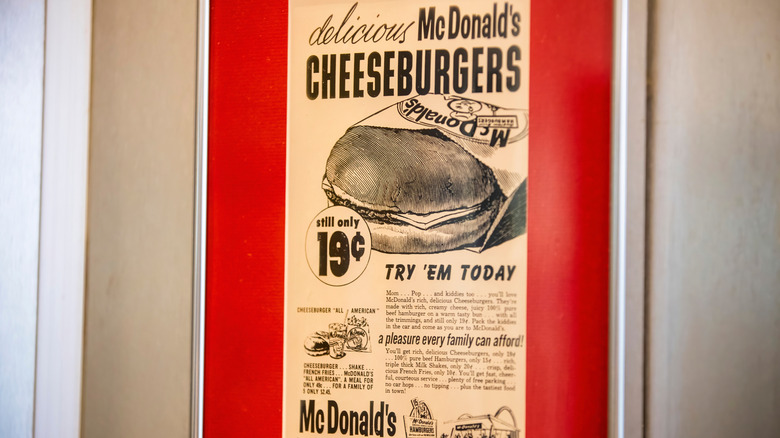
As McDonald's first non-hamburger sandwich option, the Filet-O-Fish was always a menu maverick. The blue packaging, whether on the paper wrapper or on later clamshell boxes, invariably set it apart from the chain's other fare. Over the years, McDonald's has also embarked on several marketing campaigns to draw customers to the seafood offering. One of the earliest used the tagline "The fish that catches people." While unconfirmed, this could be a biblical reference to "fishers of men" — a clever play on the burger's Lenten origin. A short-lived mascot named Phil A. O'Fish, who took the form of a fish in a sailor's outfit, also appeared in the 1970s. Replicas of ads featuring the cartoon mascot are still on display at the Cincinnati McDonald's branch where Lou Groen created the beloved menu item.
McDonald's later resorted to more somber advertising, with taglines like "Food for thought" and "Deliciously different." A "grown-up" version of the Filet-O-Fish, the Fish Filet Deluxe, replaced the original in the 1990s but was soon phased out. Marketing took another quirky route in 2009 with one of the Filet-O-Fish's catchiest TV commercials. The singing bass on the wall chanting "Gimme back that Filet-O-Fish" has lived on as a nostalgic earworm. These days, occasional marketing campaigns for the Filet-O-Fish have focused on nostalgia to promote the iconic, long-running product.
Sales numbers for the Filet-O-Fish have gone from 350 to 300 million
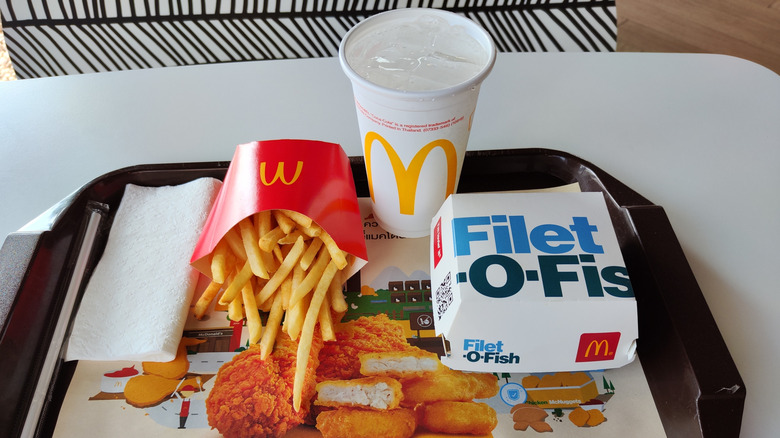
The Filet-O-Fish's long-running sales success dates all the way back to the sandwich's invention. Lou Groen developed it to bolster flagging store revenue, which it did with aplomb. However, in order for McDonald's to even consider the item a viable menu option, its sales numbers had to compete with those of the Hula Burger, championed by the chain's founder, Ray Kroc. On competition day — Good Friday, 1962 — the Filet-O-Fish sold about 350 units, beating out the Hula Burger's single-digit performance. In its first month, Groen's fish offering sold 2,324 units. Today, McDonald's sells about 300 million of these sandwiches annually across multiple countries.
While Lou Groen intended for his creation to solve a very local issue at a McDonald's in Cincinnati, Ohio, the Filet-O-Fish has since become a global touchpoint. As just one example, it has bridged various countries' eating habits with McDonald's global fast food offerings, like in Japan where the sandwich is a popular breakfast item. More broadly, since fish is a universal staple enjoyed in almost every region of the world, McDonald's most famous seafood item has gained popularity in several countries across Europe, the Middle East, and Asia.