

What Makes Pastas In America And Italy So Different, According To Giada De Laurentiis

Rome-born culinary icon Giada De Laurentiis has spent decades teaching fans about Italian cuisine. One thing the chef wants people to know is that, in her opinion, Italian dried pasta is superior to American noodles. De Laurentiis has shared her one dried pasta rule before, blaming "highly processed and modified" American wheat for its lower quality (via CNN). But there's another concern she has brought into the spotlight, and it concerns pasta dies.
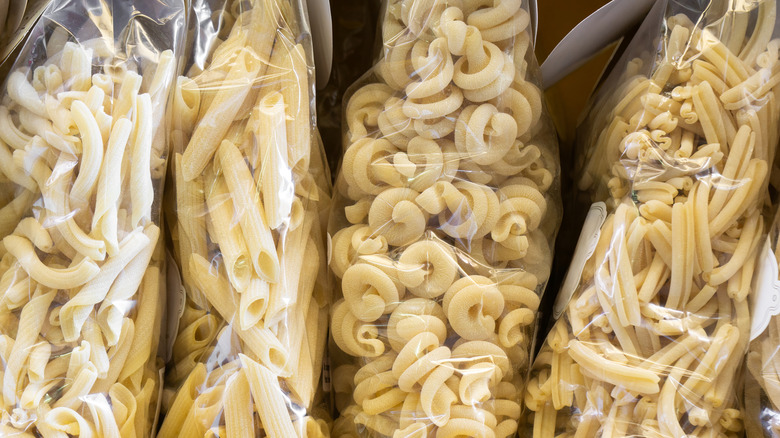
"The pasta that we import, it's also about the bronze dies," De Laurentiis explained in a 2026 episode of "No Matcha No Mama," hosted by her aunt, Dina De Laurentiis. For the uninitiated, dies give pasta its shape. A machine pushes the dough through the die and cuts it into a specific style, like rigatoni. "Most of them from Italy use bronze, not plastic," De Laurentiis continued. "In America, we mostly use plastic because you can push out more dough and ... make more pasta ... the faster you push out dough, the hotter the dough has to be. Most of them also have ... Teflon on them, so they slide out faster."
The concern is that Teflon and plastic leach into the pasta when heated. Even though manufacturers need to replace plastic dies more often than bronze, they can still produce pasta faster for a greater profit. Pasta extruded through Teflon dies is also notably smooth due to how quickly the hot dough is pushed through, which some say makes it less appealing and worse for holding sauce compared to rougher, bronze-extruded pasta.
How to find Giada De Laurentiis-approved dried pasta in America
Giada De Laurentiis' clip raised many fans' eyebrows. "Say what?! Thanks for [the] heads up, G! Just another reason for me to make my own," one user commented on the Instagram clip. "America only cares about making money, not what is healthy," wrote another. "That's why when you buy pasta, it has to say 'made in Italy,'" advised a third.
Buying Italian dried pasta is one way to avoid microplastics and Teflon in your dinner, despite them being present in a myriad of other products. This isn't the only reason to shop Italian pasta over American, though. The Italian version is typically made entirely from semolina, a product of hardy ground durum wheat, while American pasta is often cut with durum flour. This makes all the starchy difference in Italian versus American dried pasta, resulting in better color and texture. Italian pasta also tends to be more yellow from quality eggs — a vibrant yellow yolk signifies that the chicken had a natural diet and room to roam.
Luckily, finding Italian pasta stateside isn't hard. De Laurentiis' Giadzy brand sells plenty of Italian pasta, due in part to some sweet family history (her great-grandparents ran their own pasta factory in Italy). Rao's Homemade also sells bronze-extruded pastas imported from Italy, not to mention De Cecco, La Molisana, and Sfoglini. Some bigger brands like Barilla also offer bronze-cut variations. If you want to be spoiled for choice, try an Italian specialty store or market, like Eataly.