

What Proof Vodka Is Best For Cooking?
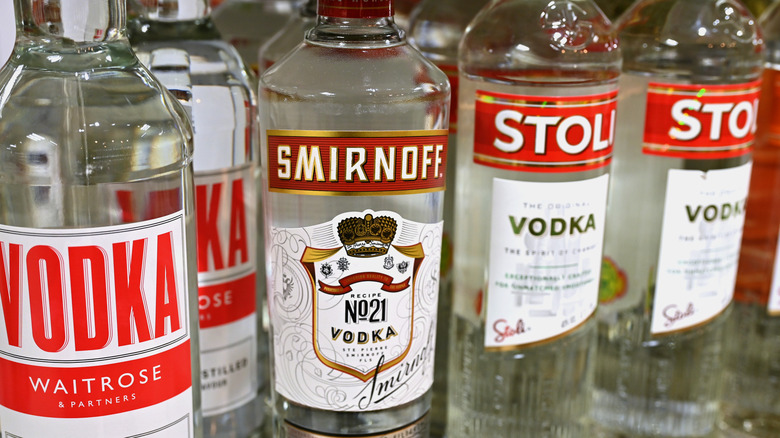
Vodka has long served as more than just a boozy beverage. It's also a frequent addition to a wide variety of recipes, even beyond familiar options like our penne alla vodka. However, a visit to the vodka section at your local liquor store can be daunting, with a sometimes overwhelming amount of brands of the mostly neutral spirit. One key consideration to make your purchase easier is the vodka's strength, otherwise known as its proof. For cooking, it's safe to go with the lowest-proof true vodka available on American liquor store shelves.
To be sold as vodka in the United States, federal law requires the spirit to be a minimum of 80 proof, or 40% alcohol by volume. This standardization, which applies to many other types of distilled spirits as well, is generally seen as a minimum, rather than a limit. Stronger vodkas are easily available as well, with premium varieties typically in the 80-90 proof range, while high-proof and overproof versions range from 100 proof (50% ABV) to an eye-poppingly high 192 proof (96% ABV).
Remember the reasons — and goals — when it comes to cooking with vodka. Generally, it's not to add an element of tipsiness, but instead to enhance the flavor of sauces and soups, to tenderize meat, or to make baked goods flakier and more tender. All of these can be achieved with standard 80-proof vodka, meaning there's no need to spend the extra money (or waste the premium booze) to cook with higher-proof options.
Pitfalls to avoid when choosing cooking vodka
Still, just because it's fine to use standard, 80-proof vodka when cooking doesn't mean it's worth skimping. Lower-quality spirits of any proof can degrade your final product. While the alcohol in the spirit is often indistinguishable by the time you enjoy the dish, it absolutely can and does leave behind subtle flavors and effects. This factor is even more important when vodka is prominent in the final result, such as making vanilla extract. Higher-proof vodka can mute the flavors, while typical-strength versions produce a warmer, more well-rounded product.
Also, don't be fooled by lower-proof spirits masquerading as vodka. Recent years have seen the proliferation of low-ABV spirits, including so-called "vodkas," go from 30% ABV to under 20%. These may not offer the same benefits when it comes to food chemistry and flavor development due to their higher water content, meaning they're better off left for light cocktails, rather than food.
Cooking with alcohol can be a wonderful treat, adding complex flavors, improving dishes, and sometimes even infusing a delightful hint of booziness to some recipes. Vodka is an easy and common choice to use. While a wide variety exists, standard 80-proof vodka should be your go-to for any meals that require a splash of the spirit.