

How Drive-Thrus Changed The Fast Food Burger
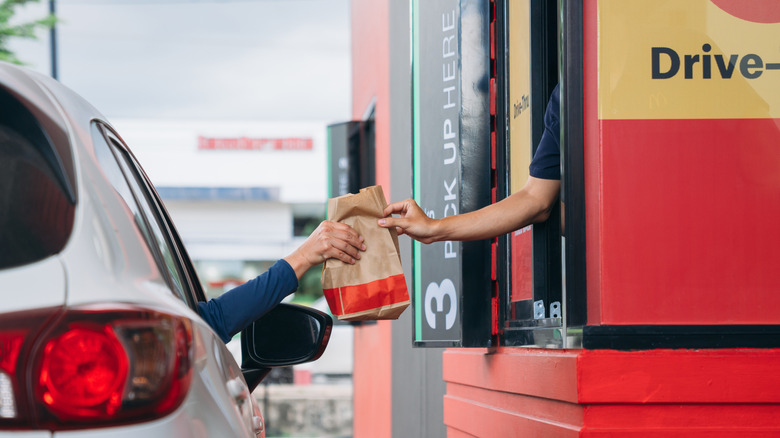
For many hungry Americans, the need for a quick meal on the go sends them straight to the local fast food restaurant's drive-thru. In fact, some fast food restaurants are drive-thru only. As many as 60% of Gen Z and millennials said they use them at least weekly in a 2025 survey (via QSR Magazine). The prominence of these convenient fast food spots is undeniable, but most customers probably don't think about how a drive-thru came about or how it has changed the way we eat.
The West Coast burger chain, In-N-Out, changed fast food forever with the two-way intercom drive-thru, but Missouri's Red's Giant Hamburg was the inventor of the original drive-thru. The drive-thru's predecessor, drive-ins, featured carhops who would bring elaborate meals out to customers waiting in cars — often full dinners, which diners would eat in their cars before driving away — which is still a far cry from food to go. The end result: Drive-thrus solidified the burger's dominance as the classic American fast food item, while also pushing restaurant kitchens to cut down preparation time and simplify the cooking and assembly process. This caused burgers to become more common, more standardized, and quicker to make.
The fast food hamburger is the perfect car food. It's simple, popular, easy to hold in one hand, and generally not messy. For example, as McDonald's transitioned to drive-thrus, the chain cut items that now sound like bizarre inclusions, like tamales or peanut butter and jelly sandwiches. So it's no surprise that, as drive-thrus became popular during the 20th century, the burger's dominance grew with it.
Drive-thrus pushed kitchens to be more efficient
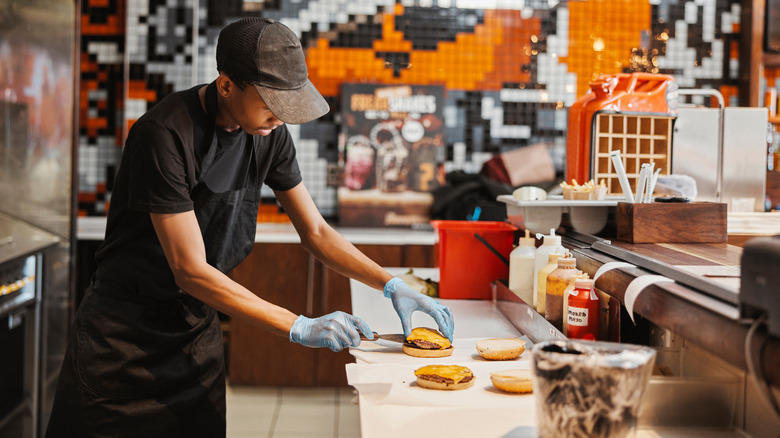
With this shift to burgers as the primary drive-thru food, they had to be made more efficiently. In a continuation of a trend already started in restaurants like McDonald's, that meant they had to be more standardized. To ensure quick service at the drive-thru, fast food restaurants developed tools that made sure each hamburger was identical to the next.
Drive-thrus require speed: Unlike inside a restaurant, where a customer can order and then wait in the dining room, drive-thrus have limited space for cars to wait. That means the food has to be nearly done by the time the car pulls up to the pick-up window. Fast food restaurants cut the number of steps required to make the burgers to make it easier for employees to put them together and implemented tools to specifically portion things like condiments and toppings.
The burgers also changed because the cooking methods continued to adapt to improve service time. Fast food restaurants adopted quick broilers to rapidly cook burger patties, as opposed to the traditional grill methods, changing the taste of the meat. Burger King, for instance, used a device called the Insta-Broiler, named after the chain's original brand name — Insta-Burger King. (When the restaurant returned to grilling burgers, it changed its name, too.) Although the cooking innovations changed the taste of the food, they also allowed restaurants to get orders to customers in just minutes.