

The First Thing You Should Do Before Cooking On Your Blackstone Griddle
We may receive a commission on purchases made from links.
Blackstone griddles, made popular with the help of TikTok, offer a compelling value to home cooks: the ease and convenience of a restaurant-style flat-top grill without needing to actually install one in your own kitchen. The grills generally come disassembled and need to be put together at home, but don't start cooking as soon as it's together and washed off with soapy water. There's one more step you should do first.
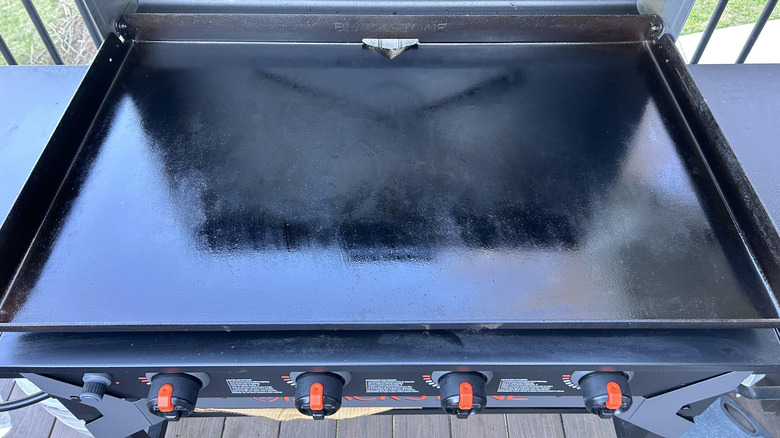
Flat-top grills like the Blackstone need to be seasoned, roughly in the same way as a cast-iron pan. Seasoning involves creating a thin, oil-based protective layer on the cooking surface that will prevent food from sticking during cooking, making the griddle naturally nonstick without a PFAS or ceramic-based coating, and prevent the metal from rusting. That not only makes grilling easier but also extends the Blackstone grill's lifespan.
The manufacturer offers a guide to seasoning a new griddle on its website. Basically Blackstone advises users to set the burners at the highest heat and let it run for 10 to 15 minutes. When the flat-top turns darker, turn off the burners and use a paper towel to thinly spread oil over the hot surface. While you can buy Blackstone-brand Griddle Seasoning & Cast-Iron Conditioner via Amazon, avocado or grapeseed oil works just as well. Get the heat going again and let the griddle surface turn black and smoke, then turn it off and go through the process again. Blackstone recommends doing this two or three times before cooking on it.
What happens at a molecular level during seasoning
If you're going to be cooking with oil, anyway, why bother adding extra oil at the beginning? The seasoning steps involve actually changing the chemical structure of the oil you use, in a process called polymerization. The oil's fatty acid molecules link into chains — polymers — which are strong and form tight bonds with both each other and the metal cooking surface when the oil is heated until it smokes. Remarkably, this process actually turns the oil into a form of natural plastic, a polymer.
Emerging research on this phenomenon appears to show that the seasoning and the fat binding to the metal results in a surface that is conditionally hydrophobic — that is, when there's a little water on it, the metal repels the water, but when there's a lot of water around, it'll get wet. This allows the surface to transfer heat efficiently as your food releases moisture, then repel the smaller amounts of water left over toward the end of cooking, which is why food that's done releases more easily from the flat-top.
On a molecular level, the seasoned griddle surface isn't fully repellent to water and may still rust, even if you've seasoned it perfectly. But still, adding that protective layer gives the griddle surface a leg up in preventing rust. It means that the small amounts of water the flat-top will be normally exposed to, like humidity, cooking liquids, and the like, are less likely to interact directly with the metal cooking surface. That makes seasoning your first line of defense against stuck-on food and rust, but it doesn't mean you don't need to protect the surface from rain between cooks with some kind of cover.