

The Midwest Brewer That Was Once America's Third Largest Before Disappearing
In the plays of William Shakespeare, there is a beloved recurring comedic character who spends most of his stage time drinking and rabble-rousing in the local tavern. His name was Sir John Falstaff, and centuries later he became the namesake for the once-iconic Midwest beer brand, Falstaff Brewing. This Missouri-based brewery was the third-largest in the United States in the mid-20th century. Then, just a few decades later, it was gone, and its lineup had joined the list of bygone beers.
The roots of Falstaff Brewing trace to the early 1840s, when German immigrant Adam Lemp opened Western Brewery in St. Louis and helped popularize German-style lager in Missouri. Like other brewers in St. Louis at the time, Lemp aged his lagers in natural limestone caves beneath the city, using ice from the Mississippi River to keep it cool. His son William later took over the business and built a brewery (which he eventually renamed Lemp Brewing) above those caves. By the 1870s, Lemp was the largest brewer in St. Louis. The company introduced the Falstaff label in the late 1890s.
But not long after, a series of personal tragedies befell the Lemp family, rendering the company vulnerable to the economic turmoil of the early 20th century as Prohibition loomed. Lemp Brewing closed in 1919, the year Prohibition was passed. Pieces of the company were sold at auction, and the Falstaff label eventually went to another St. Louis brewer, Joseph Griesedieck. When Prohibition ended in 1933, Griesedieck renamed his company the Falstaff Brewing Corporation. The Falstaff name and signature black and yellow shield outlasted the Lemp brewery, and the Griesediecks would soon take both beyond St. Louis.
The rise and fall of Falstaff Brewing
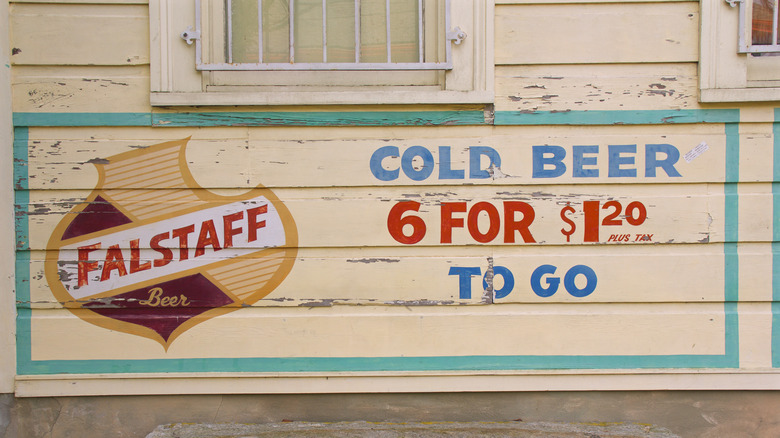
Numerous factors contributed to Falstaff's dramatic rise. Not least was the company's survival of Prohibition by selling other products and remaining prepared for beer production following the law's repeal. Falstaff also pioneered the idea of brewing in multiple geographic locations. In 1935, it purchased a facility in Nebraska and became the first American brewery to make beer in two different states. By buying up breweries across the country, Falstaff created a pioneering network of operations. In 1948, Falstaff joined the stock exchange, gaining access to capital that was rare for family breweries of the time. By the end of the 1950s, Falstaff had secured its position as a leader in American beer, surpassed only by Anheuser-Busch and Schlitz.
But beneath this success were hints of the brand's eventual demise. Documents from as early as 1962 show that the company's impressive array of regional breweries were operating at drastically different costs. Differing labor arrangements across states as well as an expensive anti-trust lawsuit also weakened the company.
One of Falstaff's most memorable missteps was a '60s mini-keg promotion. Each keg came with a plastic tap and cost the company $48. But, as the deposit was only $1, customers had little incentive to bring them back, resulting in losses estimated at $12 million. Facing bankruptcy in 1975, Falstaff was acquired by investor Paul Kalmanovitz. Brewery closures followed, including Falstaff's last St. Louis plant in 1977, and its final location in 1990. The Falstaff name hung on for 15 more years, brewed in small batches by Pabst, another Kalmanovitz acquisition. Pabst finally discontinued it in 2005.
A profoundly Midwestern beer
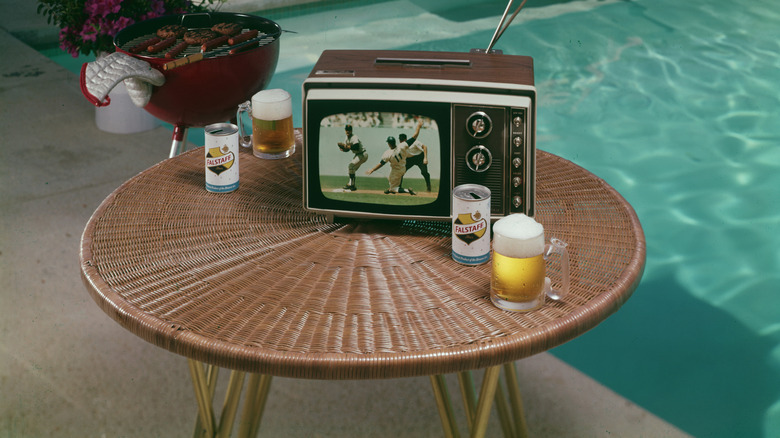
Despite the brand's trailblazing national expansion of beer production, Falstaff is remembered as a deeply Midwestern cultural phenomenon (much like the classic heartland brew of Hamm's). In St. Louis, the brewer sponsored Cardinals and Browns radio broadcasts. Among today's older generations, memories remain of their own families drinking from Falstaff cans. "It was my grandfather's favorite," wrote one Redditor on r/StLouis. "And we still have old Falstaff beer cases in our attic that are holding things my grandparents packed into them."
The brand left its mark on the landscape, too. The Lemp Brewery in St. Louis, an impressive complex of 29 structures, currently houses shops, studio spaces, and other commercial and residential tenants. Though most of the limestone caves are locked for safety reasons, guided tours are still offered of some facilities, as well as nearby Lemp Mansion. On the southeast side of Chicago, giant grain silos painted by Falstaff to resemble beer cans long offered a landmark for drivers until their demolition in the late 1990s.
Today, beer historians, along with those simply nostalgic for the brand, collect old Falstaff merchandise and memorabilia. The Brewery Collectibles Club of America even has a chapter devoted to Falstaff memorabilia and history. One vintage can design carried the Falstaff shield on the front and an illustration of Shakespeare's Sir John Falstaff on the back.