

How Bad Oil Is Ruining Fast Food Fried Chicken
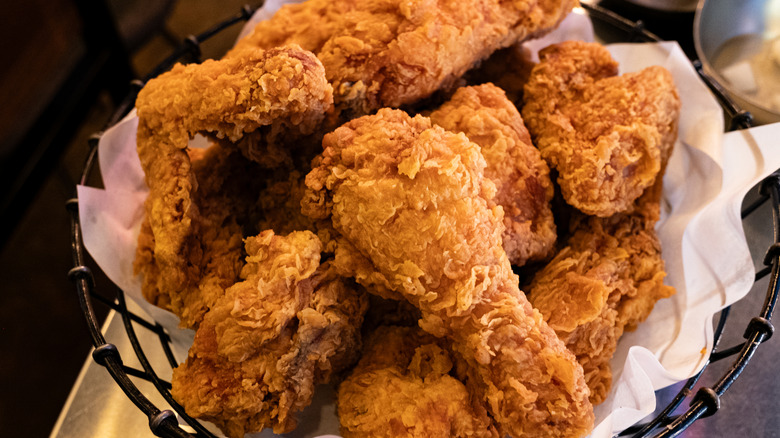
When grabbing dinner from a fast food fried chicken joint, you likely have high expectations of juicy, mouthwatering goodness from the first bite. But sadly, you might notice that when you finally open that paper bag and take that first bite of chicken, it falls short of expectations. It could be too dry, perhaps, or stomach-churningly greasy. Maybe the piece is even darker in color than you expected, causing you to squint your eyes to check that it's cooked properly.
When this happens, it's easy to assume that the workers who cooked your piece of chicken simply weren't paying attention or that you've received a bad batch. But it seems the true answer may be hiding in plain sight. These inconsistencies in the product can actually be caused by restaurants saving some costs by reusing the oil in their fryers.
To help us identify the specific ways in which bad oil can affect a piece of chicken, we turned to the experts. James Callery, head chef at Hotel du Vin in Winchester, U.K., has given us his input to steer readers in the right direction. With the additional combined knowledge of Kara Brown, a recipe developer and the founder of Bee Inspired, and Tennille "Tee" Middleton, the executive chef of Hunter's Bar and Grill as well as the corporate chef of Restaurant Zone Inc., we've gotten to the bottom of how the oil affects fried chicken.
Breaded food leaves a trail in the fryer and degrades the oil
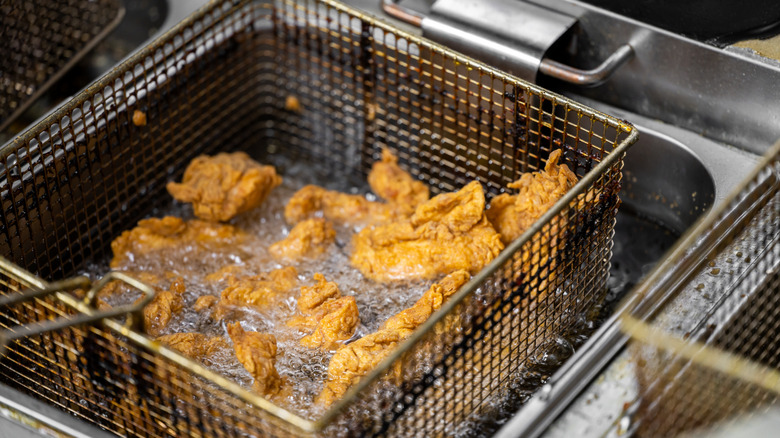
If you've ever done any sort of deep frying at home, not necessarily in a deep fryer but even in a pan, you'll have noticed that pieces of that breaded coating end up being released into the oil. There isn't really a way around this happenstance; it's just a byproduct of using oil to fry food. While you won't notice those pieces of breading missing when you go bite into your chicken, you will realize that your oil is turning darker with each reuse. These little harmless-looking breading chunks have browning agents like sugars and proteins within them, which cause your oil to both darken and begin to break down.
James Callery clarifies that this degeneration is what often causes problems with fast food fried chicken, not just using inexpensive oil. "Cheap doesn't automatically mean bad," he says. "The bigger concern is oil that's unsuitable or has deteriorated from repeated use." Kara Brown seconds this. "Reusing oil isn't automatically bad, but you need to filter it, store it properly, and replace it before it deteriorates," she explains. Tennille Middleton adds that there are reactions that happen when reusing oil that cause it to negatively affect the quality of the chicken.
Free radicals are released
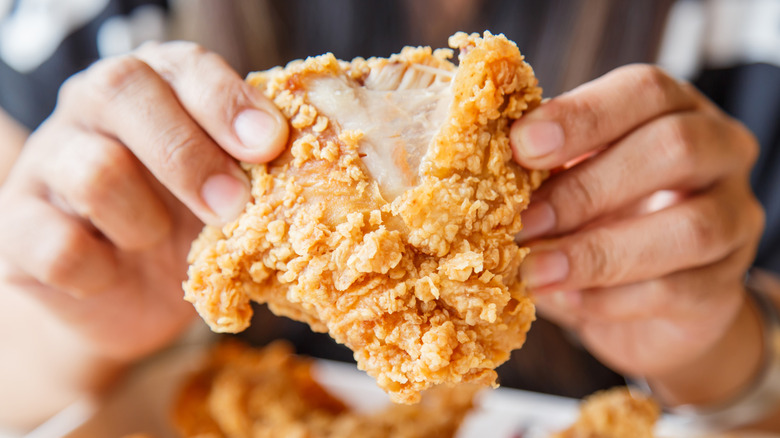
As you can probably imagine, deep frying probably isn't the healthiest way of cooking chicken. Even if you aren't entirely sure of the nutrient makeup of a piece of fried chicken, you've likely heard someone in your life mention the word trans fats and gathered that they aren't the best for your body in high amounts. As for the sodium content, it's likely a higher amount than you were hoping for. But when the oil is reused and begins to degrade, the results actually affect your fried chicken dinner and may spawn other health-related concerns.
Tennille Middleton starts off by explaining, "Oil degrades from moisture, oxidation, and chemical reactions." These processes can happen unseen when cooking oil is heated up again and again. They include oxidation, hydrolysis, and polymerization, which are basically fancy terms for the oil molecules reacting to air, water, and heat. When this happens, molecules called free radicals are formed, which have been linked to health problems. The chicken is exposed to these free radicals as it cooks in oil, and they're carried over to your digestive system after you take a bite.
When built up, free radicals can attack important cells in the body and cause damage. This is how consuming them can lead to side effects like inflammation and cell damage. Some studies even link certain types of cancer to these compounds.
The taste changes
The changes that take place in reused oil affect the final presentation of your piece of fried chicken in more ways than one. Apart from increasing the potential risk of certain health issues, they can also impact the taste of the chicken — even if you're using the best crispy fried chicken recipe on the internet. James Callery weighs in on the matter, explaining, "Fresh, inexpensive oil can produce excellent fried chicken. The problems start when oil becomes degraded, leaving bitter, stale, or rancid flavors." Callery shares with us his own mantra when it comes to serving up the dish: "Fried chicken should taste like beautifully seasoned chicken, not yesterday's fryer!" Kara Brown concurs with this statement, noting, "You might have perfectly seasoned chicken and a beautiful coating, but if the oil is past its prime, the finished dish can still taste disappointing."
Tennille Middleton, however, remarks that some oils may just be poor-quality from the get-go, sharing, "Cheap oil can make fried chicken taste bitter or give it an almost fishy aftertaste. The complete opposite of what you are going for." Middleton continues, "Bad oils break down and the flavor left behind can be acrid." The word acrid certainly does not excite the taste buds in relation to flavor.
Off-putting color
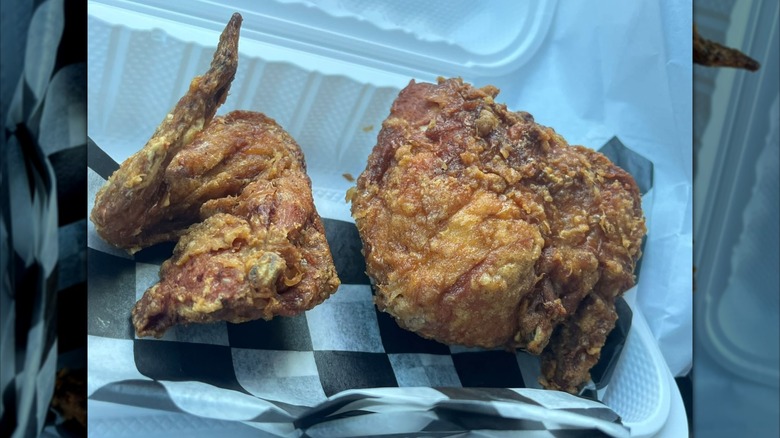
If you've ever actually reused cooking oil, you'll likely have noticed that it darkens as the reuse cycle continues. As we've laid out, this is thanks to chemical reactions and those little pieces of batter that fall off naturally during the process. What you might not realize though, is that your fried chicken will be affected not only in taste, but in color as well. When you cook in darker oil, your chicken is going to absorb some of that oil, and thus reflect the darker color. If you were looking for the secret behind perfectly cooked fried chicken, you certainly won't find it in a vat of dark oil (unless the restaurant happens to be using a naturally dark product like palm oil).
James Callery sets us straight on this one. "Repeated heating gradually breaks down the oil, which can lead to darker coatings," he asserts. He goes on to joke, "There's a difference between properly maintaining frying oil and using it until it resembles engine oil!" Kara Brown also adds that as oil deteriorates, the texture and color of fried chicken will suffer. "Fresh oil gives you a cleaner taste and a more golden crust," she says. Tennille Middleton concurs with Kara's sentiment. Middleton shares, "As chefs, we always believe you can't get your best finished product from bad ingredients. The oil type, temperature, and cleanliness all matter."
The oil deteriorates faster if improperly stored
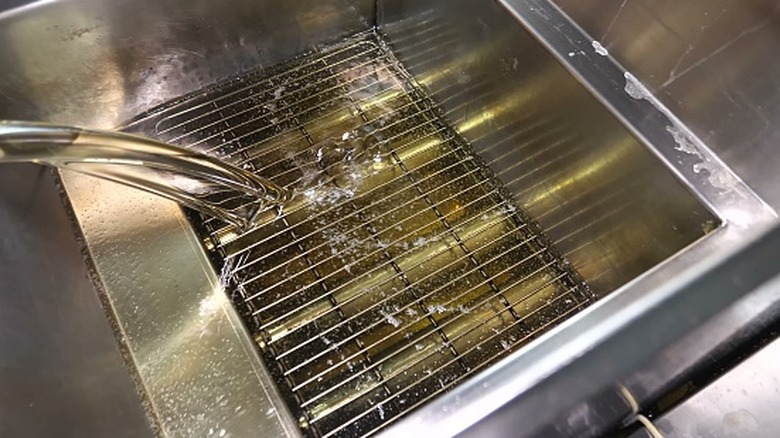
Sure, at this point you've likely seen many arguments for why reusing oil for fried chicken isn't the best idea. But what takes this to a whole new level is when you consider that this oil isn't just sitting in the fryer after closing time, awaiting the drumstick that'll be tossed in the following day. There's an entire procedure restaurants must follow to keep it safe for reuse in the first place. For example, they must wait for the oil to cool, strain the debris left behind, and then keep it sealed inside of an airtight container.
Kara Brown provides some input on this. She shares, "Reusing oil isn't automatically bad, but you need to filter it, store it properly, and replace it before it deteriorates." And if your favorite chicken chain uses cheap oil, there's another component to consider. Brown details, "One major problem is that lower-quality or poorly stored oil deteriorates faster, especially under repeated high heat." As you can imagine, she confirms that if you feel the fryer oil has deteriorated to a point beyond what is acceptable, the best method is to follow the correct protocols for throwing it out and use fresh oil.
The smoke point drops with each reuse
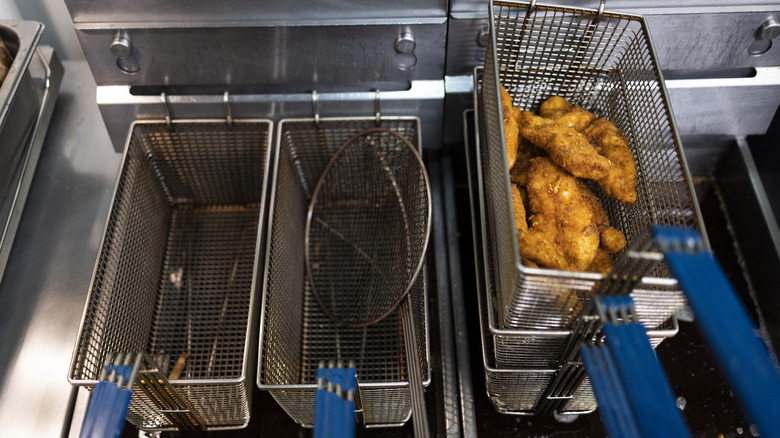
If you remember the information from our experts, every time you reheat cooking oil, it causes it to break down even more. It undergoes chemical changes during this process that alter its makeup. One side effect is that the smoke point of the oil lowers with each use as well. This can in turn make your chicken taste a bit burnt or smoky, potentially overpowering the lovely poultry and coating flavors you were expecting.
To really understand how this works, firstly we need to look at what an oil's smoke point actually means. A smoke point is the temperature at which the chemical bonds (or the interaction between the molecules) start breaking down. When they break down, acrolein is created, which is a chemical that starts producing smoke, hence the term smoke point. Different types of cooking oil have higher or lower smoke points, but regardless of the variety, when the oil is reused, the heat required to reach this threshold is lower, thus leaving you in danger of unpleasantly flavored chicken. In fact, this should be taken into account for any of your future frying endeavors, as reusing oil is one of the biggest mistakes people make when deep frying.
Your exposure to trans fats increases
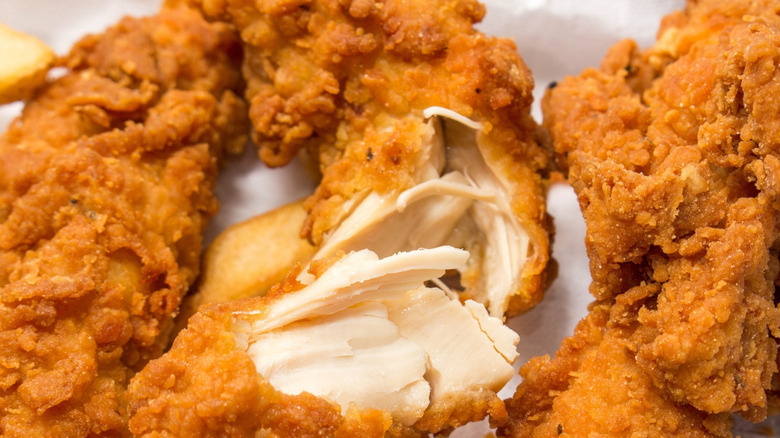
As mentioned earlier, trans fats are a buzzword that you've likely heard floating around in the health world. Even if you don't necessarily understand what they are, you've probably heard about them associated with negative health risks like heart disease. What's more, the ingredient seems to be nearly unavoidable, found in everything from meats to dairy products, something you wouldn't even expect to contain them (which is why you should always check food labels if you're trying to avoid trans fats). While these trans fats can be found in refined oils, their presence becomes even more apparent when you start reusing the oil.
You see, the long and short of it is that oil naturally has all sorts of different fats, and not all of them are considered unhealthy. Many cooking oils actually contain omega-3 fatty acids, for example, which are said to actually contribute to cardiovascular health. But when oils are heated up, these omega-3 fatty acids decrease, and other fats present in the mixture can actually turn into trans fats. With each reuse of the oil, trans fats increase, which can then carry over into your piece of chicken. So, although it might be tempting even for those of you cooking fried chicken at home to reuse your oil, you may want to consider your heart health before pulling the proverbial trigger.
Don't blame the cheap oil for the grease
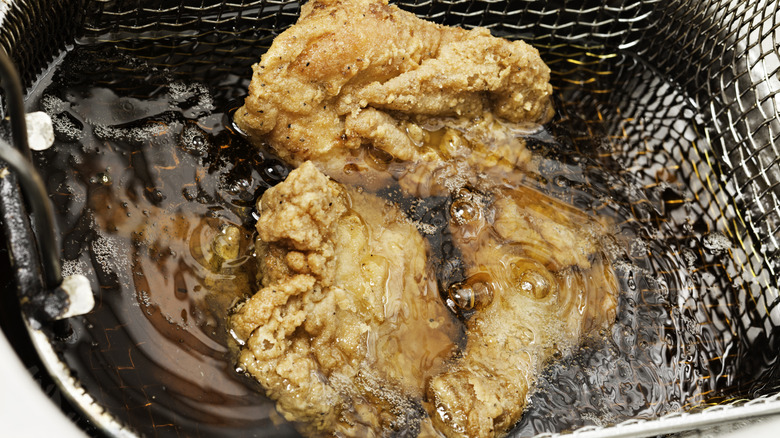
With this reused oil in fast food joints as the known culprit of so many disappointing fried chicken dinners, it'd be easy to assume that it's also the reason your fried chicken is dripping in grease. It turns out that, according to our experts, this might not be true. As Kara Brown explains it, "Greasiness depends more on frying temperature, cooking time, and how well the chicken drains after frying." She goes on to share, "If the oil temperature drops too low, the coating can absorb more oil instead of crisping properly."
James Callery agrees with this assessment. He says, "It's mostly about temperature control, preparation, and frying technique." Tennille Middleton, similarly, mentions that fast food fried chicken might be greasier than your typical sit-down restaurant but attributes it to reasons other than cheap oil. "Lower frying temperatures, large batches, and the condition of the oil can all contribute to a greasy product," Middleton details. If you are considering making fried chicken at home, you might want to take note of these problems. Most of them rank as some of the common ways you could screw up home-cooked fried chicken as well.
The type of oil matters
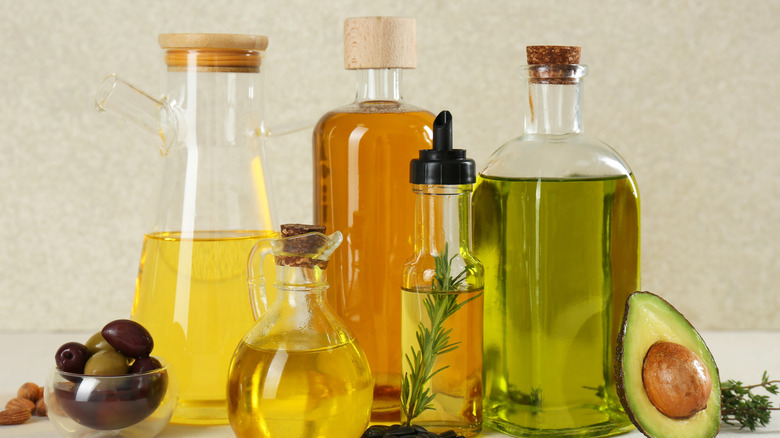
Moving on from the perils of reused oil, at this point it may be helpful to focus on the actual specific types used in fast food frying and what the effects may be of cheaper options. Sure, reusing oil saves some dough itself, but the simple fact is that certain types are more expensive to purchase from the get-go than others.
James Callery points out, "Fast food chains generally favor vegetable oils like soybean, canola, or sunflower oil because they're affordable and neutral in flavor." He adds that this varies from sit-down restaurants, which might choose typically more costly peanut oil or even beef dripping for flavor. Kara Brown agrees with Callery on which oils fast food joints commonly use and elaborates, "High-volume fast-food kitchens generally favor affordable, neutral oils that can handle repeated frying."
If this has caused you to wonder what the effects of choosing these lower-cost oils are from the jump, before they're even reused by the restaurant, Tennille Middleton mentions that they can certainly leave you with a sad-looking piece of chicken. "Using cheap oil can completely ruin your breading. It can come out soggy, greasy, or burnt, and it can even ruin the flavor," she shares. "Bad oil can foam and add too much moisture, which steams your product, or it can drop in temperature and cause overcooking."