

14 Oldest Hard Candies Still Sold In The US
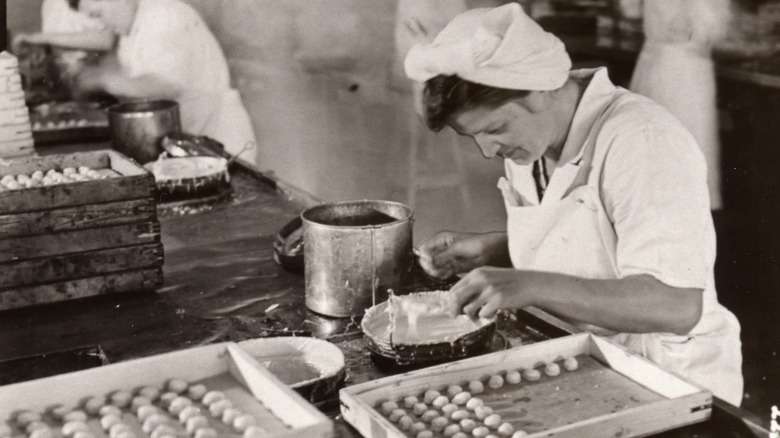
Hard candies are an incredible invention: You can pop one in your mouth when you're bored, when you're craving a little treat, and sometimes, when you want to freshen your breath. Some hard candies are mild, natural-tasting, and refreshing, while others are so potent they can transport you to another dimension. While some of the sourest, spiciest, and most absurd hard candies were produced around the mid-20th century, other hard candies date back hundreds of years.
It's delightful imagining people from long ago enjoying treats like we do today. What you may not know, though, is that plenty of the candies they savored are still around. Some may require a special trip to a historic candy shop, some can be ordered online, and many actually sit at your favorite grocery store.
What is the oldest candy you've ever tried? Read on to unwrap some of the oldest hard candies still sold in the U.S. and discover how much candy history you've already tasted. We'll start with the oldest and work our way toward modern times.
Candy canes (1670)
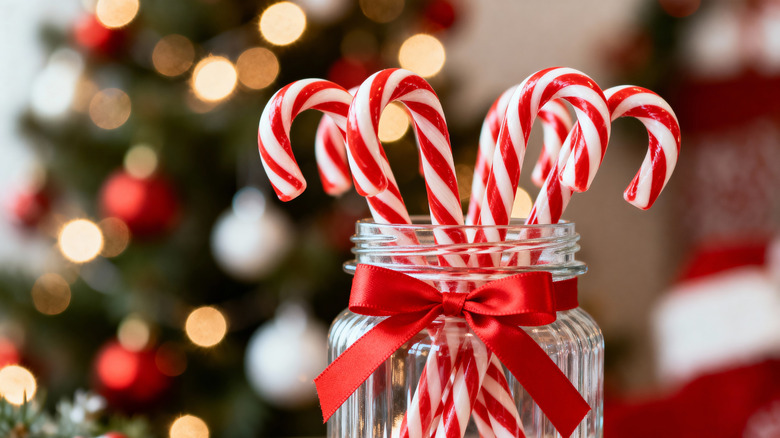
Christmas wouldn't feel complete without candy canes. Even if you're not a peppermint lover, you can still appreciate the whimsical twirl of red-and-white stripes and how perfectly they look hanging from a Christmas tree. Something about them simply feels right during the holiday season. As it turns out, one story says that we can thank a German choirmaster from 1670 for this iconic confection.
If you've ever had to wrangle a large group of boys, you know the task isn't for the faint of heart. Endearing as they can be, they can also be quite mischievous and rowdy. To placate his choirboys, the choirmaster supposedly handed out sweet candy sticks. Word got out, though, and the higher-ups believed that church should only be a serious space, not one where you snack. This choirmaster came up with the brilliant idea to shape the sticks with a curve at one end, as he bet the others wouldn't dare condemn candies honoring the shepherd's staff, and he was right. Little did he know that folks hundreds of centuries later would use candy canes as traditional holiday decorations.
So, why do we eat candy canes at Christmas nowadays? We have a second man from Germany to thank. August Imgard immigrated to America, became a big candy manufacturer, and popularized using candy canes as Christmas tree ornaments in 1870. The next time you unwrap a candy cane, you can raise it and say, "Danke!" to those sweet geniuses from centuries past.
Gibralters (1806)
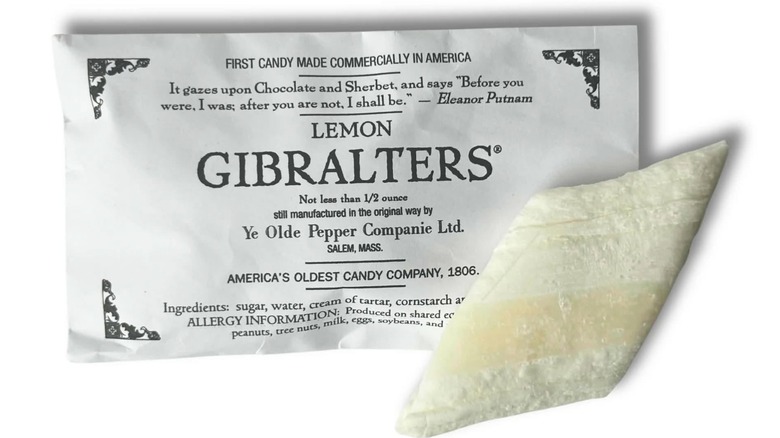
Gibralters are living proof that the simplest flavors are oftentimes the most delightful. These 1806 hard candies only contain sugar, water, cream of tartar, and lemon or peppermint oil for extra flavor. Almost the entire batch is stretched and pulled to create a melt-in-your-mouth texture. For looks, one stripe of clear, unpulled candy is placed across the center.
Gibralters were invented by Mary Spencer, affectionately known as Mrs. Spencer, in Salem, Massachusetts. Her family wound up in this charming New England city after relocating from England. Sadly, the family lost all their belongings to the sea. Locals welcomed them with open arms and helped them settle comfortably into their new life. Once they got wind of Mrs. Spencer's confectionery talents, they dropped off a big barrel of sugar to sweeten the welcome.
Gibralters are less known than candy canes today, but this wasn't always the case. Since Salem used to be a bustling seaport, Gibralters found their way into Asia, Africa, and beyond, much to everyone's excitement. Of course, Gibralters were beloved across the Salem region. Storeowners went out of their way to advertise that they stocked Gibralters. Anyone who'd like to try Gibralters today can pop into Ye Olde Pepper Candy Companie, which is still in historic Salem, or visit the second location in Andover, Massachusetts.
Black Jacks (1806)
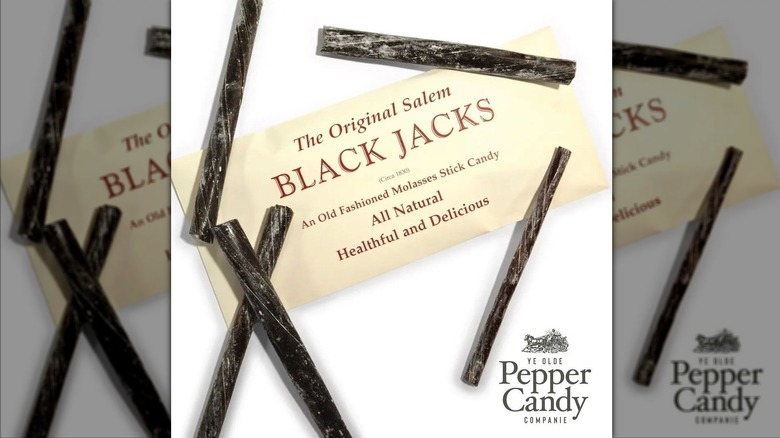
Mary Spencer certainly made a name for herself after creating peppermint and lemon Gibralters, but the Spencer family was inspired to invent another famous treat called Black Jacks. They got help from their neighbor, John Pepper, who was also a candy maker. Together, they crafted a candy recipe that would be seen as more "masculine" than Gibralters. The sole flavor was blackstrap molasses.
According to Ye Olde Pepper Candy Companie, Black Jacks were the first candy sticks produced and sold across America. The good news is that you don't need to be a rugged lumberjack or fisherman to enjoy an old-fashioned Black Jack. However, you shouldn't expect Black Jacks to be as sweet as a classic treat like molasses spice cookies because the candy is far more nuanced. Black-strap molasses is earthier and bitter, so it's a candy you'll never forget. If you can't make it over to Salem or Andover, Massachusetts, you can also order Gibralters and Black Jacks on Ye Olde Pepper Candy Companie's website.
Necco Wafers (1847)
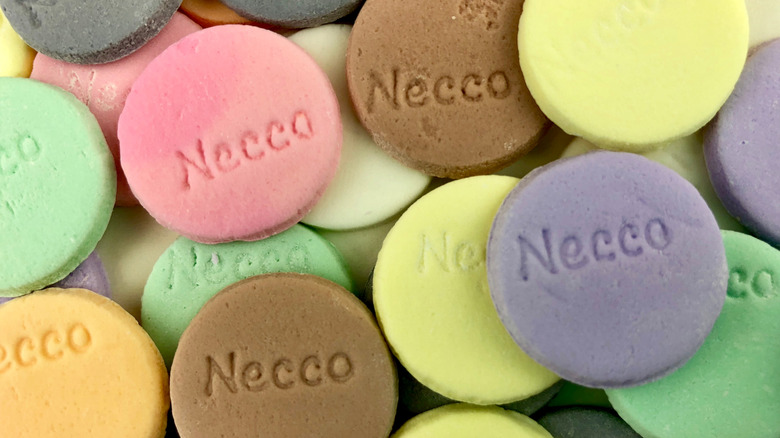
The untold truth of Necco Wafers is fascinating, as this New England candy dates all the way back to 1847. They're technically not a traditional hard candy, but they deserve an honorable mention because they are super dense and crunchy. The wafers are more chalky than crackly, but plenty of folks suck on them to savor the unique flavors. Compared to modern candies, they're not very glamorous. Some folks even compare them to communion wafers. Still, New Englanders are very protective of this bizarre yet charming candy.
Perhaps the biggest reason why these wafers are divisive is that too many conflicting flavors are crammed into one package. Plus, the colors are not what you'd expect them to taste like. For example, instead of pink tasting like strawberry or watermelon, you're shocked when wintergreen hits your tongue. Working your way through a package allows you to experience minty, chocolatey, fruity, and spicy all at once. They're not for everyone, but they're an incredible window into the dawn of American candy making.
Strawberry bon bons (mid-1800s)
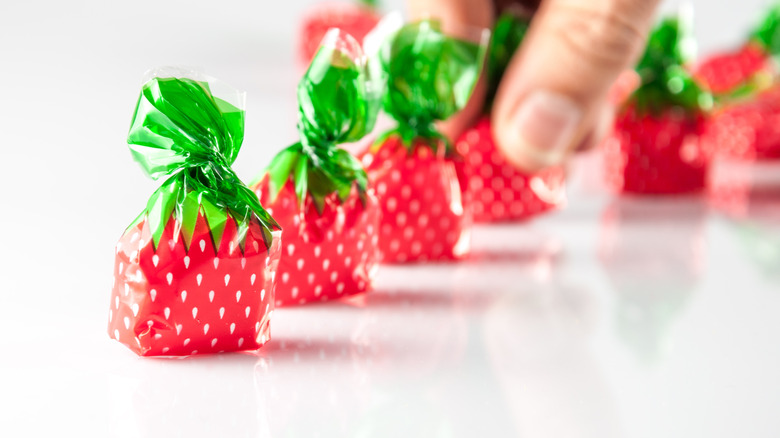
We need to share the truth about your grandma's favorite strawberry candy. Remember those little candies wrapped in the red paper with yellow speckles and a green, crinkly top designed to look like mini strawberries? Reading a description will likely conjure childhood memories for plenty of folks. Once you unwrap one and pop it into your mouth, you're greeted with an artificial strawberry flavor. The outer shell is hard candy, and the center holds a soft, chewy surprise once you suck long enough, or dare to crunch into it. Those candies, friends, are called strawberry bon bons.
Bon bons were created in France, perhaps as early as the 1600s, yet the hard-candy bon bons we know — and kind of love today — may date back to the mid-1800s. We may lovingly tease our grandmothers for being the only people who buy these candies, but hilariously enough, they may have dissed their grandmothers when they were young, too. Apparently, strawberry bon bons had an old-fashioned reputation even in the 1950s. Maybe our fate always leads us back to strawberry bon bons once we reach a certain age.
Jawbreakers (early 1900s)
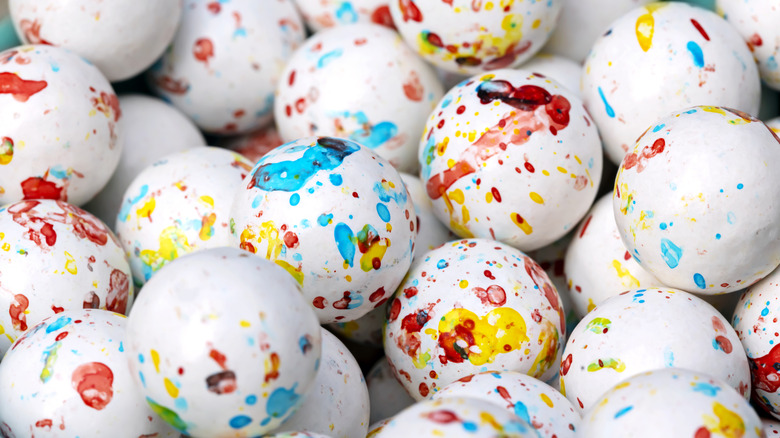
Surprisingly, we don't know the exact year jawbreakers were invented, but we know they've been around since the early 1900s. Two brothers, Thomas and James Bowers, grew up surrounded by candy because their father was a maker. When they got older, the pair developed jawbreakers and sold them at their candy shop. By 1969, jawbreakers caught Hershey's attention, and the candy giant added them to its portfolio. The name was a brilliant marketing move, because it challenged kids to make it out of the experience with their jaws intact.
Learning how jawbreakers are made is mesmerizing and makes you appreciate the candy even more. Manufacturers start at the center and work their way out. Some jawbreakers have a titillating sour center, while others have a bubblegum center. Either way, making it that far can actually teach kids patience — in a fun way.
Jawbreakers come in a range of sizes. If you grew up during the 2000s, then you likely saw "Ed, Edd n Eddy," in which three boys were always hunting for jawbreakers bigger than their heads. While any kid who watched that show had to face the devastating fact that they'd never be able to cram one that big into their mouth themselves, it's nice to choose how much energy you want to put into sucking on one before you reach the yummy center.
Werther's Original (1909)
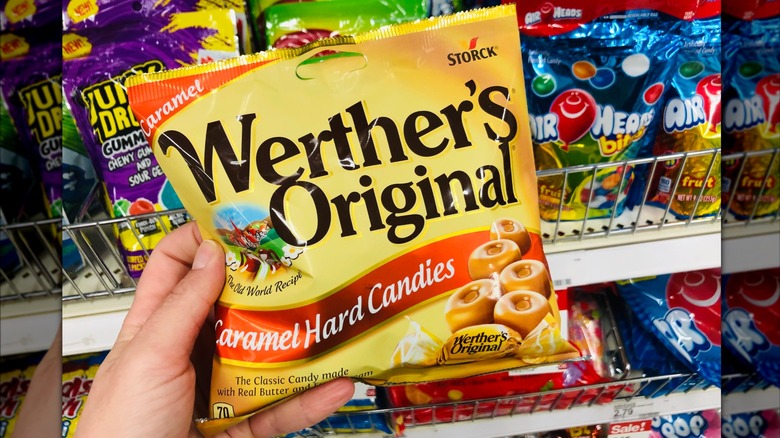
Werther's Original is another hard candy with a vintage reputation. Like strawberry bon bons, people like to dunk on Werther's as something you'd find at the bottom of grandma's purse. However, once you pop one into your mouth, you can't even pretend to suffer. Unless you're a bona fide caramel hater, Werther's Original is such a sweet, simple treat that can keep you occupied for 10 minutes. As controversial as this may be to some, Werther's even landed first in our ranking of hard candies.
We've all spotted Werther's Original when we're hunting for candy at the grocery store. You may not snack on them regularly or sneak them into the movie theater, but you'll always be grateful if someone offers you one. What you may not know, though, is that these caramel hard candies were invented in Werther, Germany, in 1909. The wild part of this story is that it took around 70 years for this candy to debut in America. How can such a fairly new candy carry such an old-fashioned stereotype? The brand thought it would be brilliant to market the candy as something cool grandparents hand out to their grandkids in 1989. Perhaps this was a risky move, but it paid off by making a new candy feel nostalgic and comforting.
Life Savers (1912)
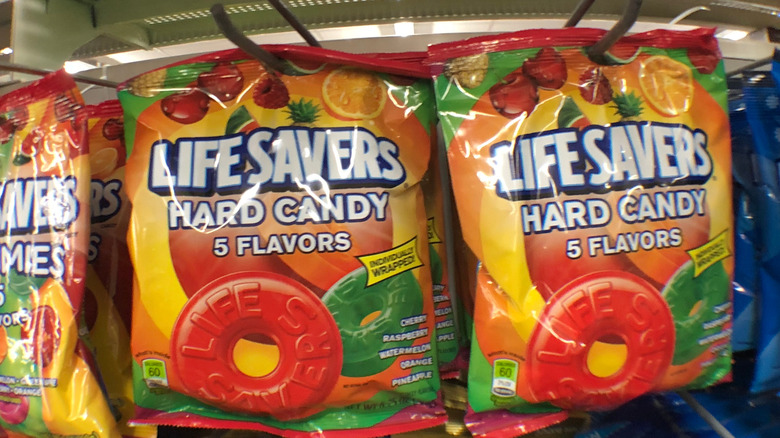
A candy's name can make all the difference in whether people try it. With such a dramatic name, who could ignore Life Savers when they hit stores in 1912? The first flavor was mint, and maybe the name is justified because they've saved so many people from embarrassingly bad breath. In 1921, Life Savers released lemon, lime, and orange to add more zest to people's lives, literally. The brand stayed popular enough to introduce two more flavors in 1935: cherry and pineapple. These five fruity flavors were then packaged into the famous five-flavors rolls.
Now, many of us have wondered why there's a hole in Life Savers. We may have heard random stories about kids choking on candy, and that a hole in the center lets enough air into your lungs if you accidentally swallow a Life Saver. But simply put, the creator of Life Savers added the hole in the center to set the candy apart from competitors. He realized that the candy looked like it belonged on a boat, and that's where the name came from. In addition to looking intriguing, it's also fun to run your tongue across the candy while you savor it. It's no wonder people have been enjoying Life Savers for over a century.
Claeys Old Fashioned Hard Candy (1919)
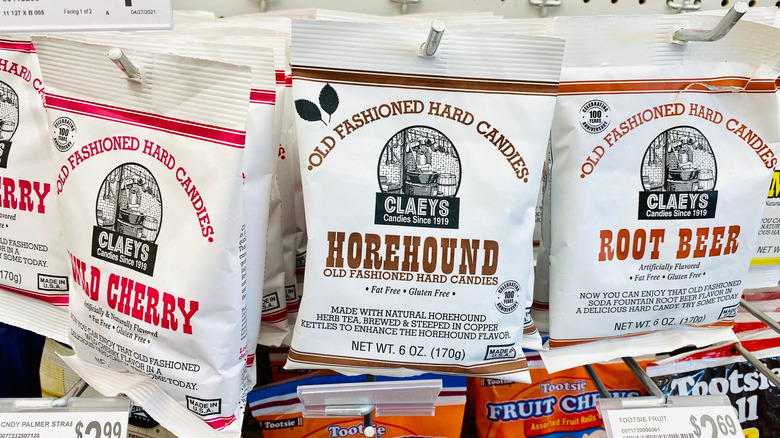
Most would agree that a garage might not be the best place for a candy business, yet that's where Claeys Candy began in South Bend, Indiana, in 1919. Since the products were so tasty, the owner, Jerome C. Claeys, was able to move into larger buildings. Claeys developed several unique candies, including a marshmallow and peanut chocolate named after Charlie Chaplin. One of Claeys' most popular candies still around today is its array of hard candies. There are a dozen flavors to choose from, including sassafras, watermelon, wild cherry, anise, and horehound.
Until 1970, every candy was handmade. Although production methods changed after the brand became popular, the recipe is still old-fashioned. Even the packaging is nostalgic, with each bag boasting the words "old fashioned" at the top, plus a vintage black-and-white drawing of Claeys mixing a batch of candy. These candies may or may not be in your local grocery store, but if you keep your eyes peeled, you can spot them in general stores and even hardware stores.
Jolly Ranchers (1949)
Many folks love a good story about a power couple, yet Jolly Ranchers' history isn't widely known. Bill and Dorothy Harmsen were a couple with endless ambitions from Minnesota who moved to Colorado in 1942. Bill built a career as a commercial pilot but decided he wanted to branch out. Dorothy grew and sold flowers and fruit. The couple owned a farm where they also did woodworking projects. Eventually, they focused more on food and opened an ice cream shop in Golden, Colorado.
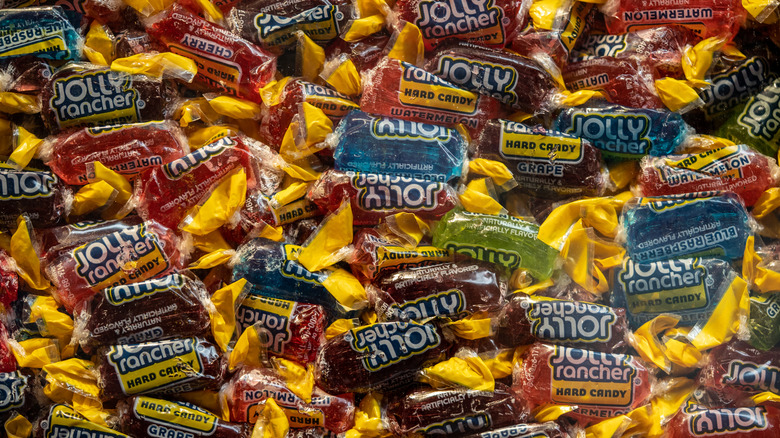
To boost profits, they added chocolates and candies to their offerings. Their candy sales grew so large that they opened franchise stores and even remodeled their home to run the business there. They named the company Jolly Rancher. It's fascinating that an entire company name could slowly morph into one specific candy product in the public's mind over time. Technically, the label reads Jolly Rancher hard candy.
In 1996, Hershey's reached out to partner with Jolly Rancher to make the candy an even bigger national sensation. With Hershey's vast resources, the brand expanded its product lineup to include more beloved treats like lollipops, ropes, and gummies. Today, the hard candies we know and love come in 14 fruity flavors. Hershey's has reported that watermelon is the ultimate fan favorite, but our ranking of Jolly Rancher's flavors concluded with blue raspberry in first place.
Atomic FireBalls (1954)
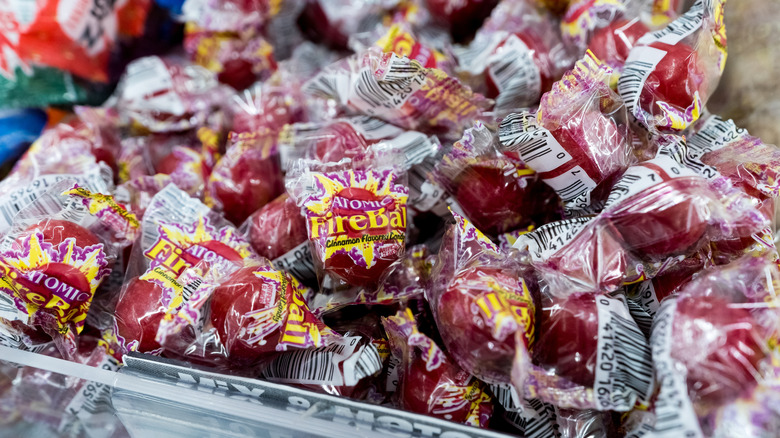
As it so happens, Atomic FireBalls became one of the most popular candies Americans ate in the '50s. Their legacy endures, and folks still enjoy the spicy cinnamon flavor today. The candy's name, though, deserves a deep dive. As you might suspect, Atomic FireBalls are fully inspired by nuclear explosions. During the '50s, Americans were endlessly mesmerized and terrified of this new technology. Naming a candy after something so dangerous was a gamble, but it quickly became the company's top-selling product.
An interesting bit of context is that Americans were exposed to a lot of fireball imagery because of nuclear testing. Although dark, Atomic FireBalls got free press that way. If people started associating the endless news stories with delicious candy, perhaps they'd crave it more.
The invention was brilliant because both kids and adults could enjoy them. They had the allure of a jawbreaker, and the cinnamon heat appealed to mature palates. Plus, they were smaller than many jawbreakers, so they were a more sensible quick treat. People loved them so much that they eagerly bought big boxes containing 120 Atomic FireBalls.
Lemonheads (1962)
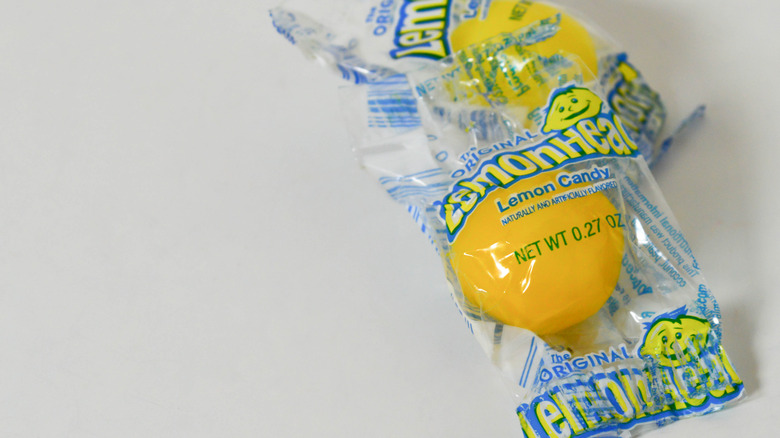
Lemonade is a beloved drink because its tanginess and sweetness blend perfectly. It's refreshing enough to stop after a small glass, but you also won't feel too overwhelmed by the sugar if you have another serving. Adding some tartness to candy can be beneficial in the same way. When Lemonheads were introduced in 1962, people were delighted by the sweet outer layer that gave way to a sour middle layer, then ended on a sweet note in the center. Ferrara Candy achieves these layers and crunchy textures through a technique called panning. It involves agitating the candy in big, spinning drums and drizzling the ingredients to build a shell.
You should also know the bizarre way Lemonhead candy got its name. When a child is born, parents are usually swept away by their creation, marveling at the child's cuteness. Nello Ferrara; however, reacted differently. The first glimpse of his newborn son shocked him, because he truly believed his son had a lemon-shaped head. The son, who eventually inherited the company, would laugh when he retold this story and was said to eagerly invite people to examine his head. What an observation to inspire an iconic American candy, though.
Warheads (1975)
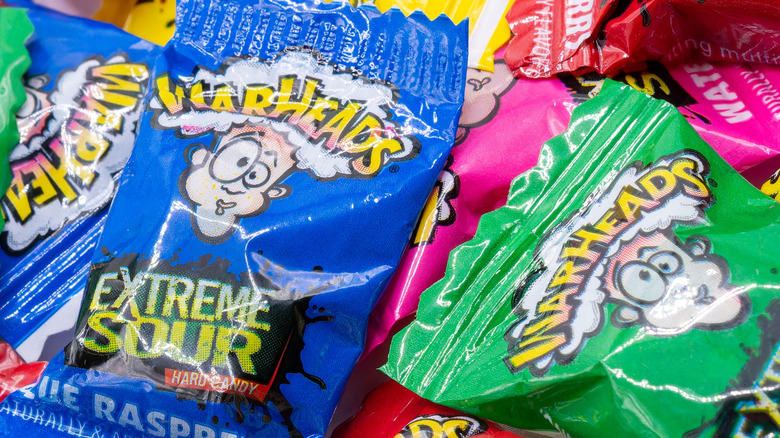
Warheads are one of the wackiest inventions on this list because so many people love hurting themselves with them. They tear our mouths apart, and yet we can't stop inflicting them upon ourselves. It's always a delight when you encounter someone who's never tried one and watch their expression contort the second it hits their tongue. The candy industry needed time to concoct something so bold, so it's probably not shocking to learn that Warheads debuted in 1975. The unexpected country Warheads originated in is actually Taiwan.
Warheads couldn't start tormenting Americans until 1993, but boy, did these candies make a splash. If people could get through the initial blast of malic acid attacking their taste buds, they were then treated to tasty flavors like watermelon, black cherry, blue raspberry, lemon, and apple. The shock lasts only a few seconds, yet it's so visceral that your mouth may be watering just thinking about Warheads.
Everlasting Gobstoppers (1976)
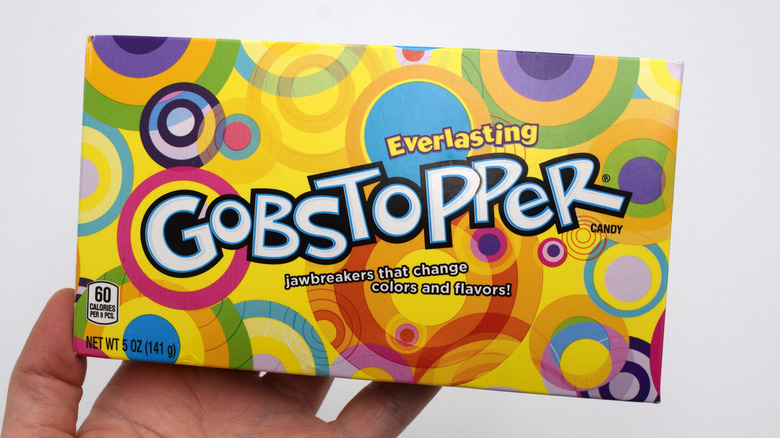
How many times have you read a book with a food description so fantastical that you wish you could try it? Whether it's lembas bread from "The Lord of the Rings" or green eggs and ham from Dr. Seuss's book with the same name, wacky food inventions are a simple joy. Sometimes, if we're lucky, these fictional foods become a reality. Kids who wished with all their might to get their hands on an Everlasting Gobstopper from "Charlie and the Chocolate Factory" had to wait 12 years after the book's release and five years after the movie adaptation to finally unwrap one.
Gobstoppers are like jawbreakers, but the major difference is that Gobstoppers have distinct, colorful layers, each with its own unique flavor. As the Gobstopper dissolves and reveals a new layer, your tongue gets stained, and your taste buds experience a new profile. While real Gobstoppers eventually end, they pay homage to the fictional ones that offer endless fun. To ensure each layer is distinct, candy makers have to let the layers dry completely before adding another. The whole process can take a few weeks, so it's a labor of love.