

The Truth About Bologna Meat
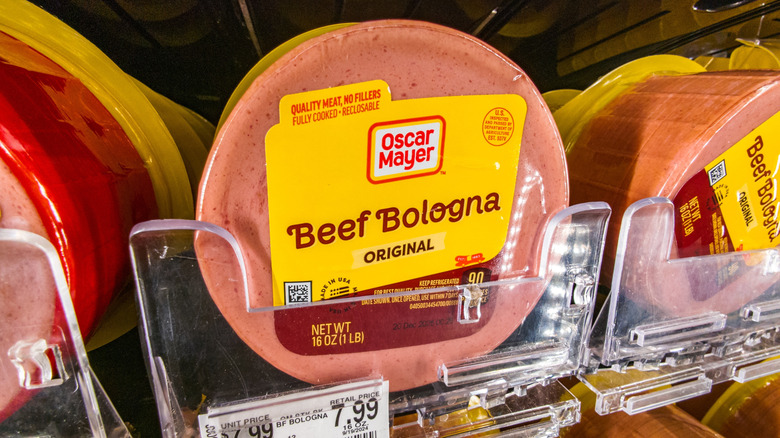
For many people bologna is a nostalgia food, like Campbell's chicken noodle soup, Spaghetti-Os, or the bright blue box of Kraft Macaroni and Cheese you remember from your childhood and still occasionally enjoy today. More than likely, bologna sandwiches were a non-negotiable part of summer time, and also a major part of school lunches. Growing up, you had a few choices of meals that your parents would pack you in your lunch box (if you didn't have a Thermos full of mystery leftovers). A tuna sandwich (which was the worst), a plain American cheese sandwich (also the worst), a peanut butter and jelly sandwich (just plain boring), or if you were #blessed that day, you'd dig in your brown paper sack or your Evel Knievel lunch box and you'd discover a bologna and American cheese sandwich — and life was good.
Due to this nostalgia, and also because hipsters have to hipster, bologna is suddenly cool again. Bust out your Oscar Mayer, your Miracle Whip, and your white bread, and get ready to learn all the deep dark secrets of this round pink delicacy.
Bologna started off as fancy mortadella
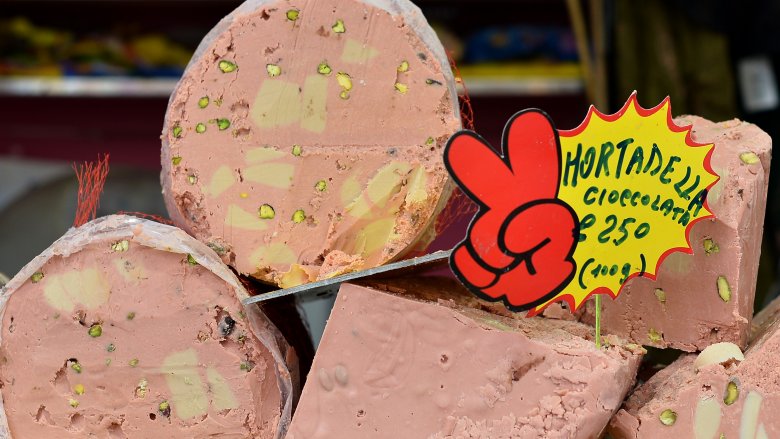
Bologna may be a low-cost lunch meat today, but its roots are lot more fancy. In fact, bologna is the great-great grandson of the Italian's mortadella. Mortadella, much like bologna, is made from finely ground pork meat. Mortadella is then cured and cooked in a low temperature oven before it's packaged.
The main difference between bologna and mortadella is that mortadella also contains added fat or lard, which gives it that marbled appearance. Mortadella also sometimes has pistachios or green olives in it — sort of like a fancy version of bologna's olive loaf. Mortadella also contains a lot of spices, and at one point it was considered a food for the rich and powerful, due to the cost of the spices used in the production of it.
Yes, the standard grocery store bologna you'll find pre-packaged in your grocer's refrigerated cold-cut section doesn't contain a lot of spices (which helps it be a lot more palatable to your average third grader), but if you visit a meat market and buy sliced bologna you will probably be able to discern pepper and coriander and garlic.
So what exactly is bologna made of?
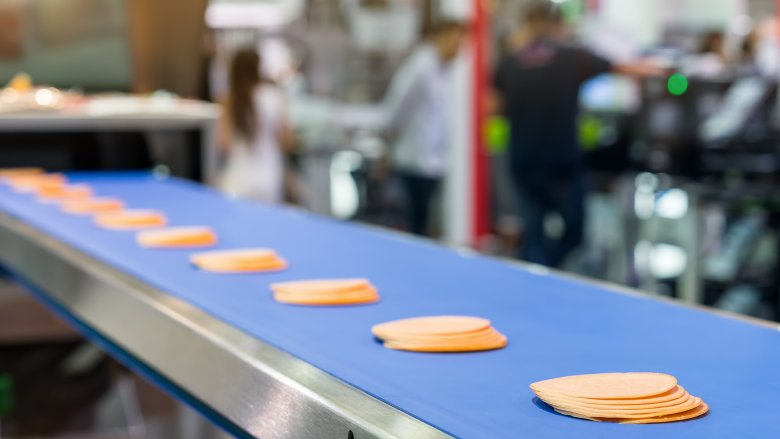
Bologna has always been known as kind of a mystery meat, but it doesn't have to be — let's gaze behind the curtain and see exactly what bologna is made of.
When you purchase lunch meat like ham or roast beef at your deli, you basically see what you are getting. Ham looks like ham. Turkey looks like turkey. That's not quite so with bologna. You can't quite tell exactly what it is. There's a reason for that.
The FDA requires that all bologna be created in such a way that it's ground into tiny particles, which makes it so that consumers can't discern any fat or spices. Essentially, the result of this process creates a "meat batter." What goes into this meat batter? Beef, pork, turkey, chicken... or all of the above.
One of the most common varietes, the Oscar Mayer brand, is made from mechanically separated chicken and pork. The USDA explains "mechanically separated meat is a paste-like and batter-like meat product produced by forcing bones with attached edible meat under high pressure through a sieve or similar device to separate the bone from the edible meat tissue." Or to put it another way, don't think about how your bologna is made or what exactly it's made from, and just sit there peacefully and eat your sandwich.
Why do we pronounce bologna like baloney anyway?
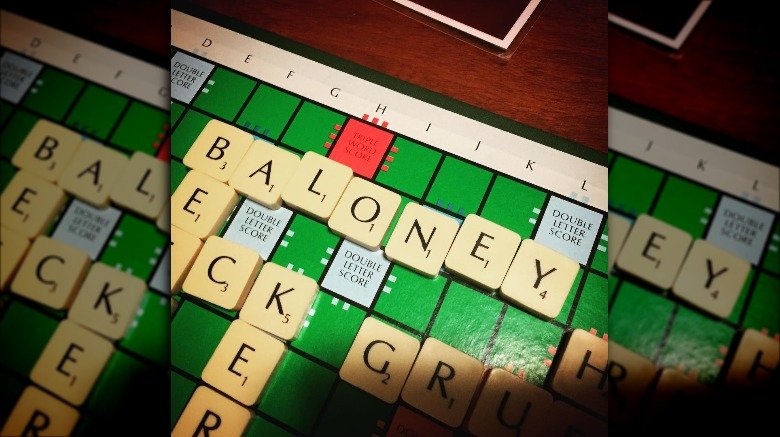
Bologna comes from Bologna,Italy. So why we pronounce it like "phony" or "pepperoni" is a mystery. It's not like you would hear a travel agent booking you a ticket to Baloney, Italy.
According to word expert Ben Zimmer, we may have started pronouncing bologna incorrectly partly because in the 1920s, "sportswriters in particular were looking for funny words to describe these lumbering boxers and whatever connection they were making to the sausage ― whether it was that they had sausage for brains or they kind of looked like big sausages ― it served its purpose as a funny-sounding word." And when you consider how this word has evolved to describe "nonsense," pronouncing it like the city in Italy isn't nearly as evocative as adding that "nee" sound to the end of it.
There are more long-winded theories on Reddit that basically boil down to the fact that bologna became baloney because Americans pronounced it wrong and eventually it caught on — another very plausible theory. The one thing that most people can agree on, is that if you can remember the classic Oscar Meyer jingle from the 1970s, then you definitely know how to spell b-o-l-o-g-n-a... even if you might not say it correctly.
Bologna became popular when kids started bringing lunches to school
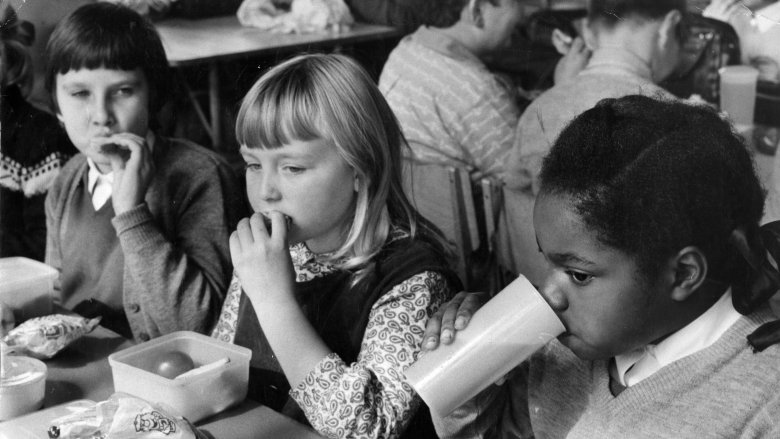
During the early 1900s, most kids went home for lunch. By the 1920s and 1930s, many schools had a lunch program where children were either given free meals or meals that cost pennies. During this time, guidelines about what constituted a nutritious lunch were quickly changing, but schools did their best to keep up.
How did bologna become such a popular lunch time staple? It had a lot to do with the fact that in 1946, President Truman signed the National School Lunch Act, which established the National School Lunch Program. The National School Lunch program provides low-cost or free lunches to children each school day. Because bologna is a low-cost food, it ended up on a lot of lunch trays and in a lot of lunch bags. Around this same time grocery stores began offering "fresh foods" that were packaged to have a longer shelf life than they had previously. Bologna was a lunch meat that was relatively inexpensive, able to be kept fresh, and appealed to the taste buds of children. What more could schools and parents want?
The great bologna red string debate
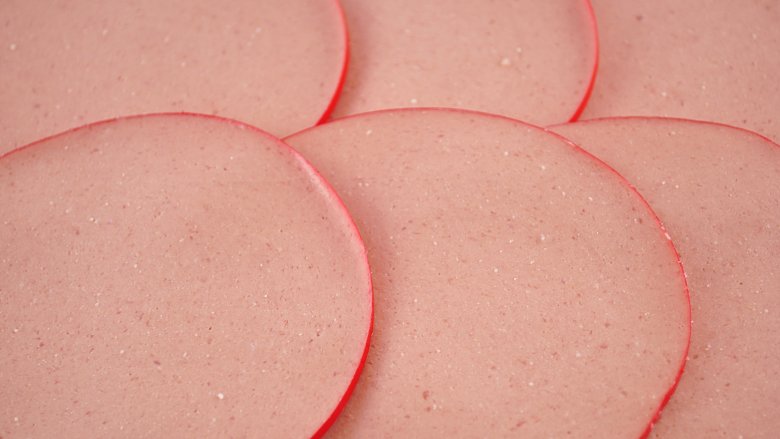
Packaged bologna sometimes comes with a red string or seal around it. What exactly is that stuff, and can you eat it? It might be a casing made from the gastrointestinal tracts of cattle, sheep and hogs — which makes it slightly gross, but still edible. If it's bright red though, it's most likely a synthetic casing, which may be made from collagen, plastic, or other fibrous material. Not all bologna has this red casing, and sometimes it's removed before it's sold in stores. So which does yours have?
On Facebook, when confronted with this question, Oscar Mayer replied "Yup, all the bologna in the package purchased is good-to-eat," though questions about specific products went unanswered. While red synthetic casings may or may not be edible, it's probably safer to remove them before consumption if they peal away easily, unless the packaging specifically states that they're edible. There's a good chance that they're not, and that's a chance you probably don't want to take. A little bit of plastic isn't going to do much to make your sandwich taste better, that's for sure.
Eating bologna may or may not give you cancer
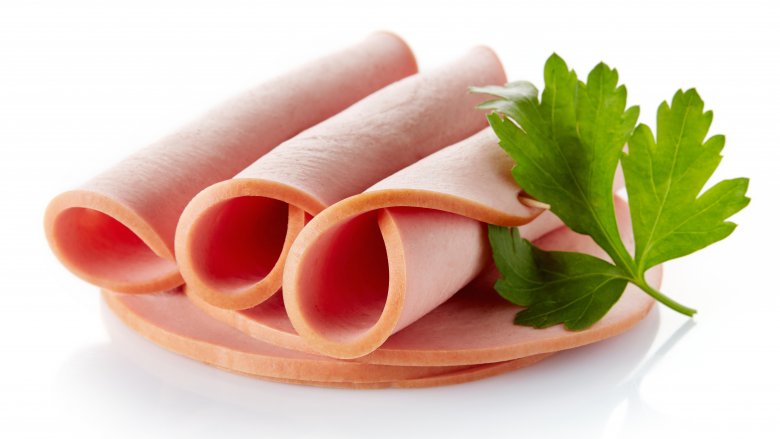
It's common knowledge we should all be trying to limit processed foods, including lunch meats like hot dogs and bologna. But how bad is bologna for you?
Well, for one thing, it's got a lot of salt and fat. One slice of bologna contains 7.9 grams of fat and 302 milligrams of sodium, about 13 percent of your entire daily intake.
The real risk, though, lies in the nitrates in bologna, and processed foods like bologna are frequently cured by adding sodium nitrate to them. Nitrates can help stop food from spoiling and botulism-causing bacteria from growing. The big downside to eating processed deli meats is that the International Agency For Research on Cancer concluded that each 50 gram portion of processed meat eaten daily increases the risk of colorectal cancer by 18 percent. Even though that risk is somewhat small, eating less processed meat can decrease your bowel cancer risk.
This basically means that bologna should be a sometimes food if you simply can't resist the urge to indulge. The World Health Organization has classified processed meats as a Group 1 carcinogen, like cigarettes and alcohol — which means they recommend it should be avoided entirely. Depressing news, but better to be safe than sorry and swap out your bologna sandwich for peanut butter on occasion.
Bologna may be used as a form of punishment
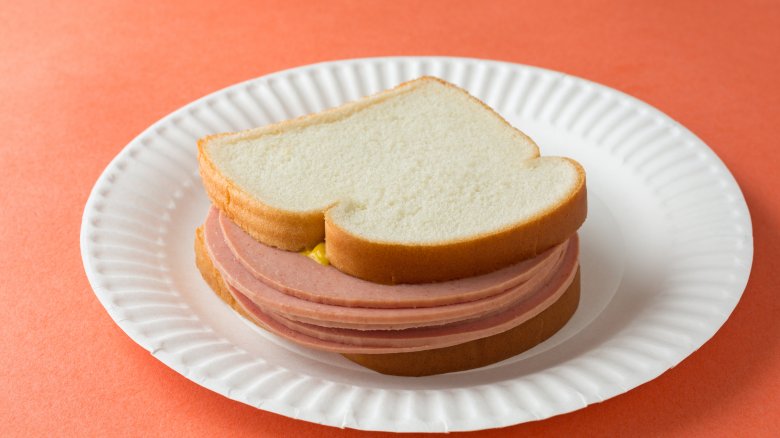
Even if you are a huge bologna fan, the idea of being locked up in the Dakota County Jail sounds pretty awful because bologna is all you get. The jail serves two turkey bologna sandwiches and a small side dish of fruit per inmate, seven days a week, 365 days a year. Even on Christmas.
In Alabama, a sheriff was locked up after feeding the inmates at his jail grits and paper-thin bologna sandwiches. Wardens in Alabama are allowed to pocket money left over from providing inmates with meals, and bologna is a very inexpensive choice to feed inmates.
In Alaska, two Muslim inmates were fed bologna sandwiches during Ramadan and later sued for having their civil rights violated.
Infamous Maricopa County Sheriff Joe Arpaio not only makes his inmates wear pink socks and underwear, but he has also boasted about serving them rotten food, including green bologna. Most prisons allow access to vending machines and canteen services where incarcerated people can supplement these meager mealtime offerings, but all that talk about bad bologna is enough to make anyone rethink any illegal activity that may result in jail time.
Bologna has been used as a weapon
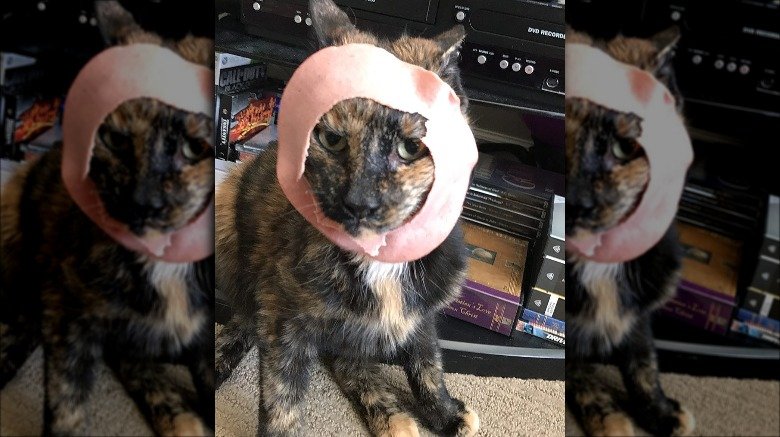
People do some very bizarre things with bologna.They put it on their pets. They throw it at their friends. And some people urinate on it and leave it on their neighbor's doorstep. Well, at least one guy does. According to KOB4, a mystery man in Albuquerque was leaving bags of bologna and white bread, that smelled suspiciously like urine, on the doorknobs of the residents in one neighborhood.
Another bizarre prank involves putting slices of bologna on cars so when the bologna is peeled off, the paint also gets stripped off. It's not guaranteed that this prank actually works, because a YouTube video suggests otherwise. Bologna was left on that car for twenty hours and no damage can be seen.
Bologna shouldn't be used for any of these things. It should be kept safe and cozy between two slices of bread and never used as a weapon — or as a hat for your adorable cat.
Restaurants are serving bologna sandwiches in honor of Trump
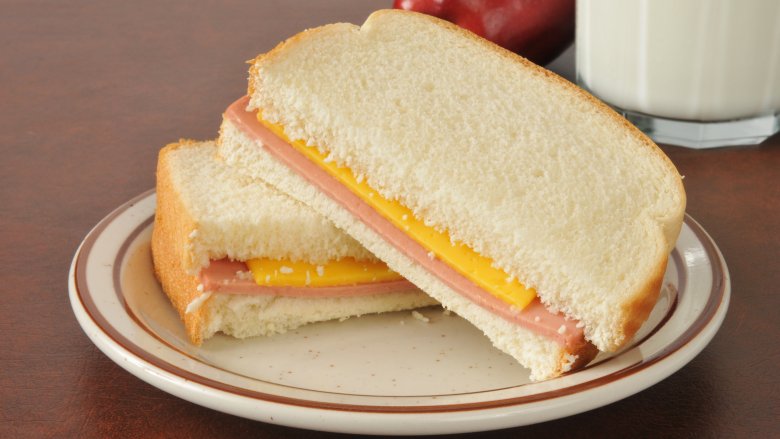
Make America grub again because grub is food and lunch is food... and all over the world people keep making sandwiches in honor of President Donald Trump. And what do these sandwiches contain? Bologna.
The Donald is not the first president to be associated with bologna. President Bush was said to order bologna sandwiches with a side of Doritos when he stayed at the Waldorf Astoria in New York City. Barbara Bush handed out bologna sandwiches at a soup kitchen in Washington. President Obama served bologna sandwiches at a D.C. nonprofit that serves low-income families.
But restaurants from New York to Sweden are serving up the Donald Trump special which is, "white bread, full of baloney, with Russian dressing and a small pickle." Don't look for Trump to be ordering this delicacy anytime soon, because he has said his favorite sandwich is a meatloaf sandwich.
Let's all make bologna salad
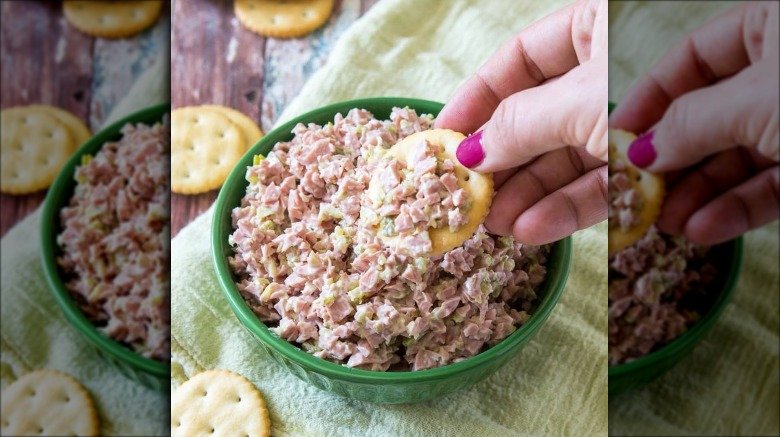
If you thought the only way to eat bologna on a sandwich was to open the package, pull the little red string off, and slap it into bread you'd be sadly mistaken, because you can also enjoy the down-home deliciousness of bologna salad.
Nobody knows exactly where bologna salad came from. It may have just been an offshoot of ham salad when a clever housewife only had bologna in her refrigerator in the 1950s so she decided to whip that into a bologna salad. But everyone knows someone who has a grandma or an aunt or a cousin who made this. Bologna was cut up and mixed with mayonnaise and pickle relish and sometimes celery. Then you either ate it on white bread or with crackers.
If you read a recipe online, a lot of the comments are "I ate this growing up" and "Wow, I thought only my grandmother made this." Nostalgia food at its finest. You're going to make it now, aren't you?
Here's how you make bologna cake
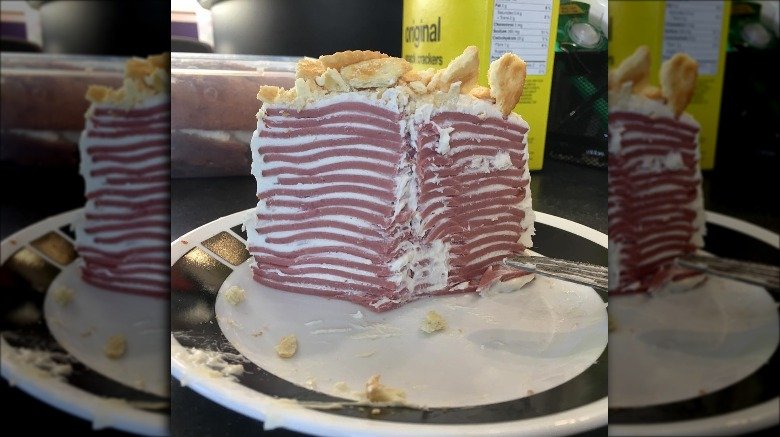
For those of you who want more bologna with your bologna, why not whip up a delicious, creamy bologna cake?
This cake resembles a normal cake, until you slice into it and reveal layers of bologna with a zesty cream cheese and ranch dressing frosting between the meat layers. If you think it couldn't get any better than this you'd be so wrong because you also decorate this deliciousness with cheese. IN A CAN. That's right, you decorate the cake with aerosol cheese. Serve it up with some yummy buttery crackers or cocktail bread and watch your friend's faces light up.
Who needs a plain old cheese ball when you can have a cheese and bologna cake? This fantastic cake was even mentioned in the Reese Witherspoon movie Sweet Home Alabama. Sounds like a pretty delicious football game treat or something to eat with a nice cold can of PBR.
The bologna of your childhood
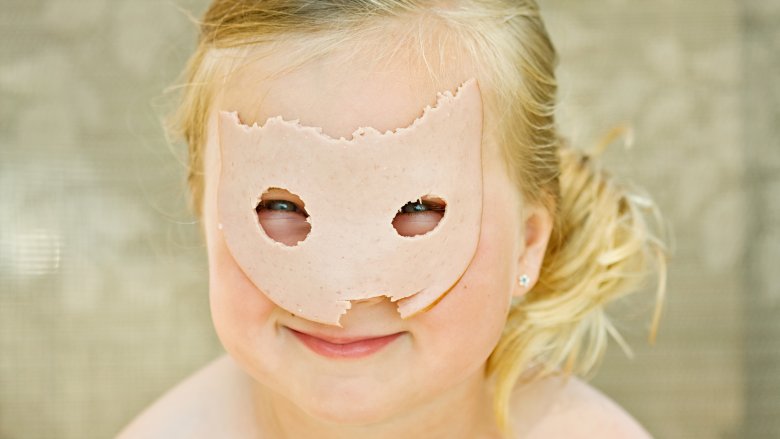
Part of the appeal of bologna, besides the fact that it's inexpensive and can be found in almost every supermarket or convenience store, is that it has a pretty big nostalgia factor for a lot of people.
IwasIamka on Reddit says "I ate bologna as kid in the 70s occasionally. On white bread, washed down with Tang." Whitesttrash says "Fry it in a skillet and put mustard on it on bread. Best sandwich ever."
Sadly, a lot of people hate the bologna from their childhood as well. On Reddit, Overshadows says "I was probably 7, and it was disgusting. I remember judging my friends family... because really, how much more expensive would turkey have been?" and a user by the same of Pink_Mango says "I had a bologna sandwich just about every day for lunch for like 4 years in elementary school. Bologna grosses me out now. Which is too bad because I remember it being very yummy, but I definitely ate my entire lifes share already." AnytimeYoga says "The last time I couldn't: 1) buy lunch; 2) skip lunch; 3) pack my own lunch; 4) barter with someone for something I liked better; 5) convince our lunch supervisors that picking out the bologna and eating the mustardy bread was good enough." There's a lot of bologna hatred out there.
Bologna sandwiches are hella fancy now
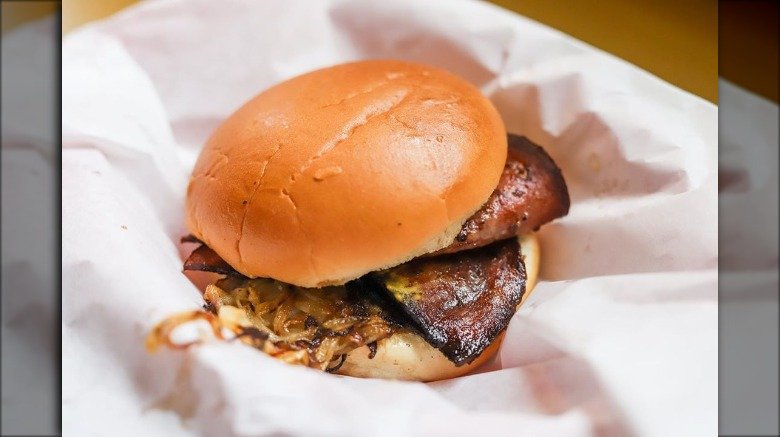
No longer relegated to the category of desperation lunch, bologna sandwiches are suddenly the hippest thing since sliced bread.
Turkey and the Wolf, a restaurant in New Orleans, makes theirs like this according to Bon Appetit, "three slices of locally made bologna were griddle-fried, blanketed in American cheese, and stacked on thick-cut, butter-griddled Pullman slices with house-made hot mustard, Duke's brand mayo, and 'shrettuce' (what Mason calls shredded lettuce). It was further crunchified with two fistfuls of vinegar-brined potato chips." Are you drooling yet?
Food and Wine interviewed chefs who are serving upscale bologna sandwiches, and Chef Matt Bolus said this, "Growing up, my grandmother would always fry our bologna sandwiches; that's because fried bologna is good for your soul. Cold bologna can be just as delicious when done right. I mean, really, all bologna is good for the soul, it's the food of the people."
Good for the soul, whether you are enjoying a gourmet version for your next meal out, or eating a cold bologna sandwich over your sink, it's time we all started welcoming bologna back into our hearts and stomachs — in moderation, of course.
The big 2025 bologna recall demonstrated that different types of bologna require specific labeling
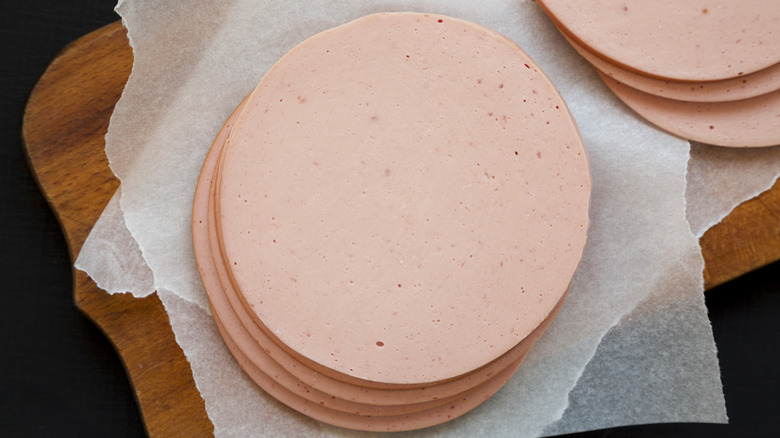
All the urban folklore about what really constitutes bologna meat was proven at least a little bit justified thanks to a fall 2025 recall. Around 143,416 pounds of the lunchmeat was pulled back due to undeclared elements that had been included in the mix. And you thought bologna was a catch-all cold cut that used all the leftover bits no matter where they came from.
Gaiser's European Style Provisions Inc. produced the bologna between March 20 and June 20, 2025. Seven different products rolled off the assembly line with pork, chicken, and beef ingredients that failed to show up on package labels. Though the FSIS (Food Safety and Inspection Service) hadn't received word of customers encountering adverse health reactions to the bologna in question — and also didn't expect that there would be any — the recall did recommend that anyone who might feel they'd been adversely affected should call their medical providers to follow up.
The European-style bologna products were considered "misbranded," though the components in question are often found in bologna. By not ensuring proper labeling, the company ended up confirming that although its sliceable deli loaves may contain a mishmash of meats, there's a protocol for making sure each type of bologna wears its proper ingredients on its packaging. So, you can't just toss a bunch of meat items together and call it bologna unless you keep track of what went into the recipe. Lesson learned.
The bologna market just keeps growing and growing
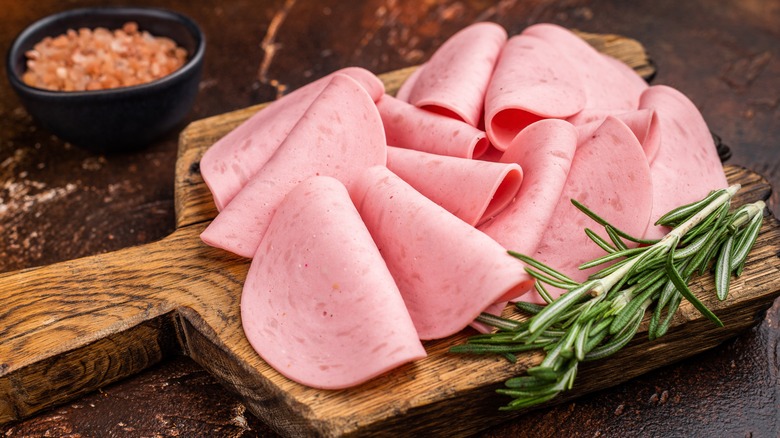
If you think bologna is just a vintage pleasure, taking a peek at how sales have increased should clear things up. Somehow, this so-so sandwich filler just keeps rolling onward and upward, representing a value of $7.5 billion in 2023. That level is expected to rise by a respectable 5.1% between 2024 and 2032, bringing the market to a staggering $11 billion.
How does that break down into real-world numbers? The estimated average per-person consumption of processed meats including bologna as proposed by the USDA was a mindboggling 52.3 pounds in 2020. That may seem like an incredible amount of meat, but spread out over the course of a year it's really just 1 pound per week. Considering the number of options in the processed meat sphere, bologna has held firm.
What's causing this surge in bologna consumption? It's possible that nostalgia with a gourmet twist is a driving factor. So many dishes that made our younger years warm and cozy have made comebacks as adults who loved them, reinventing the basic recipe as something special. Think of how upscale mac and cheese has become, or the elegant reimagining of simple hot chocolate. Bologna may have been a lunchbox staple for decades, but now that culinary creatives have made charcuterie boards a dinner party standard, this humble sandwich slice finally has a seat at the grown-up table.
Producers are pushing a healthier version with uncured and grass-fed bologna
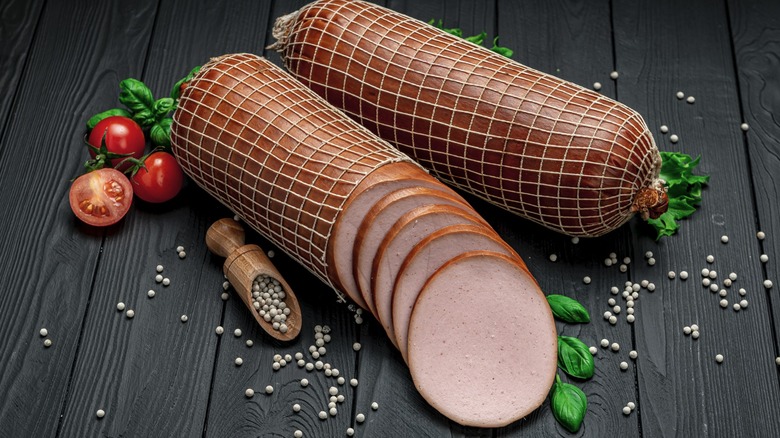
Higher quality is definitely a part of the bologna upswing, with producers trying to keep up with modern trends in the cold cut space. One of the more notable moves is removing common yet troublesome curing agents like nitrates. These additives have been identified as possible causes of inflammation. The removal of nitrates may not make the meat tastier, but at least it contributes to the nutritional profile.
Similar to steaks and ground beef, farmers are also aiming grass-fed cuts at bologna producers to elevate the concept of the cold cut. It may not be wagyu or aged beef that makes it into the grinder, but having more organically raised beef become savory sandwich fodder provides an aura of sophistication, bringing it closer to its original mortadella ancestor.
And just as soon as a product like bologna shows potential as a more sophisticated dish, clever chefs have taken to preparing it in more thoughtful ways. Some gourmets profess a love of smokingbologna, similar to smoking a ham. Rather than using slices, pitmasters purchase the entire loaf and treat it as a cut of meat. The result is a rich and flavorful upgrade to the basic bologna essence, which can then be incorporated into more complete meat dishes in place of pork or beef. Maybe a mistake everyone has been making with bologna all this time has been not treating it like the premium meat product it could be.
It's most popular in the Midwest and Southeast states
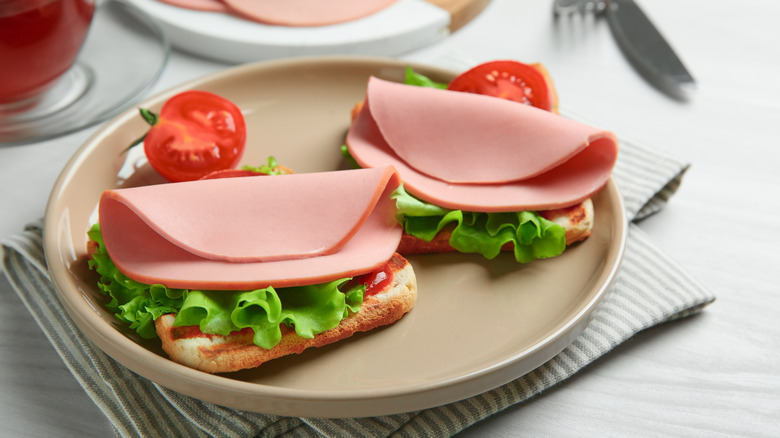
If it seems like bologna has greater appeal in certain sections of the U.S., that's because it does. Heartland eaters in the Midwest and Southeast pay more attention to the cold cut than finicky coastal eaters. But that doesn't mean the rest of the country gives bologna short shrift.
To determine which areas consume the most bologna in America, Oscar Mayer provides a map detailing consumption by pounds per person. The top eaters for 2024 turned out to be West Virginians, who took in the most of the brand's bologna products per person. With Tennessee and Kentucky following, tied for second, the trend in the farming states appears to be that bologna is a prime part of the local diet.
Beyond those three top states, the map still shows bologna is popular in most of the country. So rather than being the old-fashioned favorite that inspired its own theme song, Oscar Mayer bologna has remained a perennial favorite.
Like other beef products, bologna is becoming more expensive
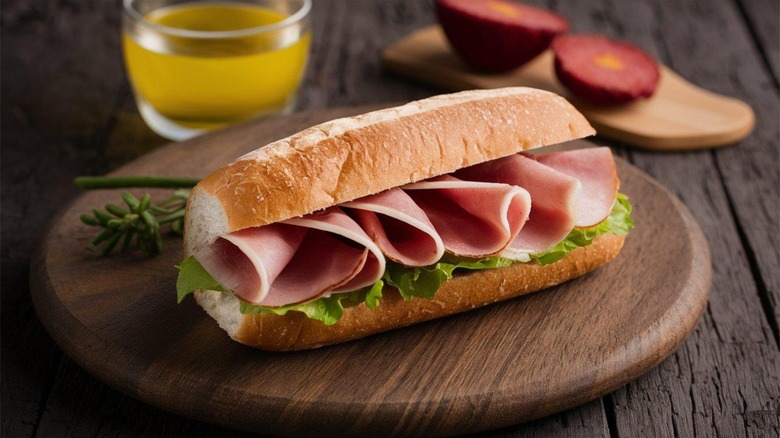
Beloved as a cheap meat, it's subject to the same inflation as higher quality meats, thanks to the inclusion of beef as a core ingredient. In 2024, Canadian grocer Loblaw's had its bologna priced at $32.90 per kilogram. It may have been a more premium version of the lunch meat sliced fresh in the deli, but at prices that steep, it should come with a bologna steward who makes your sandwich and feeds it to you.
In 2023, shoppers were reporting on Reddit that Publix stores had shelved the usual Oscar Mayer brand bologna at $7.95, which broke down to almost .50 per ounce. Commenters who chimed in were unanimous in their complaints that this was entirely too much to pay for an otherwise base level lunchmeat.
And if all of that happened before beef prices started their climb into nosebleed territory in 2025, you can imagine what bologna goes for now. A quick glance at Kroger Boar's Head deli sliced bologna shows $8.95 per pound. Walmart's Wunderbar pork and chicken bologna is considerably less, though still pricey at $4.95 per pound, while a simple 16-ounce package of Oscar Mayer beef bologna at Target was priced at $7.99. As with everything in times of rising prices, shopping around for the most affordable bologna seems to be a best practice.