

Can You Trust 'Local Catch' Shrimp At Restaurants?
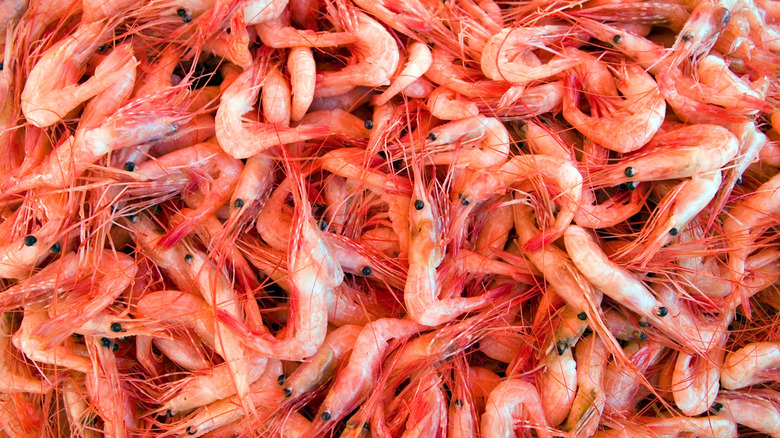
Seeing the phrase "locally caught" on a seafood restaurant menu is attractive — if you order this dish, that means you're supporting local fishermen and getting the opportunity to taste a regional specialty. Yet, can you actually trust that label? Unfortunately, "locally caught" is up there with vague and misleading phrases like "all natural" — it's not always true. And when it comes to shrimp, this claim can often be straight-up fraud.
In an ABC News 4 video report, it was found that in Charleston, South Carolina, a city famous for its seafood and shrimp industry, 90% of sampled restaurants were not serving locally caught shrimp as they claimed. At the 44 restaurants targeted in the investigation, a majority were serving imported, farm-raised shrimp, and only four restaurants were actually using locally caught shrimp. While retailers must label the country of origin for shrimp under federal law, this does not apply to restaurants. Those who make false origin claims (as well as implied claims), however, are in violation of the law under the Federal Trade Commission.
This issue is not unique to the Low Country. Gulf states like Texas, Mississippi, Louisiana, and Florida are home to huge shrimp industries. In this region, USA Today reported that a food safety company called SeaD Consulting found that the two cities with the greatest amount of mislabeling were Tampa Bay and St. Petersburg, Florida. Out of the 44 restaurants that were tested, 96% were serving imported shrimp; only two restaurants truly served locally caught shrimp.
Why do restaurants serve imported shrimp and label it as something else?
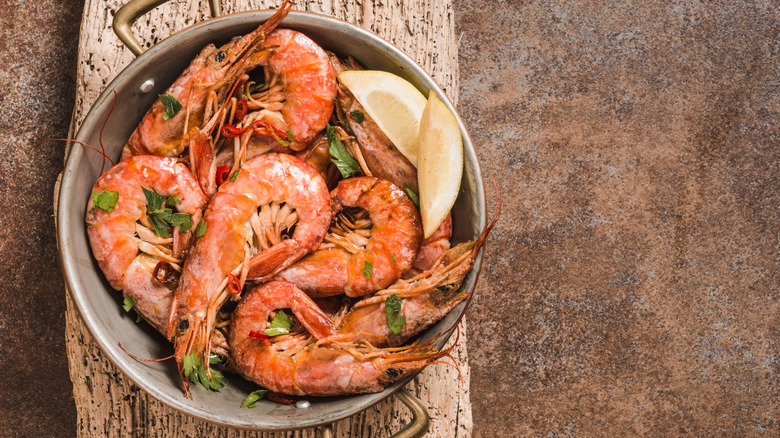
Looking at the seafood industry in the United States as a whole, these numbers aren't so surprising. According to the USDA, the United States imports 80% of all its seafood. Estimates of how much of this is mislabeled vary greatly, with the Center for Agriculture and Food Systems at Vermont Law School estimating that it may fall anywhere between 16.5%-75%. Aside from shrimp, another seafood often subjected to fraud is scallops.
Even if you're already aware of the shady secrets of the seafood industry, you still might feel angry finding out that a favorite restaurant of yours is not serving the locally caught shrimp you thought it was. If restaurants are blatantly mislabeling their menus to encourage higher sales through catchy labels, you have every right to be frustrated. However, it's not always the restaurant's fault. A good example of this is that a restaurant may have purchased shrimp from a local fish market, and while some of what the market sells is actually sourced locally, not all of it may be — and the restaurant may assume that everything is.
The meaning of "local catch" is pretty obvious to the consumer, and you'd be right to assume that shrimp with this label was caught in the body of water closest to wherever you are. But this label can also become contrived. If the shrimp was raised in a foreign farm, yet shipped, processed, packaged, and distributed locally, one could slap a "locally sourced" label on it.
How to know if your shrimp is locally caught
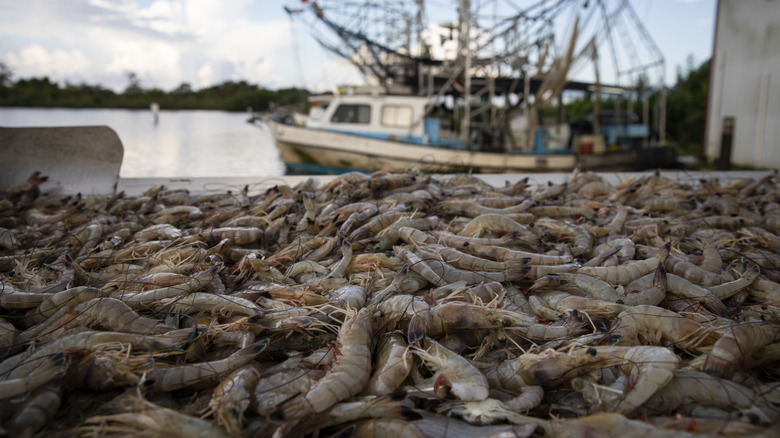
These numbers are disheartening. If you were to apply these average findings to restaurants across the country, then it would be safe to assume that most restaurants aren't serving locally caught shrimp. So how do you know which ones actually are? It's a challenging job for the diner to discern which shrimp is locally caught and which is imported — a visual inspection is not going to help much.
Wild-caught shrimp typically have a stronger, sweeter flavor and a firm texture with delicate flesh, while farm-raised shrimp may be less flavorful. This distinction is helpful when determining wild-caught vs. farm-raised, but without DNA testing (like what was conducted in the studies mentioned above), it's not feasible to pinpoint where exactly the shrimp came from.
Inquiring with restaurant staff is one way to start. Although the staff might not be aware, it doesn't hurt to ask if they know exactly where it was sourced. If the shrimp is not listed on the menu as a "local catch," don't assume it is. If it is labeled as such, it is fair to have your doubts. To be sure, you may be able to depend on local organizations that are in place to protect their local industries. For example, the South Carolina Shrimper Association has a list of restaurants, stores, and markets that do actually source and serve locally caught shrimp. With shrimp fraud making the news, this has led to more regional laws and restrictions. In Louisiana, a law was passed that requires restaurants menus to label if their shrimp has been imported.