

Is It Actually Illegal To Eat A Burger On Sundays In This Minnesota Town?
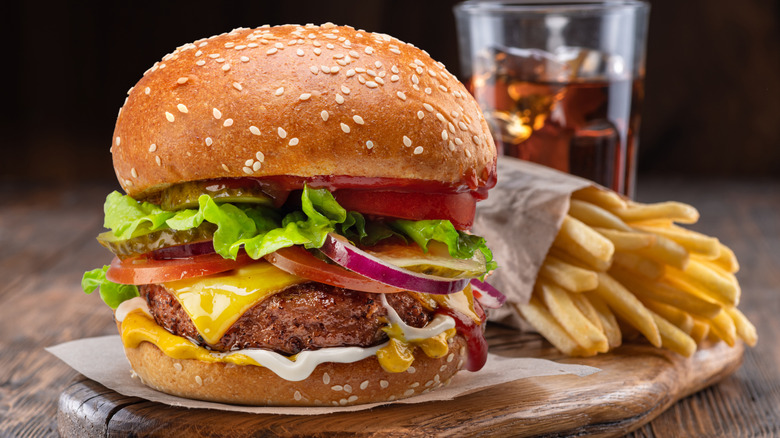
Since the internet went mainstream, there have been listicles containing dubious factual accuracy, with weird food laws in the U.S. among the many topics of public fascination. Not every unusual legislative claim you may stumble upon online is false. In California, it really is against the law to eat a frog that has participated in a frog jumping contest, and an obscure city ordinance means it's technically illegal to eat chicken with a fork in Gainesville, Georgia. One persistent online rumor is that it's illegal to eat hamburgers on a Sunday in St. Cloud, Minnesota. We can confirm this is categorically false.
Where does this myth come from? It boils down to something called blue laws. Sometimes called Sabbath laws, these are outdated laws from colonial America meant to reinforce Christian values. Sundays are meant for worship and rest in many Christian denominations, so indulging in a warm, juicy hamburger or working at an establishment that sells them may have once been viewed as an ungodly maneuver.
Blue laws are no longer in place in most states as they're either unenforceable or questionably constitutional. That said, it's wise to be wary. There are still some remnants of blue laws in state code. For instance, in Minnesota, the hours you can legally purchase alcohol for private consumption on Sundays are restricted to 11 a.m. to 6 p.m. Rest assured, though, there's nothing in St. Cloud's municipal code regarding hamburgers. So, enjoy Minnesota's favorite burger, the Juicy Lucy, on a Sunday without risk of arrest.
Some strange Minnesota food laws are actually true

While the law forbidding eating hamburgers is the stuff of internet myths, Minnesota does have some unusual food laws that are real. When it comes to roadkill, you need a permit to salvage and eat any game you find on the street. If you want to sell that harvested venison, however, this is strictly prohibited in order to prevent potentially tainted meat from entering the commercial market.
On the topic of food safety, Minnesota has some interesting laws regarding raw milk. You are allowed to buy and consume raw milk in the state, but only if you buy it directly from its source. This is controversial, to say the least, given that raw milk has been a point of public debate in recent years. What is raw milk exactly? It is dairy milk that has not been pasteurized. This means it potentially contains harmful bacteria and microorganisms that can cause serious infections and foodborne illnesses — despite false claims that consuming raw milk can cure ailments ranging from asthma to allergies. Legal restrictions on the sale of raw milk for human consumption are in effect in several other states, with Rhode Island, Nevada, and Hawaii banning it completely.