

The 11 Corporations That Quietly Dominate Every Aisle In The Supermarket
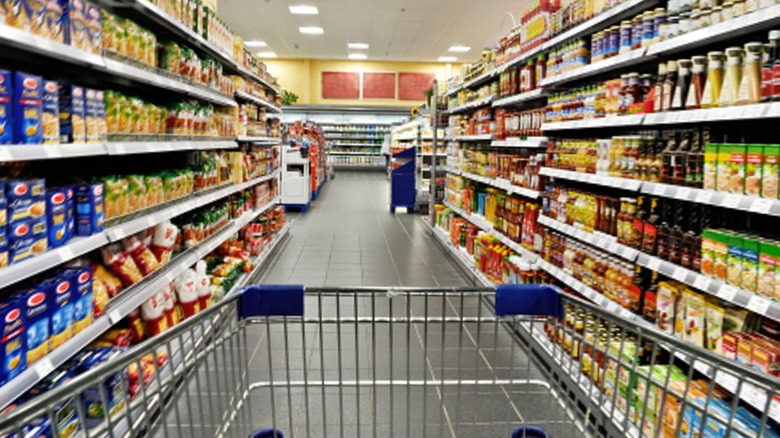
You see hundreds of different products lining grocery store shelves when you shop, but how much do you know about the companies that create all of those bags, boxes, and jars? Would you be surprised to discover that most of what you buy is produced by a handful of companies that run the majority of the packaged grocery industry? The names on the labels tell only part of the story; many are brands represented by corporations that have a presence in literally every section of your favorite grocery store.
You might even recognize the names of some of these companies without realizing just how far their reach extends. Well-known banners like Green Giant, Progresso, and Pillsbury may appear to be independent entities, but all of these and more roll up under the umbrella corporation of General Mills. Others are some of the best grocery brands you've never heard of, cropping up in countries around the world.
Though many brands likely began as distinct companies, the shifting tides of corporate ownership have resulted in buyouts and takeovers, where smaller brands are snatched up by bigger organizations until there are only a handful of players at the top of the food chain. Here's a peek into the catalogs of some of the most prevalent corporate entities in play, and some of the more recognizable brands that make them power players in all areas of the grocery world.
1. Mondelēz
Mondelēz has slowly gathered a catalog of smaller brands, amassing one of the most impressive collections of banners in the food industry. As a standalone corporation, it came into being in 2012 when Kraft Foods broke into two separate companies, Kraft and Mondelēz. The brands owned by this spin-off organization represent such quintessential products as Chiclets, Milk Bones, and Shredded Wheat.
The company credits the founders of its subsidiary organizations on its website, providing an image of pedigree for its range of products. Familiar names like John Cadbury of chocolate fame and James L. Kraft from your favorite mac & cheese box are among the pack.
Though snacking is the space Mondelēz favors most, there are plenty of other shelves filled with the company's products. In fact, this operation leads the pack as the No. 1 spot in the world for cookies and crackers, as well as topping Hershey and Mars for candy sales. It's the umbrella organization for Oreo, Cadbury, Sour Patch, Ritz, Clif, and Chips Ahoy. All of these wildly varied items and more comprise the inventory Mondelēz provides the grocery world in more than 150 countries.
2. Kraft-Heinz
You may buy Kraft and Heinz products as separate considerations, but your money ends up with the same company in the end. The famous blue box containing Kraft Mac & Cheese is the primary banner that puts a face to the name; Heinz ketchup also does its share as a tentpole product most shoppers identify with the brand name. Together, these two grocery superpowers have captured the taste buds and wallets of the modern shopping public.
Kraft-Heinz reigns over the cheese section of the grocery ecosystem, providing everything from American cheese slices to shelf-stable Velveeta. Of course, the company's selection of condiments and spreads features Heinz ketchup and mustard, as well as Kraft mayonnaise and Philadelphia cream cheese. Beyond the refrigerator section, you'll find the corporation represented in Jell-O dessert items, Kool-Aid and Capri Sun beverages, and Maxwell House coffee.
The hyphenated name shows the obvious merging of two previously separate companies, which took place in 2015. A corporate separation that occurred in September 2025 means the future will take both Kraft and Heinz in separate directions once again. The cause for this business divorce appears to be too many categories being covered by the combined entity — a clear sign that not all mergers are meant to last.
3. Nestlé
Your most familiar association with Nestlé is, of course, chocolate. The brand is one of the key players in the candy aisle, with its logo stamped on Crunch bars, Butterfinger, and 100 Grand. The categories shown on the company's website cover everything from family nutrition and pet care to ice cream and plant-based provisions.
In 1867, Henri Nestlé came up with a baby food replacement that revolutionized the way people fed infants. This led to a merger with the Anglo-Swiss Condensed Milk Company, creating the Nestlé group and starting what would become one of the world's best-known food brands. Expansion to the end of the 20th century led to Nestlé's interests in pharmaceuticals and wellness products, while championing sustainable food practices and fair trade labor initiatives.
What do you see in the grocery store that belongs to Nestlé? Carnation, DiGiorno, and Lean Cuisine help Nestlé tackle the bread-and-butter needs of contemporary consumers. Purina and Friskies help pet owners keep their fur babies well-fed. And a whole suite of beverages from Nespresso to Nestlé Quik and even Perrier are on hand to quench the thirst of all tastes and sizes.
4. PepsiCo
The Pepsi in PepsiCo is just a taste of the vast selection of brands and banners that roll up under the corporate moniker. With it comes a slew of canned and bottled beverages you know and love, names like Bubly, Aquafina, and Mountain Dew.
Pepsi beverage was its own company, started in 1902 by Caleb Bradham to market and sell his proprietary cola creation and Coca-Cola competitor. In 1965, the Pepsi organization merged with Frito-Lay to become PepsiCo, a savvy move that brought snacks and drinks together under one flashing neon name. The company has expanded through the decades and now features more than 500 branded items, making it one of the major players in the food universe.
Despite the company's omnipresence in the carbonated beverage world, PepsiCo is much more than just the space it takes up in the soda aisle. Lay's, Tostitos, Doritos, and Gatorade are all members of the PepsiCo family, which means your entire tailgate party might be covered by this mega corp. All of these premium snack products make it clearer that PepsiCo aims to provide enjoyment to the average consumer in all aspects of their grocery shopping habits.
5. General Mills
As a mighty conglomerate of prepared and packaged foods, General Mills has been a big gorilla on the scene for decades. Baking goods, snack foods, frozen goods, cereals — it seems like the offerings from this enormous corporation could stock an entire grocery store all on their own. That's what happens when you keep your business growing for more than 150 years.
As the history of this monumental company goes, the General Mills enterprise began with a single flour mill back in 1866. This was where Gold Medal flour would eventually help General Mills make its fortune, taking on the company name in 1928 and positioning for future expansion. Soon, the mill was producing kitchen solutions like Bisquick and Wheaties, modern inventions designed for convenience in the 20th-century kitchen.
In 1970, General Mills even took a swing at the restaurant business by buying up Red Lobster. All the while, new labels were being introduced to the world, like Nature Valley and its various forms of granola goodness. The company was also acquiring natural-based food companies like Cascadian Farm to explore new avenues of food production. Larabar, Pillsbury, and Old El Paso all call General Mills home, which means the corporation has likely been stocking your pantry shelves this whole time.
6. Mars
The Mars corporation is best known for its contributions to the concept of the candy bar, thanks to founder Frank C. Mars and his 1911 buttercream candy invention. Milky Way, Snickers, and Three Musketeers — the candy bar trifecta — all came along shortly afterward. And the real reason M&Ms were invented? Mars created these treasured candies in 1941 to provide a portable energy source for soldiers.
Future acquisitions around the globe helped position the organization in standard food sections, until nearly every aisle in the modern grocery store layout contained a Mars item or two. Among the recognizable names that take up space in the Mars portfolio: Altoids, those curiously strong peppermints; Cesar, the upscale cat food felines love; and Tru Fru, the chocolate-dipped fruit that turns upscale snacking into a chilled-out occasion.
In another development from a seemingly endless chain of purchases and takeovers, Mars also became the owner of Kellanova (owner of Kellogg's, Pringles, and Pop-Tarts, among others, at the close of 2025. The products you know and love from that conglomerate now roll up under what turns out to be an even larger operation.
7. Coca-Cola
The best-known carbonated beverage on the planet spreads its corporate grocery tendrils far and wide as the expansive Coca-Cola Company. After more than 130 years in business, the company that gave soda an indelible spot in the history of beverages now lays claim to an array of over 200 products produced and sold all around the world.
The one and only Coca-Cola that started it all came about in 1886, when Dr. John Pemberton, who'd invented the flavored syrup, saw his creation become a fountain drink in Atlanta, Georgia. More than 130 years later, this massive organization is emblematic of how much a company can grow and how many related products can roll up into a single banner, even when you don't realize how the structure is laid out.
The untold truth of Coke is that plenty of non-Coke sips and chugs on your shopping list are part of the Coca-Cola arrangement. Costa Coffee, Minute Maid juices, Dasani bottled water, and Topo Chico sparkling mineral water all gather in the company's corporate bucket. There are even dairy selections like Fairlife milk and alcoholic beverages like Simply Spiked to ensure all sectors of the drink world are represented.
8. Kellogg's-Kellanova
Kellogg's has long been a leader in the breakfast cereal sphere, providing ready-to-eat selections like Special K and Corn Flakes to make morning prep an easier prospect. Even kiddie cereals like Apple Jacks and Froot Loops are tucked under the Kellogg's wing, though these cereals have been banned in some countries due to questionable ingredients.
The non-cereal portion of the company became a separate entity called Kellanova in 2023. This brought fan favorites like Eggo, Cheez-Its, and Nutri-Grain bars under a separate heading while still retaining a dotted line to the original Kellogg's organization. You'll find both brands represented by a single website, making it easier for you to identify which products fall under each respective banner.
To shake things up even further, Kellogg's-Kellanova was split into separate entities and sold to Ferrero, who bought the Kellogg's portions, and Mars, who scooped up the Kellanova portion. It's quite a twist, and one that reinforces the idea that corporate grocery mix-and-match isn't going to stop anytime soon.
9. Post
Post started out as one of the titans of cereal production all the way back in 1895, when founder C.W. Post launched the first product, a breakfast beverage called Postum. In 2015, Post merged with MOM (formerly Malt-O-Meal) Brands to become Post Consumer Brands, elbowing its way further into the cereal quadrant of the grocery store floor plan.
Grape Nuts, Honey Bunches of Oats, and Raisin Bran are all standard cereal selections that belong to the Post family of brands. If you've ever picked up a bag of Malt-O-Meal-branded cereals — those one-off versions of more popular creations like Cocoa Puffs and Frosted Mini-Wheats — you've purchased a Post product, too.
Pet food is another passion for the people at Post. If your dog has ever chomped on Kibbles and Bits or your cat has savored 9 Lives, you've purchased brands that Post acquired from the J.M. Smucker company in 2023. The pet food aisle also includes Nutrish and Nature's Recipe as representatives of Post's mighty profile.
10. Keurig-Dr Pepper
You may not realize that single-serve coffee giant Keurig paired up with the alternative cola creators Dr Pepper to form a megacorp, expanding its reach among soft drinks shelves. This powerful maneuvering is enough to make it the foremost beverage provider in North America — not surprising when you find out which labels fall under its auspices.
Obviously, Keurig single-serve coffee capsules and every Dr Pepper flavor best and worst, are the representative products for this grocery store heavyweight. But the whole package includes over 125 various partnerships and labels. If you've cracked open a Schweppes, served Margaritaville margarita mix at a party, or enjoyed an A&W root beer, you've partaken in the wide-ranging beverages this combined company offers.
In its most recent power play, Keurig Dr Pepper has moved to acquire Peet's, expanding its footprint with the chain's popular coffee selections. In the grocery industry, growth is a never-ending endeavor, as the company's January 2026 announcement demonstrates.
11. Anheuser-Busch
Don't mistake Anheuser-Busch's cornerstone creation, Budweiser beer, as the extent of this widespread corporate entity. You may know the corporation best for its top-performing brew, but more products are lurking in the liquor aisle bearing this company label than you may realize. The company has slowly spread its wings to become more involved in other areas of adult beverages, transforming into a brand powerhouse with a load of offerings on the market.
But what the Budweiser label really means goes deeper than just representing one of America's favorite brews. The story of Anheuser-Busch is a classic American dream tale that begins with a neighborhood brewery back in the 1850s. With German lager becoming popular in the U.S. at the time, the company innovated brewing technology that led to some of its best-known labels, including Budweiser and Michelob.
Outside of the drinks that link more directly to Anheuser-Busch by name and reputation, the brewer bubbles over with specialty creations like Kona Big Wave beer and Stella Artois. There are also inventive formulas aimed at more modern audiences, including Cantaritos hard sodas and MD 20/20 spiked punch, a renewed spin on the classic Mad Dog drinks. More than 100 brands under the corporate banner ensure no grown-up thirst goes unquenched.