

When You Should (And Shouldn't) Use Hot Sauce At A Mexican Restaurant, According To A Chef
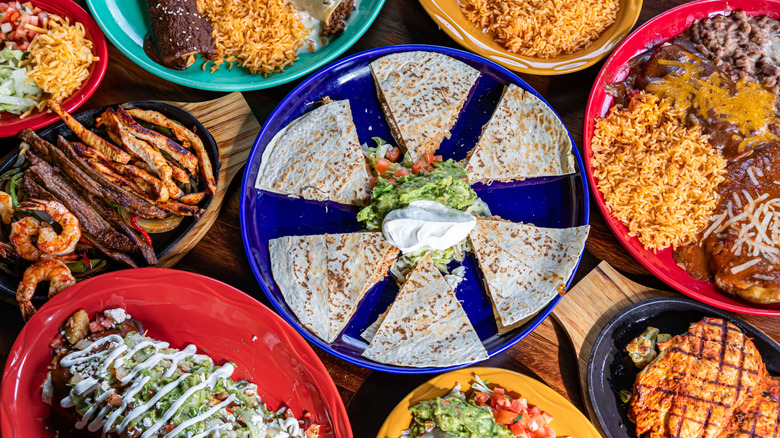
Mexican cuisine is a vibrant patchwork of deep flavors, fresh ingredients, and regional specialties. It's the kind of food that encourages culinary experimentation, and keeping an open mind is one of the best ways to avoid the common mistakes everyone makes at a Mexican restaurant.
Okay, but what about hot sauce? Is it a mandatory part of the dining experience, or will it overwhelm the dish? In an exclusive chat with Jorge Guzmán, executive chef and partner at Sueño in Dayton, Ohio, we gained insight into proper hot sauce usage. The James Beard Award finalist told us, "It all kind of depends on the dish and the circumstance."
When you're unsure about reaching for the hot sauce, one of the basic principles to consider is whether hot sauce comes with your meal. Guzmán says, "If I'm eating at a fancier Mexican restaurant ... and the dish does not come with a hot sauce, I'm not about to pour a bunch of sauce to change the flavor." According to Guzmán, there's a big difference between a Michelin-starred establishment where food "is very deliberately created to exacting standards" and a local Tex-Mex taqueria. In one case, adding hot sauce may undermine the flavor profile of the dish, while in the other, it may complement or even improve your meal. Guzmán tells us that this rule applies to all types of hot sauce, including house-made and store-bought varieties.
Restaurant hot sauce: how spicy is it?
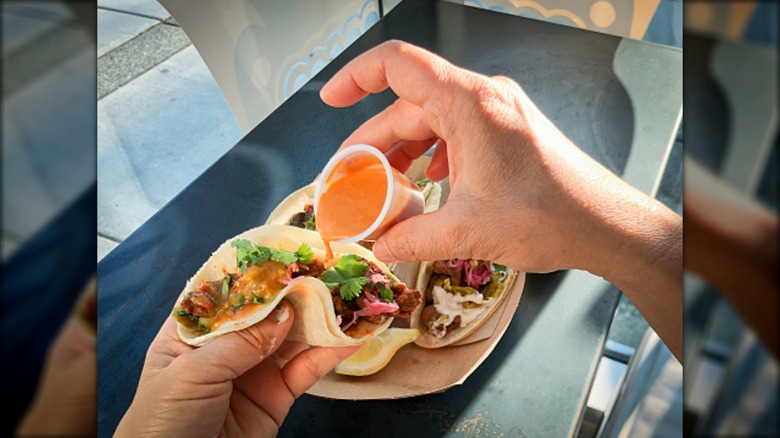
Though carefully crafted food doesn't rely on condiments, chef Jorge Guzmán says there are times when hot sauce is the perfect complement to Mexican cuisine. The restaurateur explains, "If I'm at a taco stand eating carnitas, then I'm going to load up on the salsa used for that taco." Of course, that doesn't mean you should neglect your preferences. Guzmán says you should contemplate your hot sauce tolerance and ask, "Will it not blow your palate out if you eat it?"
A quick primer: Spice levels are determined by the Scoville scale, invented by an early 20th-century pharmacologist named Wilbur Scoville. This scale uses Scoville heat units (SHU) to measure how much capsaicin (a type of capsaicinoid) is in individual chile varieties. If you're not fully confident in your spice tolerance, you may want to research different types of chiles used in hot sauces. For instance, a sauce made with habaneros or ghost peppers, which have high SHU levels, will be a lot spicier than those primarily containing jalapeños or cayenne. Chiles can play a major role in the heat level of dishes and condiments, but the notion that all Mexican food is intolerably spicy is one of many pervasive myths about Mexican cuisine you can stop believing.