

The Only Way You Should Be Storing Caviar
We may receive a commission on purchases made from links.
Caviar, or salted eggs harvested from large fish, like sturgeon, is something people tend to reserve for special occasions. Until recently, at least. The delicacy has become more affordable, and therefore more commonplace. If you're dabbling in the world of fish roe, you should know how to store caviar properly.
One might think that caviar's salt content preserves it, but this is actually a false fact about caviar that many foodies thought was true. The best way to keep caviar fresh is by storing it in the refrigerator (or an environment of 28 to 32 degrees Fahrenheit, according to Caviar Hub) in its original packaging. Refrigeration maintains the taste, quality, and freshness longer. If you store it somewhere too warm, it will go bad. Caviar that gets too cold can freeze, which causes moisture to accumulate and spoil its flavor.
Chef Eric Ripert of Le Bernardin gave Mashed his expert explanation of why caviar is always served cold. "The cold helps to keep away the smell of the ocean. Sometimes, if [the] caviar is warm, it can become slightly fishy," he said. It's also key to ensure that the package isn't damaged, as air can expedite caviar's spoiling. It's also why caviar often ships in vacuum-sealed tins and insulated packing material. With optimal storage, a sealed tin of caviar lasts four to six weeks. The Caviar Co. recommends consuming an open tin within four days or less. Other brands suggest 48 hours.
How to serve properly stored caviar

Now that you know how to store it, what's the perfect caviar for a beginner to try? Osetra sturgeon caviar is a good choice due to its nuttiness and natural balance. Siberian sturgeon caviar is another mild option that won't turn newbies off. Regardless, good caviar has shiny, uniform pearls and a fresh scent that smells like the sea without being straight-up fishy. Its appearance in terms of color and size depends on the kind you buy.
Caviar often comes with a mother-of-pearl spoon for serving, made from the iridescent interior of mollusk shells. This isn't just for aesthetic reasons: Metal utensils can react with caviar and impact its flavor (nonreactive materials, like wood or glass, are fine alternatives). You can serve it straight from the tin or in a glass bowl. Place either receptacle on ice to keep it cold.
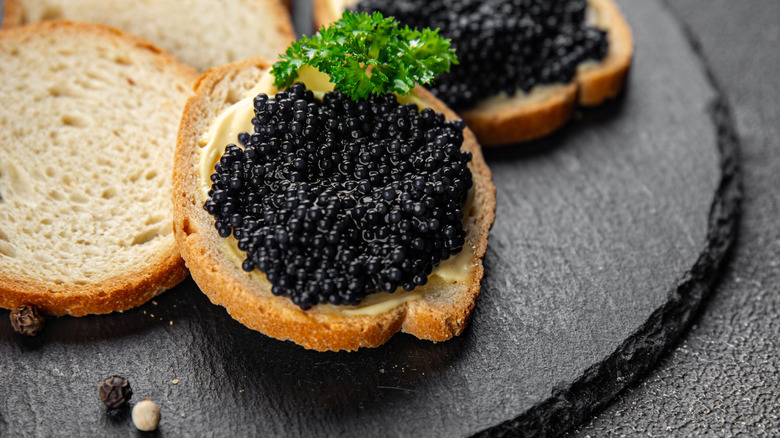
Chilled caviar can be served alongside a variety of foods. Blini, a delicate wheat pancake from Russia, is a timeless pairing. Caviar is also great for dressing up hors d'oeuvres, including smoked salmon on rounds of baguette, smoked fish dip, whitefish salad, and retro apps like deviled eggs. It's also an elegant match for salty, neutral carbs, be they latkes or potato chips. Of course, you can always nosh on caviar straight from the tin, as it's delectable on its own.