

Why Costco Chooses Not To Work With Many Name Brands
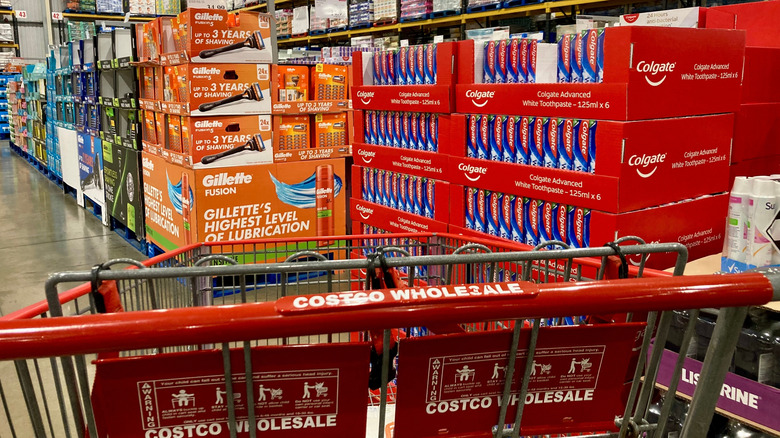
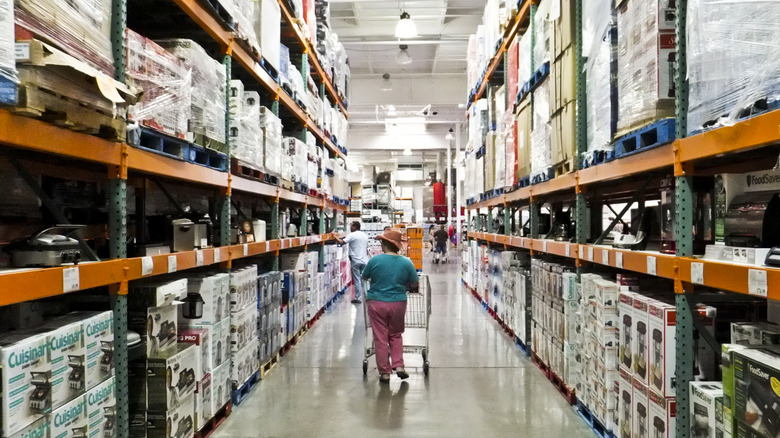
An average Costco warehouse is vast, measuring about 150,000 square feet. You might expect an endless array of offerings to fill that retail space, but the choices available are surprisingly few when compared to many grocery stores. Per The Motley Fool, a Costco outlet typically has about 4,000 SKUs (special codes identifying unique products and their variants). At an average supermarket, you'll find about 30,000. This is one of the many ways in which Costco differs from other stores. As part of the retail giant's rigorous inventory strategy, it only works with a handful of brands.
While Costco handles fewer SKUs, it stocks large amounts of the items it does offer. This allows the world's third-largest retailer to command favorable prices from suppliers and organize logistics more efficiently. It also helps ensure that products on the store's shelves are high-selling, high-quality, and low-priced. In fact, the strategy even extends to payment systems, seen in Costco's shift from accepting AMEX to exclusively VISA in order to keep transaction fees lower for customers.
Even when brands are able to meet all the conditions set forth (and it's easy to imagine that many are keen to partner with Costco), it still may not be in the retail chain's best interest to source from a large number of name brands. For one, while offering fewer choices to buyers may seem counterintuitive, it can actually lead to higher sales. Various studies suggest that having too many options causes decision fatigue (via The Decision Lab). That could actually dissuade people from making purchases. Thus, limiting the number of name brands could benefit Costco as well as its loyal members in this regard.
How does Costco choose which name brands to work with?
The first layer to peel back when attempting to understand the store's brand selection strategy is its private label catchall, Kirkland Signature (KS). It is Costco's secret weapon. Everything from batteries and diapers to high-end vodka and even the food court's famously cheap hot dog combo is sold under this label.
Any third-party brand that Costco stocks also has to compete with Kirkland Signature. This not only gives the retail chain bargaining power but also keeps the name brands on their toes by creating pressure to deliver more desirable products. "Kirkland Signature also provides a sort of healthy tension there to make sure that, that value and quality is there for our members," explained Costco Executive VP & CFO Gary Millerchip in a 2025 earnings call. Even KS products aren't immune from getting axed, and many Costco staples that won't be around in 2026 are from the private label.
The retailer's choice of brands can be unpredictable, as the chain functions opportunistically through frequent changes. Outlets take into consideration local preferences and stock popular regional products. You might find high-end brands like Burberry and Versace at certain locations, while others will have Columbia. Very often, a KS version of the branded product can be found on an adjacent shelf. Or, if Costco is simply unable to make a viable in-house version of a product — like mayonnaise — you'll just find name-brand options on the shelf.