

Are You Storing Your Mustard Wrong?

We often see restaurants keep their mustard bottles on tabletops, which suggests that it's safe to store the condiment at room temperature. For the most part, that's true — mustard is remarkably shelf-stable. According to EatByDate.com, some mustards even stay safe to eat for as long as three years after its "best by" date. But just because you can store mustard at room temperature, doesn't mean you should.
In an interview with Simply Recipes, McCormick & Company executive chef Hadar Cohen Aviram recommends keeping mustard away from high temperatures and direct light, as both could affect the quality of its flavor. What this means is that mustard actually counts among condiments you should refrigerate, since the fridge ticks both of these boxes. In addition, author Helene Sawyer, in her 1987 book "Gourmet Mustards: How to Make and Cook with Them," wrote that refrigeration slows down the dissipation of mustard's volatile oils, which helps preserve its pungency.
It should be noted that storing mustard in the fridge is more about maintaining its quality rather than preventing spoilage, so keeping it in the pantry shouldn't hurt too much. Allyl isothiocyanate, a chemical compound that gives mustard seeds their pungency, is naturally antimicrobial, making it highly resistant to spoilage. The vinegar and salt that go into the prepared condiment also help stave off bacteria that would otherwise make the mustard unsafe to eat.
Some types of mustard need the fridge more than others
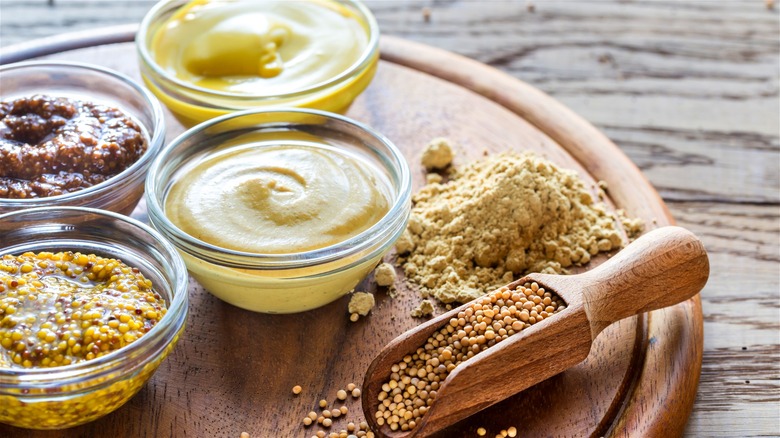
While mustard may be resistant to spoilage, it's not completely immune to going bad. Some types of mustard are more vulnerable to contamination than others because of their differing salt, acid, mustard, and sugar content. Yellow mustard, for example, is the hardiest of the lot because it's made primarily with mustard seed, salt, vinegar, and turmeric — all of which create a hostile environment for bacteria. Sweetened mustards, on the other hand, can have lower acidity levels and higher sugar levels, which makes it easier for bacteria to thrive.
Open bottles of yellow mustard can last as long as two years in the pantry, and for longer than that when refrigerated. Grainy mustards like Dijon — which you should always keep in stock at home — last up to a year in the pantry and up to two years in the fridge after opening. Open bottles of sweetened or low-acid mustard should be refrigerated immediately, and should last up to six months.
You should also keep in mind that all of these estimates depend on perfect conditions, and that your environment at home can sometimes shorten that safety window. High humidity, for example, can cause moisture to accumulate inside your bottle of mustard and create more conducive conditions for mold growth. If you see anything resembling mold, smell rancid odors, or detect any other signs your mustard has gone bad, it's best to avoid eating it. If you want things to be as food-safe as possible, your best option may be to refrigerate all your mustard, regardless of the type.