

Why Does Aldi's Produce Use So Much Plastic?
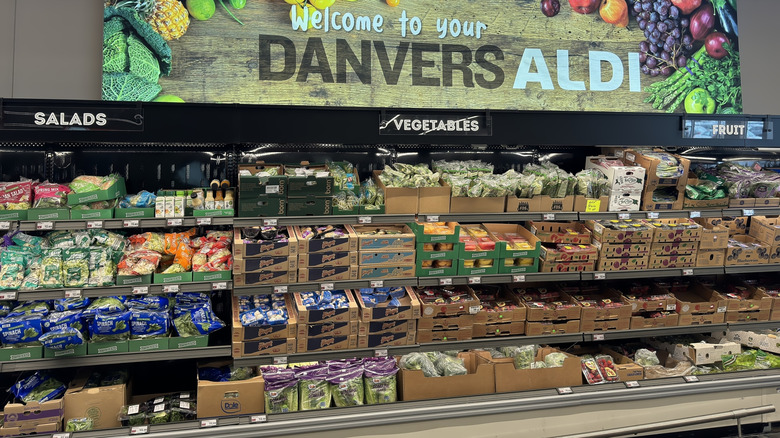
Supermarkets take great pains to make the produce department an attractive, open, and welcoming department. Stores will pile produce high with fresh vegetables and fruits to make a good first impression at a grand opening. Some will almost feel like a farmers' market with bountiful vegetation that's crisp and vibrantly colored.
Now instead, picture a produce department where almost all of it is wrapped in plastic to the point you can barely see the product. That would be Aldi. It's not the typical supermarket: With smaller footprints and less staff on the floor, Aldi prioritizes efficiency over beauty. That means aside from a few hidden produce gems to be found, its produce departments sure won't look like the sprawling marketplace of a big-box grocer.
So how does more plastic mean more efficiency? For one, it actually helps reduce the number of employees needed in the store. It takes manpower to stock, arrange, maintain, and rotate elaborate displays; some items even need a little more TLC to remove rotting leaves or keep them hydrated. Packaged produce means that it can be stocked the same way that grocery items are, with no additional maintenance. Plus, at checkout, packaged items already have bar codes, so nothing has to be weighed or looked up in the system by the cashier. That keeps checkouts moving faster, which means fewer cashiers have to be on duty.
Aldi says plastic keeps produce fresher; the data isn't so definitive
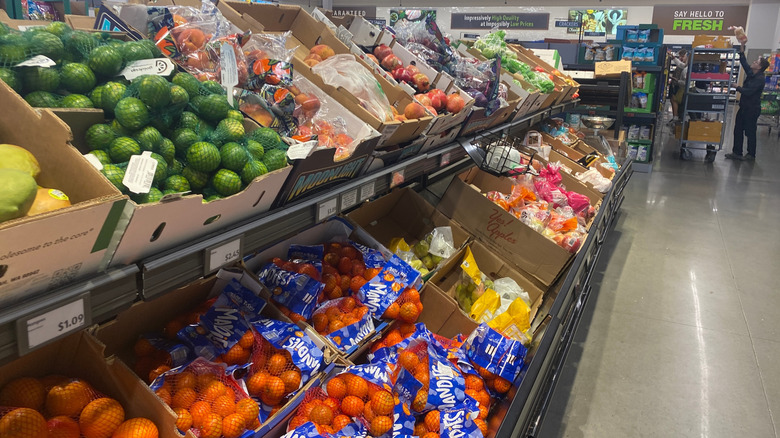
Aldi has an innovative supply chain unlike any other supermarkets. The plastic packaging is part of that for a simple reason: "It keeps the product fresher," Aldi Australia then-CEO Tom Daunt said to News.com.au in 2018. But research doesn't clearly show that. A 2021 study found that the environmental impact of throwing away a plastic cucumber wrapper had just 1% of the environmental impact of throwing away a rotten cucumber, but a 2022 study by a British nonprofit found that plastic wrapping doesn't really preserve the fresh foods' shelf life.
Plus, wrapping produce has cultural implications. In Europe, wrapping produce in plastic is simply the standard. European customers perceive packaged produce as more hygienic and fresher. But here in the United States, customers prefer to browse loose produce items. Given Aldi's German roots, it's logical its stores would stay closer to the European model.
Customers here in the States aren't always so open to a European way of doing things. In fact, British grocer Tesco briefly had a presence on the West Coast of the United States under the name Fresh & Easy. But the stores never caught on, in part because the packaged produce standard in Europe was baffling to American customers, who saw it as a way to hide inferior produce rather than keep it fresher longer. Still, Fresh & Easy's problems extended far beyond the produce aisle (and the whole chain went under in 2015), so Aldi isn't in danger of failing the same way.