

What A Watermelon's Shine Says About Its Ripeness
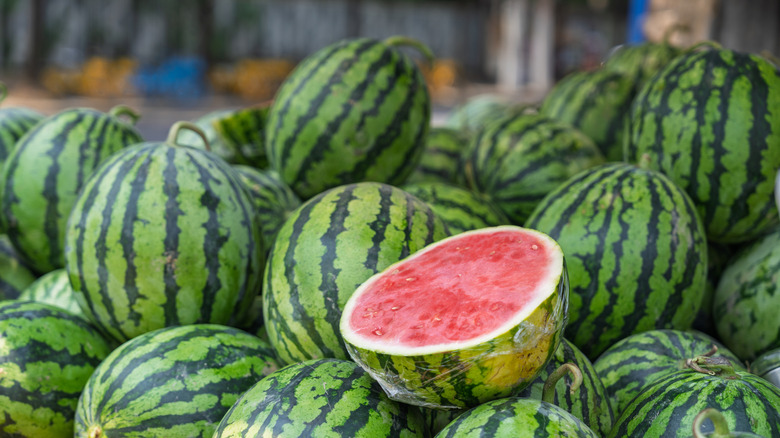
Walking into a grocery store or farmers' market, it's only natural to have your eye drawn to glistening produce. Humans like shiny things that get our attention (because we associate them with our need for water, according to a 2014 study in the "Journal of Consumer Psychology"). Some produce items naturally produce a waxy coating, which is nothing to be worried about, though it's often washed away during processing and replaced with a thin layer of resin to preserve freshness.
So when picking out the perfect watermelon, it's logical you might go for the shiniest one in the bin. That isn't a good idea, though. A glossy watermelon is likely underripe, so it won't taste as sweet and delicious. Ripe watermelons should have a dull, dark color with a rind that's matte in texture, which is one of the signs for buying the perfect watermelon. (An important caveat: This holds true for most watermelon varieties sold in grocery stores, but each variety may behave a little differently.)
Why is a gleaming apple appealing, but the same isn't true of a watermelon? It comes down to the ripening process. Plants naturally develop a layer called a pericarp that serves as protection for the fruit, and in watermelons, that's the rind. The outermost layer within the pericarp is called an epicarp, which is a waxy film covering fruit that is produced naturally by the plant as it grows. That's the shiny part. As a watermelon ripens, though, it loses its outermost layer and becomes duller. So the less shiny a watermelon, the riper it is.
A watermelon won't continue to ripen when you get it home
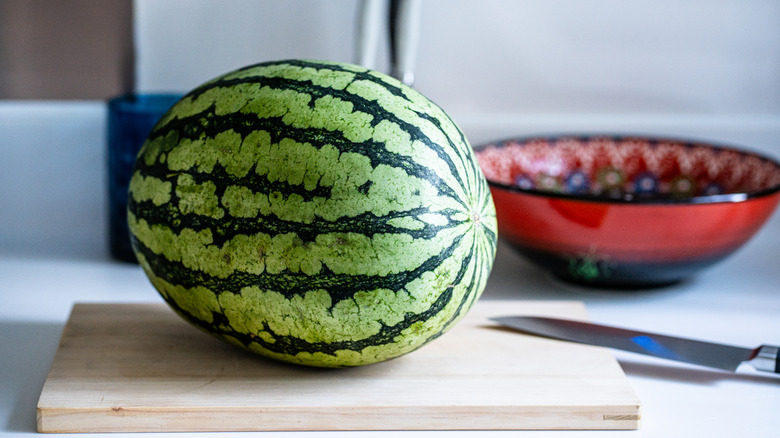
Some fruits continue to ripen long after they've been harvested. Not only do bananas keep maturing when separated from their plant, but they can also help other fruits ripen, too. Some tropical fruits like mangos and kiwis behave the same way. Watermelons don't. They never ripen beyond the stage they were at when harvested, meaning it's important to choose one that's fully ready to eat.
There are more than 1,200 varieties of watermelon grown in the world, according to Watermelon Times, and they're not always labeled the way different types of apples are marked, for instance. They each grow slightly differently, and not all lose their shine as they ripen. (Academic research on watermelon ripening has generally centered on seeded, not seedless, melons.) Some will instead develop a dusty coating, for example. Still, it's a good general rule in choosing a watermelon, since it holds true for many varieties that are readily available in stores.
Many types also change color along with changing their glossiness. It's not a universal rule, but generally, a darker colored rind means the watermelon is riper. You can also investigate the field spot, or the place where the melon sat on the ground as it grew. On a ripe watermelon, it'll be a deep yellow. A pale or white field spot, especially if it's shiny, is a sure sign of an unripe watermelon.