

Why Do Some People Poke Holes In Potatoes Before Baking Them?
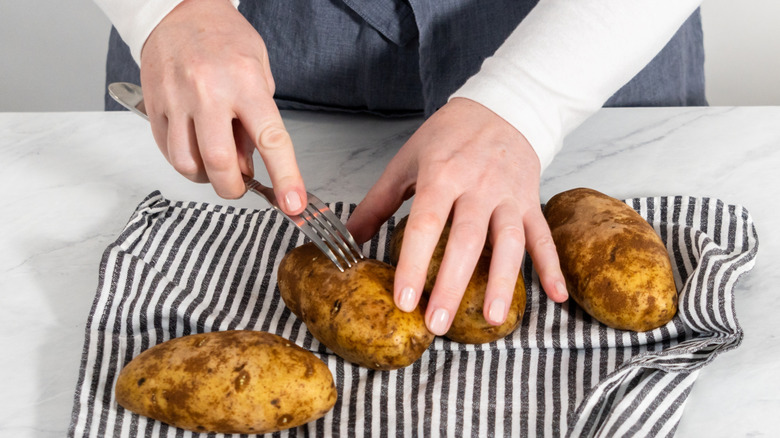
If you've watched people cook baked potatoes, you likely saw at least one who chose to poke some holes in the spuds before popping them in the oven. And if you've wondered about the purpose of this step, you're not alone. It comes down to a common belief about how potatoes cook, although it's unclear how much impact the move really makes.
The main idea of puncturing the skin with a fork or similar implement is to release steam that builds up inside baked potatoes as they cook. To be clear, poking holes isn't a method designed to prevent your spuds from bursting. According to the experts at the Idaho Potato Commission, that's unlikely to happen. However, chef and food personality Alton Brown is among those who adds the hole-poking to his potato prep, arguing that creating these tiny steam-release valves improves the baked potato's texture by keeping it from becoming too dense.
However, fellow big-name chef Alex Guarnaschelli disagrees with Brown on this prep step, noting she doesn't poke holes for baked potatoes. Additionally, side-by-side tests by Food52 found no bursting from unpricked potatoes and little difference in texture between the two methods.
More impactful ways to improve your baked potato
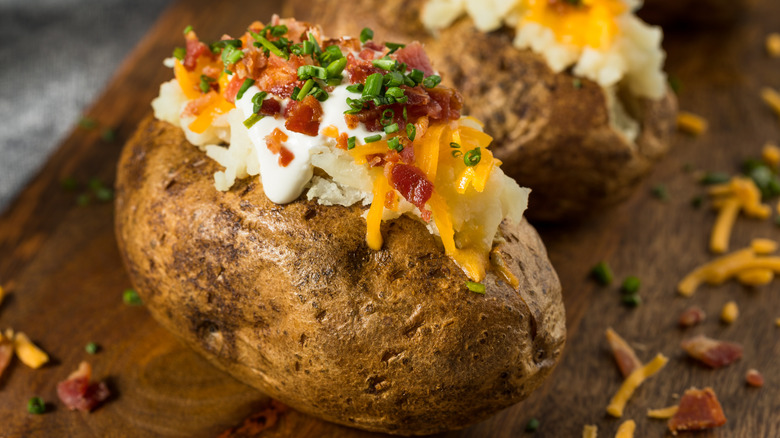
If you choose to poke holes in your baked potatoes, there are some things to keep in mind. For one, you want to do it as close as possible to the time of baking. Otherwise, the holes exposed to air could oxidize and turn an unpleasant darker color. Holes don't need to be deep, either — just enough to pierce the skin will do the trick.
Although some see failing to poke holes as a mistake when baking potatoes, any potential negative impact is small compared to other common issues, such as not washing and drying the potatoes, not wrapping them in foil to cook, and most fundamentally, choosing the wrong type of potato to bake. Generally, russets are seen as the best choice due to high starch content, which creates a fluffier interior. A waxy, lower-starch variety, such as red bliss, results in a different baked potato experience (and are really better for roasting) regardless of whether or not holes are poked in the spud. So choose your baked potato variety wisely.
Whether you're keeping your baked potato as a simple side or taking it to the next level by topping it with a frozen dinner, there's no need to dedicate too much time to poking holes (or not). Although some, including expert chefs, see the step as a must-do, others are open about skipping it, and tests suggest differences are likely small, if they exist at all.