

How Many Shots Of Espresso Does A Standard Cup Of Coffee Equal?
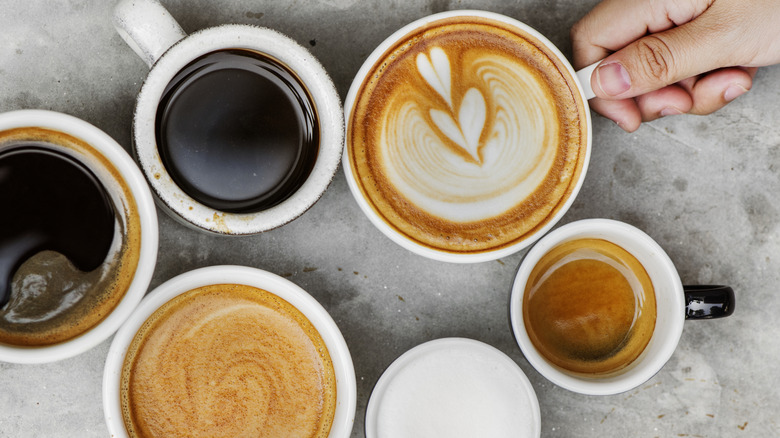
Coffee is one of the world's most popular beverages, and it's served in countless ways around the globe. Among the best-known styles is espresso, a smaller-volume, highly concentrated version of the drink developed in the early 20th century. While it shares many similarities with more traditional brewed coffee, it differs in other areas, most notably size and strength. Still, the number of espresso shots that translate to a standard cup of coffee depends on the metric you use.
Generally speaking, a single shot of espresso constitutes 1 fluid ounce of liquid, equivalent to roughly 30 milliliters. In contrast, a standard cup of coffee is typically 8 ounces, or just under 237 milliliters. However, common mug sizes can reach 12 or even 16 ounces, and travel mugs can be even larger. Therefore, in terms of volume, a standard cup of coffee is equivalent to eight shots of espresso, and potentially 16 or more depending on the serving vessel.
However, those who need a jolt of energy or a morning pick-me-up are often more concerned with caffeine content. While this varies depending on the beans and other brewing factors, most espresso shots contain anywhere between 60 and 80 milligrams of caffeine. In contrast, drip coffee contains 80 to 120 milligrams per 8-ounce cup, with pour-over methods producing as much as 175 milligrams. Using these general ranges, a 1-ounce shot of espresso is roughly equivalent to an 8-ounce cup of weak coffee or ½ to ⅓ cup of a stronger brew or pour-over version.
How coffee and espresso differ
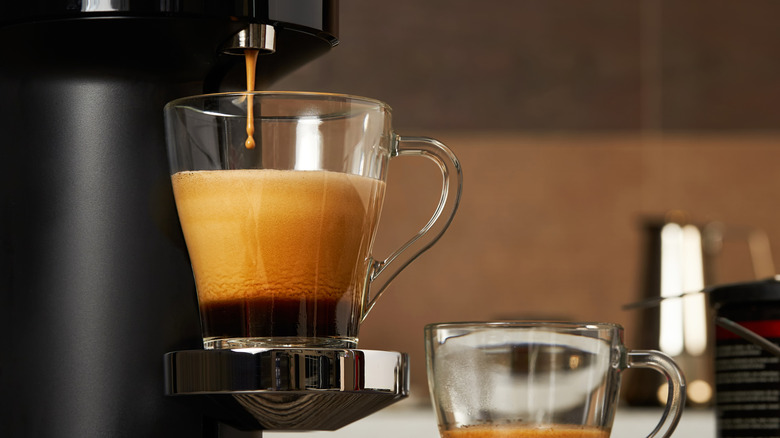
The significant difference in coffee and espresso's caffeine-to-volume ratios is what makes the latter so effective — and also potentially hazardous to your health. The FDA recommends no more than 400 milligrams of caffeine per day, which translates to around 5 to 7 fluid ounces of espresso or 26 to 40 ounces of regular drip coffee. As you can probably guess, it's far easier to consume an unsafe amount of caffeine in lower-volume espresso, which can lead to issues like sleeplessness, headaches, irritability, upset stomach, racing heartbeat, and more.
These differences in serving size and relative strength aren't the only factors that distinguish espresso from typical coffee. Traditionally, "espresso roast" coffee is darker than many familiar medium or light roasts found on the market, although this has become less uniform over time. Coffee prepared for espresso is also ground finer than beans used in other methods. In part, this is what allows espresso shots to brew in just 20 to 30 seconds of intense water injection, as opposed to the several minutes drip, pour-over, and French press coffee require.
There's no denying that both of these size and strength measurements are mostly theoretical at many coffee shops and chains. Starbucks' "Tall" size, for example, is already one-and-a-half times as large as a standard cup of coffee (which is only available in an off-menu size), while commonly ordered "Grande" and "Venti" options include multiple espresso shots per drink. Still, it's vital to understand the way that standard sizes relate, both to help make better coffee drinks and to safely manage your caffeine intake for maximum alertness with minimum side effects.