

Here's Why McDonald's Executives Were Hesitant To Release The Big Mac
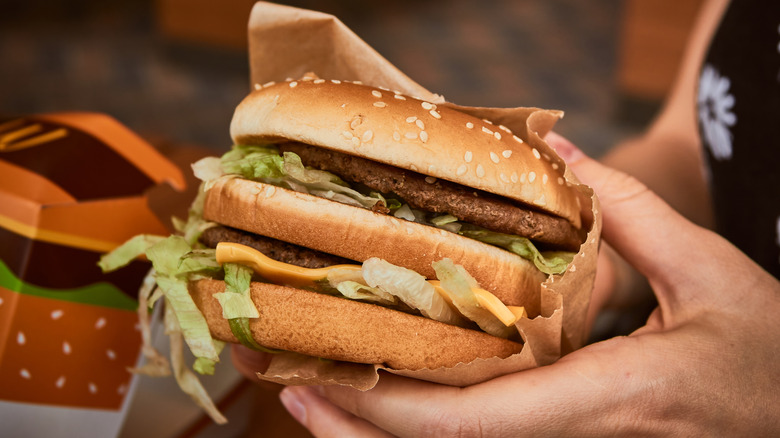
It was 1967 in Uniontown, Pennsylvania. Jim Delligatti owned about a dozen McDonald's franchises in the area not far from Pittsburgh. He was the first franchisee in western Pennsylvania, and worried about the competition from other fast-food chains, like Burger King. To better lure in hungry Pennsylvanians, Delligatti devised a new, more deluxe menu item: a burger with two patties, stacked between buns and piled high with lettuce, pickles, cheese, onions, and special sauce. It wasn't an instant success.
This new burger — that would eventually be called the Big Mac — went against the core values of the McDonald's menu: speed and simplicity, with an eye on standardized recipes and ingredients for quick preparation. Executives worried that this more complicated menu item would make McDonald's kitchens less efficient, according to Delligatti's 2016 obituary in The New York Times.
Then there was the price. A double-patty burger with extra toppings costs more to produce. Delligatti priced it at 45 cents to make up for the expense, well above the 18-cent price tag of the standard burger at the time. For comparison, the main competitor — the Whopper — cost 37 cents at its 1957 debut and stayed at that price through at least 1970. McDonald's executives worried that the higher price would dissuade customers and jeopardize the chain's low-cost reputation.
McDonald's welcomed franchisees' ideas but tested them thoroughly
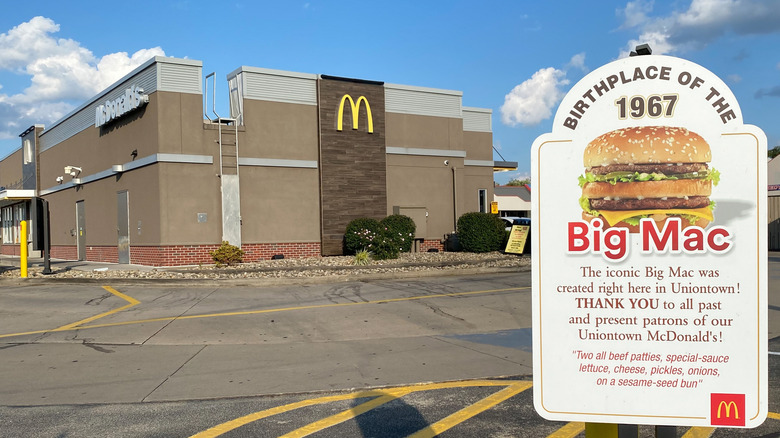
McDonald's initial corporate hesitations didn't sink the new invention, though. Delligatti introduced the new burger in his Uniontown restaurant in the spring of 1967, later bringing it to his other locations with corporate's blessing. When the Big Mac came onto the menu, sales picked up every time. Executives took notice, and the new offering rolled out nationally the following year.
The Big Mac wasn't a fluke. At the time, the corporate culture at McDonald's welcomed innovation from franchise owners. Former franchisee Jim Lewis told Restaurant Business, "I was a 30-year-old operator and I could call the CEO and have a conversation with him because he knew who I was." That didn't mean then-CEO Ray Kroc would immediately add new inventions to the menu, though. First, they had to go through a testing process to see if customers liked them and if the existing kitchens could make them.
McDonald's customers today might be surprised by just how many famous menu items came from franchise operators instead of corporate. When franchisees sought a meatless option for Catholics on Fridays during Lent, Kroc's idea was to grill a slice of pineapple topped with cheese in place of the burger patty. But in 1962, Cincinnati franchisee Lou Groen suggested fried fish , evolving into today's Filet-O-Fish. Similarly, franchisee Herb Peterson invented the Egg McMuffin in the 1970s.