

5 Ways To Revive Hardened Honey
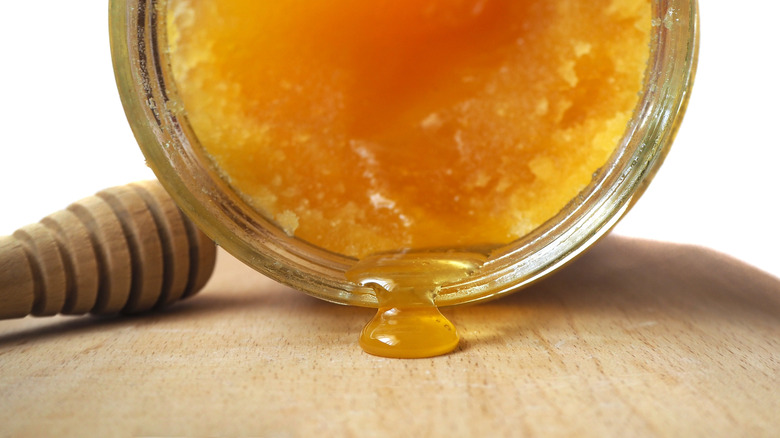
The shelf life of honey is famously long, as shown by archaeologists that have reportedly found honey still edible after being buried in tombs for thousands of years. One of the mistakes people often make with honey, though, is thinking when honey crystalizes and turns hard, it means it has gone bad. This could not be further from the truth.
Crystals form when the water content in honey can no longer hold all of the sugar. So those crunchy crystals aren't impurities or spoilage, they're sugar, and honey's liquid nature can be revived. This is mostly achieved by applying heat, however the technique you use matters — no one wants burned honey. And using the wrong vessel, such as one made of plastic, is not a good idea. Anyone who has made this mistake knows how melted plastic ruins the container, not to mention the taste of the honey, while releasing chemicals.
Warm bath
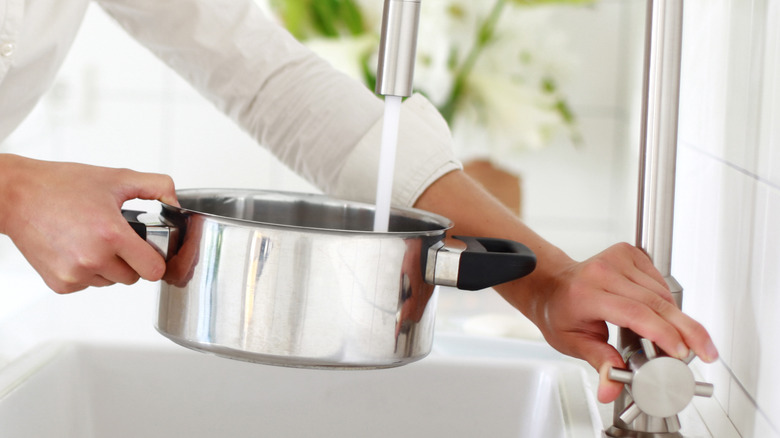
If the honey in your cupboard has crystalized, all you need to soften the honey is warm water. This can be as simple as running your sink faucet until the water turns hot or heating up a kettle of water. The key is to not use boiling water. To maintain optimal flavor, aroma, and molecular structure, the water temperature should be between 104 and 122 degrees Fahrenheit (40 and 50 degrees Celsius). The boiling point of water is about double that, so if you use a kettle, be sure to let the water cool before putting it in a bowl or pot to make your bath.
Residential tap water doesn't typically get above 140 degrees Fahrenheit (60 degrees Celsius), so running hot tap water into a vessel to place your jar of honey should be fine. This is also convenient if your honey is in a plastic container. Many plastic bottles made today begin to warp at 140 degrees Fahrenheit.
If your honey is stored in buckets or if you have a lot of jars, this technique can be scaled up. Instead of using a bowl, use a larger vessel like a cooler or bathtub. The bathtub is convenient because it is easy to fill using the hot water tap. No matter how large the vessel, be sure to keep the top of the honey containers poking out of the water so water doesn't get inside. It's a bath, not a drowning.
Slow cooker
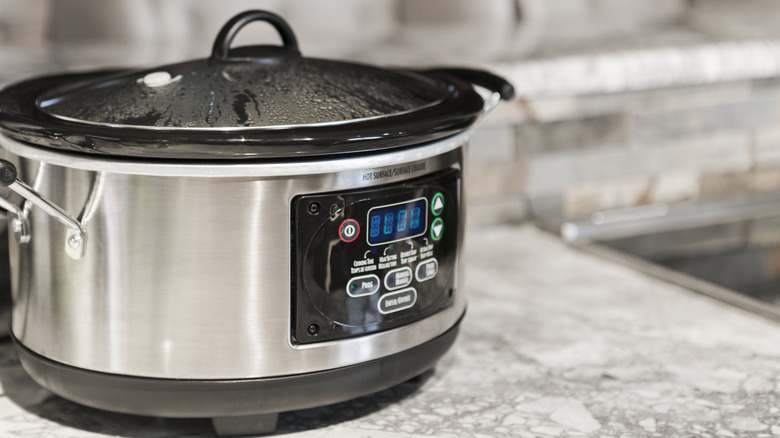
If you don't want to stand at your sink waiting for your tap water to heat up or for boiled water to cool down, bring in the slow cooker. There are two bonuses here. First, you don't have to stand around waiting. Second, depending on the size of the slow cooker, you can soak multiple honey containers at once.
Fill the slow cooker until the glass jars are shy of being covered completely. You don't want water getting inside your jars and spoiling the honey. Set the slow cooker to its lowest setting but do not put the lid on. Most slow cookers set to low reach temperatures between 164 and 182 degrees Fahrenheit (73 and 83 degrees Celsius), and many have an even lower setting called warm, which is meant to keep already cooked food safely edible. This setting, which keeps temperatures between 160 and 170 degrees Fahrenheit (71 and 76 degrees Celsius), can also work for honey. If you are concerned about water temperature, test it throughout the process and, if necessary, turn the slow cooker off to allow the water to cool. If using plastic honey jars, definitely keep the water temperature on the lower end.
Sous vide
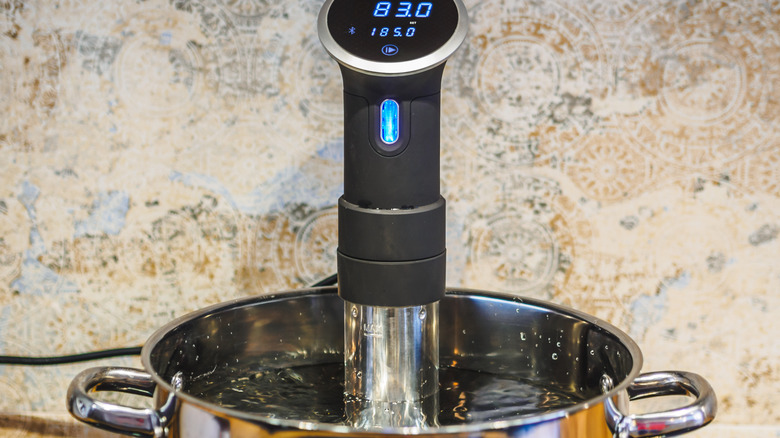
Sous vide (French for under vacuum) is a slow cooking technique you can set and walk away from while it cooks. However, it is not the same as using a slow cooker. Usually when you cook sous vide, you vacuum-seal the food to keep it away from the hot water bath. When using sous vide to decrystallize honey, you can skip this step because the honey is already in a container. The big advantage sous vide has over a slow cooker when it comes to honey is you can set the precise temperature you want.
One Redditor said of this technique, "I use my sous vide machine and let it go at like 100 [to] 105 [degrees Fahrenheit] overnight. Works perfectly without destroying the delicate floral aromas and flavors of the raw honey." Sous vide is another method that can be scaled up. Another Reddit commenter said, "Sous vide is the method I use for five-gallon buckets, I put the bucket in a massive pot and run my sous vide at 115 [degrees Fahrenheit] for five hours and bam, nice liquid honey. Over 120 [degrees Fahrenheit] degrades honey quicker."
Sunlight
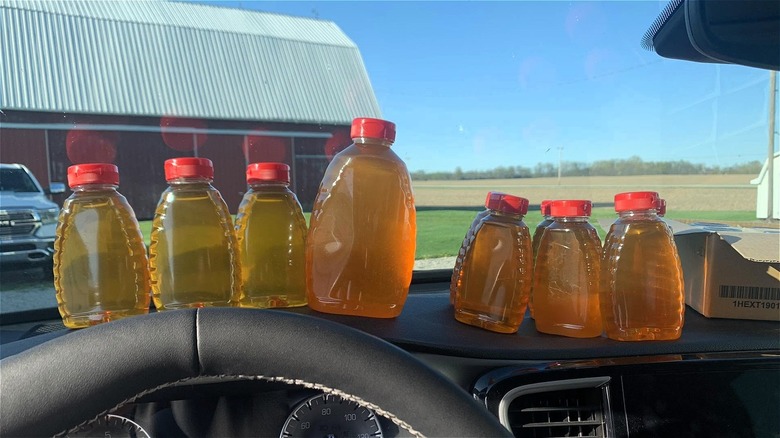
Probably the most hands-off approach to softening crystallized honey is to use the power of the sun. Because the key to dissolving honey crystals is heat (warm water is convenient but not required), setting a jar of hardened honey in a spot of warm sunlight on a windowsill or counter should do the trick. However, there are a few drawbacks — you can't control the temperature of sunshine and could inadvertently destroy your honey. Some claim leaving honey in the sun for too long degrades its flavor, aroma, and color due to ultraviolet light exposure, as well as potentially killing beneficial properties. When storing honey long term, it is recommended to keep it in a dark, cool place.
A surprising number of honey enthusiasts use the dashboard of their car to decrystallize honey. The dashboard of a car on a hot summer day can reach as high as 200 degrees Fahrenheit (93 degrees Celsius), more than enough to liquify hardened honey. Some worry this technique will pasteurize raw honey and suggest other methods with better temperature control. If you want to use the heat of the sun, place your honey in the morning light for a short duration.
Microwave
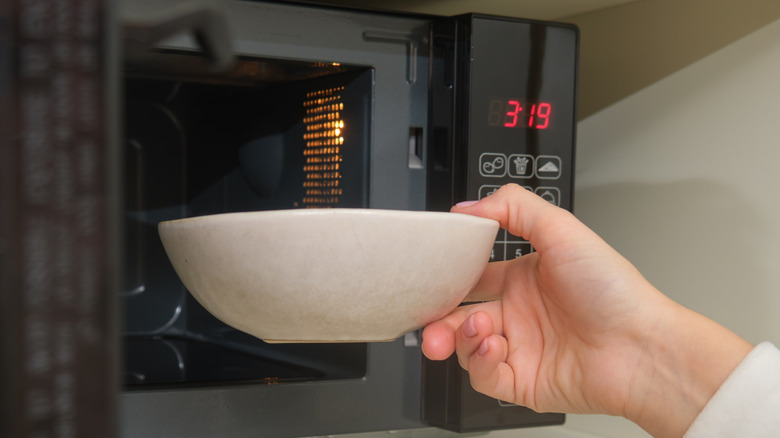
One of the first things that probably comes to mind when told to heat up food is the microwave. Depending on your concerns, this may be a valid technique. If you only need a little bit of honey for a recipe, this might make sense. But remember, microwaves heat liquid quickly, so it's best not to microwave a honey jar made of plastic, which warps under high heat. Some companies use foil in their labels, so avoid microwaving those as well.
Instead, scoop the crystallized honey into a label-free glass container and microwave that. Be sure to lower the power setting to about 50% and cook for just 30 seconds. After stirring, if the honey isn't smooth enough for you, put it back in for another 10 seconds and stir again. Short bursts are key. You don't want to overcook it.
A concern many have with the microwave is it destroys honey's nutritional benefits. A 2018 study published in Food Chemistry found microwave heating destroyed honey's antibacterial properties while conventional heat at 45 and 55 degrees Celsius (113 and 131 degrees Fahrenheit) did not.