

Sailors Drank This Boozy Precursor To Whiskey Sour Cocktails
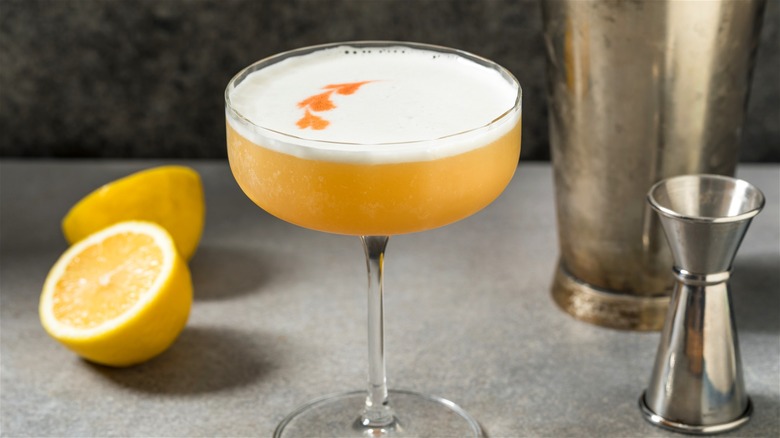
The venerable whiskey sour has been one of America's favorite cocktails for a very long time, with the oldest known mention of it being in an issue of the Waukesha Plaindealer in 1870 (via Difford's Guide). The classic drink itself may have been an offshoot of a gin sour, which itself had its earliest mention in 1856 on the menu of Mart Ackerman's Saloon in Toronto (via The New York Public Library). Sours as a whole, however, may have roots in an even older cocktail, first enjoyed by British sailors in the mid-1700s.
In 1740, with the hopes of stymying his sailors' tendency to guzzle their rum rations and get too drunk to function, Admiral Edward Vernon of the U.K.'s Royal Navy ordered that the booze served to sailors be diluted with water, and suggested adding lime juice and sugar for flavor. Because Vernon often wore a cloak made of grogram — a fabric made of silk and mohair — his men called him "Old Grog" and eventually named his prescribed drink "grog." It's believed that sailors brought grog to shore with them, which in turn led to the development of sour cocktails.
If you look at a modern whiskey sour recipe, you'll see that the foundation of a grog is still there: liquor, a sour juice, and a sweetener. The only difference today is that the booze isn't typically diluted with water (although any ice will do that to a smaller degree), instead creating balance through a 3-2-1 ratio of liquor, sour, and sweet ingredients.
How to make historically accurate grog at home
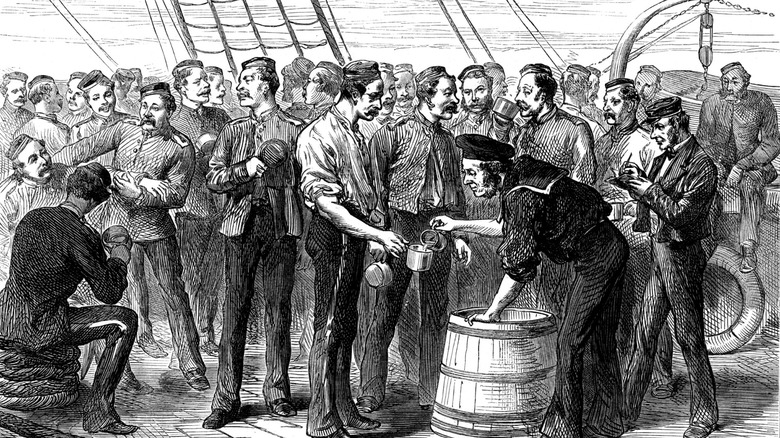
Vernon's orders are well-documented, so recreating authentic grog is easy. He wrote that every half-pint of rum should be mixed with a quart of water, with extra lime juice and sugar to make it palatable. This gives us a loose conversion of four parts of water for every one part of rum, with lime juice and sugar added to taste. The Royal Navy did end up making lemon juice a mandatory ingredient in 1795 to combat scurvy, prescribing ¾ of an ounce of juice plus 2 ounces of sugar mixed into grog, so you can also go with those proportions.
To make it as historically accurate as possible, use Pusser's Rum, which is made with the same official recipe the Royal Navy used. You can also use rum from the very last batch the Royal Navy itself made — it was hidden away for 40 years until UK-based supplier Specialty Drinks acquired it and made it available to the public in 2010 as Black Tot Last Consignment. It'll set you back quite a bit, however, with a bottle going for over $1,200 as of this writing.
Several recipes online call for the use of brown sugar in grog, but it's important to know that not all brown sugar is the same. The Navy likely didn't use moist, dark brown sugar for their grog because the Caribbean sugar plantations they worked with typically extracted the molasses from cane sugar to make rum. Old-school grog would probably have used the clearer, lighter-hued type of cane sugar.