

How Many Bottles Of Bourbon Come From A Single Barrel?
Though we grow older, curiosity for many of us does not wane. As kids, we may have asked questions like "How many M&Ms are in a bag?" or "How many Pringles are in a can?" As we become adults, these questions change along with our pleasures. You may have wondered, perhaps, how many drinks are in a pitcher of beer or how many bottles of bourbon come from a single barrel. Since we know how bourbon is really made, how much liquid does a barrel actually contain?
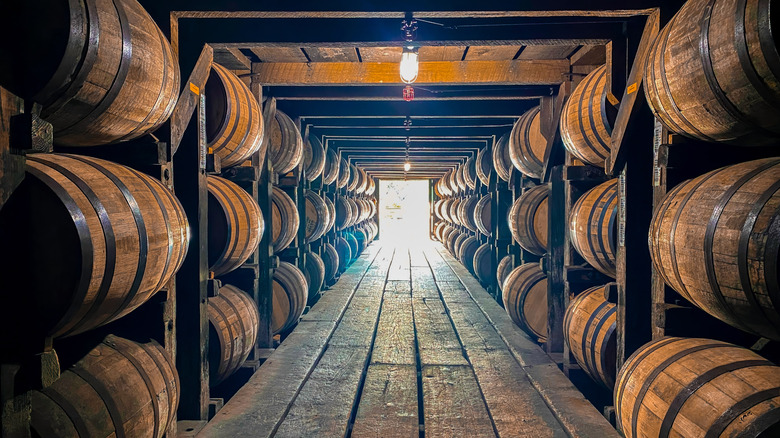
In the U.S., where this spirit is made, the most common barrel size distilleries use holds about 53 gallons (or 200 liters) of bourbon. According to Southern Living, if you were to pour one of these barrels out, undiluted, into standard 750-milliliter bottles, you would get between 160 and 180 bottles. But this is a general estimate for bourbon whiskeys aged for an average of four to six years.
You may believe the bourbon myth that it must be aged for so many years to be good. But the longer it's aged, the more bourbon goes to the Angel's Share, resulting in less bottles. What is an Angel's Share? Oxidation is a necessary part of the bourbon-aging process, so whiskey barrels aren't airtight. This means the more bourbon that evaporates over time, the more evaporation becomes mixed with the ambient air, earning its loving nickname. If the summer is particularly hot and humid, more bourbon goes to the Angel's Share, which reduces the amount of bourbon available to be bottled.
Other factors that determine the number of bottles of bourbon per barrel
Some bourbons are bottled at cask strength, which means the alcohol content at bottling is the same as it was in the barrel. This is also called barrel, entry, or original proof. The number on a bourbon bottle followed by the word proof signifies how strong the alcohol is (the higher the number, the more alcohol it contains).
For many folks at the beginning of their bourbon journey, this undiluted cask strength (up to 125 proof) may be a bit too harsh to swallow. Distillers will instead proof the bourbon — that is to say, dilute or filter the bourbon before bottling. Distillers take the original contents of the 53-gallon barrel and dilute it with water and then filter it according to different proofs. The legal minimum proof for whiskey is 80 proof, which results in a bottle with 40% alcohol by volume (ABV). In this case, you can get between 250 to 300 bottles of proofed bourbon, compared to the initial 160 to 180 bottles of cask strength bourbon.
However, in addition to being easier to drink, distillers proof bourbon for other reasons. Many distilleries will proof according to its own recipes, fine-tuning the alcohol content to highlight specific flavor profiles. So, don't think whiskey distillers are trying to make more money off the consumer by diluting what comes out of the barrel — it really is done for a better drinking experience. However, there are upsides to purchasing cask strength bourbon because you can dilute the drink on your end to your preferred strength with mixers of your choice.