

13 '80s Candies That Belong Back In Stores

From pop music to Pop Rocks, the 1980s were a watershed decade for pop culture. Even four decades later, the songs, TV shows, and films of the 1980s continue to resonate and even dominate America's cultural landscape. And that extends beyond the box office to the box of candy clutched in your hungry hands as you watch the latest nostalgic '80s revival on the silver screen.
Some of the most popular and iconic candies around first rose to popularity in the 1980s. Nerds, Sour Patch Kids, and Big League Chew are just some of the enduring candy brands that kids today are enjoying in the same way that their parents (and grandparents) enjoyed way back in the day.
But like many other once-popular foods every '80s kid will know, there are also numerous classic candies from the decade that sadly have disappeared in the long years since. Whether you're nostalgic for the 1980s because you lived through them or because you've heard so much about them, these lost flavors and disappeared delicacies provide a tantalizingly elusive window into a lost past. And more: while these candies may have failed at the time, times change, and some seem like a perfect fit for today's candy enthusiasts. So which '80s candies deserve to be unearthed from Mr. Bones' candy coffin for a second chance at sweet, sweet life? Pucker up, because these treats are totally mint.
1. Wonka Bar
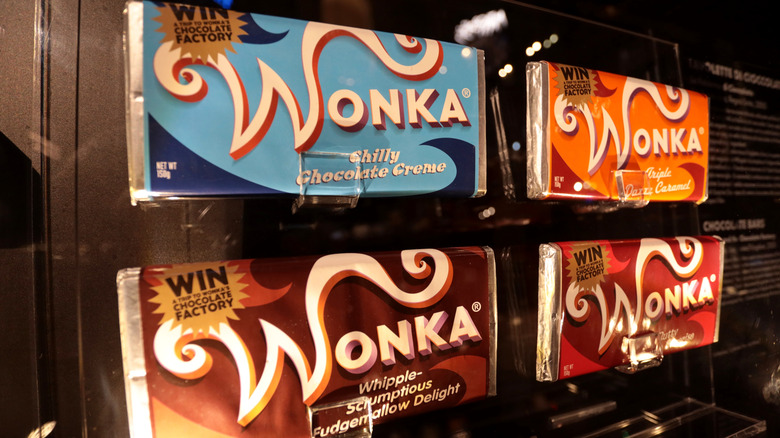
Wonka. Thanks to Roald Dahl's hit 1964 book "Charlie and the Chocolate Factory" and the 1971 film adaptation "Willy Wonka and the Chocolate Factory," perhaps no name in fiction is as synonymous with delicious candy as Wonka. So it only makes sense for there to be a real Wonka candy company with a real Wonka bar for kids and adults to enjoy.
That was the thought process of Quaker Oats when it decided to help fund the production of the "Willy Wonka and the Chocolate Factory" movie. The company wanted to get into the candy business, so the marketing and product placement opportunities seemed too good to pass up. Unfortunately, though, the original 1971 Wonka bar itself was a mess, and had to be quickly pulled off shelves due to a faulty formula.
By the '80s, a line of remastered Wonka bars returned to the market, and in 1988 the brand was bought up by Nestle. Thanks to Nestle's promotion, the second generation Wonka bar became a staple of the '80s candy market, experiencing another revival in 2005 with the release of Tim Burton's big screen adaptation of the "Charlie and the Chocolate Factory" novel. By 2015, though, Nestle had rebranded the whole Wonka line out of existence, with the remnants sold off three years later. The result is that there were no Wonka bars available when the 2023 film "Wonka" came out — seemingly the perfect time for a much-hoped-for revival.
2. Mr. Bones Puzzle Candy
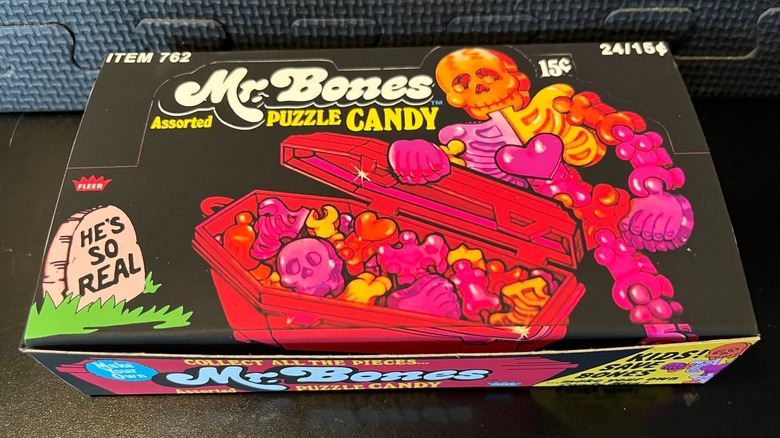
Sometimes candy is about the taste, the texture, and craveability of each bite. And other times it's about pure vibes. Any candy lover will tell you that some candies are just cooler than others. And in the long annals of candy history, perhaps no sweet treat has the kind of top level swag boasted by Mr. Bones.
Mr. Bones Puzzle Candy, to give it its full name, was a staple of the '80s candy scene thanks to the innovative packaging and design. First released by Fleer in 1977, Mr. Bones Puzzle Candy was created by candy designer Vero Ricci. Ricci was an expert in making interactive candy containers, such as Topps Garbage Can-dy, which was a tiny plastic garbage can filled with candy trash. With Mr. Bones, though, Ricci outdid himself. Kids would buy a small plastic coffin (which, thanks to a built-in loop could be easily made into a necklace) which was filled with candy bones. Get the right mix of bones and you could actually construct an entire human skeleton, skull and all, before snacking down on the whole grisly mix.
The candy was discontinued in the '90s, but nostalgia for this sugary goth grab-bag remains high. In fact, Mr. Bones was even brought back in 2023 as a collectible action figure complete with the coffin and multiple points of articulation. You may not be able to eat it, but at least you can play with it, which after all was half the point of Mr. Bones Puzzle Candy.
3. Summit Cookie Bars
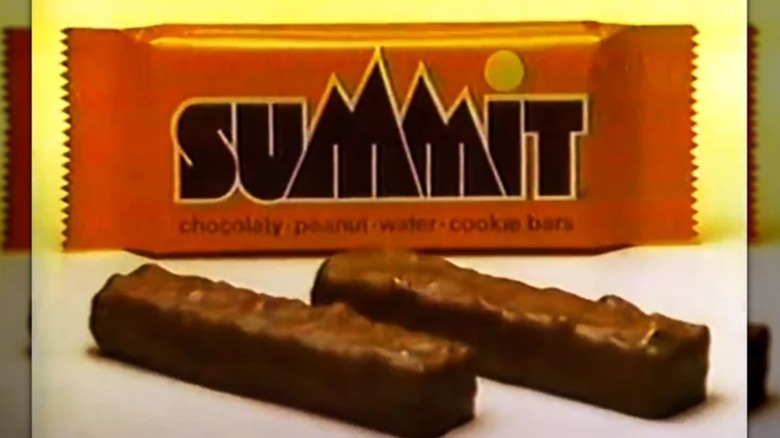
What was the absolute peak of '80s candy? According to some, the answer is simple: Summit Cookie Bars from Mars. This stretch of chocolate delight was backed by both a wafer center and a layer of peanuts, giving it the best of both worlds. People found them to be delicious — but also to be a complete mess due to the fact that they melted too easily. Fans reportedly resorted to freezing them to avoid the melting issue, but that made the bars a little too hard to comfortably eat.
Mars responded by changing the formula in 1983. Out went the peanuts, replaced by even more chocolate — 30% more according to Mars. Reaction to the revised Summit was muted at best, with unimpressed consumers complaining that while they couldn't taste any extra chocolate they could taste the absence of peanuts. As a result, despite robust ad campaigns for the candy bar, Summit went out of production in the mid-1980s. People who experienced Summit at its height, though, still wax nostalgic about it. Maybe it's time for Mars to consider bringing it back — assuming that four decades has been long enough for them to solve the melting problem.
4. DinaSour Eggs
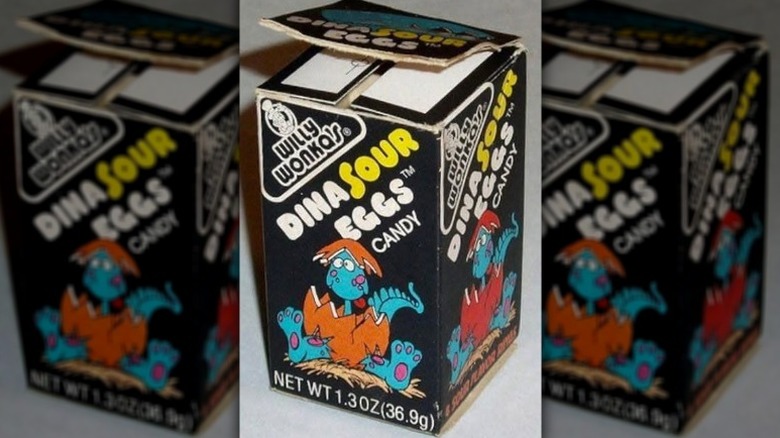
Want a candy that can really stand the test of time? Then Willy Wonka's DinaSour Eggs are perfect for you. Introduced in 1981, the original DinaSour Egg was a single massive egg-shaped sour jawbreaker in a box, advertised as long-form entertainment, as it promised to last up to a full hour per egg.
As time passed, DinaSour Eggs turned plural: by the late '80s, a box of eggs would include multiple smaller sour jawbreakers instead of one colossal whopper. Either way, DinaSour Eggs were the ideal candy for dinosaur-obsessed children, or for anyone who just likes sucking on sour treats.
There are still many devoted fans who consider DinaSour Eggs to be one of the best candies of that decade. Unfortunately for them and for you, though, Willy Wonka apparently quietly phased out DinaSour Eggs sometime in the 1990s. Seems like it's just about time for someone to Jurassic Park these things and bring them back!
5. Nestle Alpine White
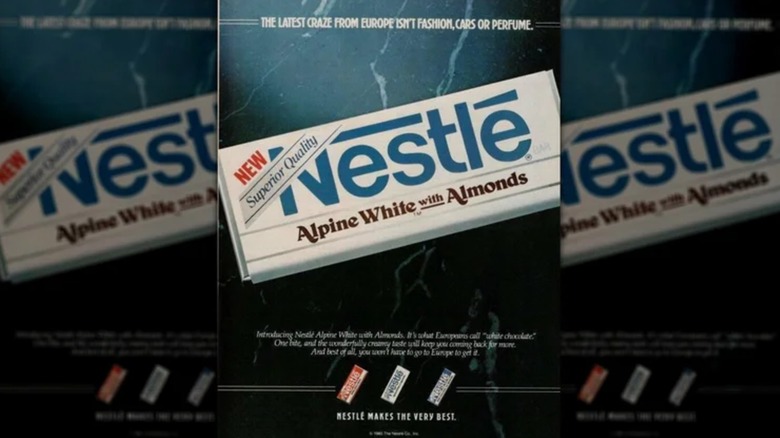
Nestle Alpine White holds a special place in candy bar history — and pop culture history, for that matter. Debuting to much fanfare in 1985, the Alpine White was a white chocolate bar with almonds that helped make white chocolate mainstream in America. By 1986, white chocolate was officially a fad, with Alpine White rising to become Nestle's second bestselling candy bar, behind only its iconic Nestle Crunch bar.
That same year, the Alpine White also seared itself into the memory of every American television viewer with an iconic commercial featuring broody supermodels posing in front of mountains of white chocolate. The accompanying jingle proved such an unassailable earworm that it was even covered by experimental metal group Faith No More. As one YouTube commenter put it, "If you ever need to explain the '80s to someone who didn't experience it, just play this commercial for a candy bar. The ENTIRE vibe of a decade, in 30 seconds."
Despite the strong start, though, sales soon faded for Alpine White, and Nestle stopped making it in 1993. Who knows, maybe if the legions of nostalgic Alpine White fans sing the theme song in unison, Nestle might hear their pleas and bring it back. It can't hurt — and maybe it will even help get that song out of your head for a while. "N-E-S-T-L-E-S!"
6. Cosmic Candy / Space Dust
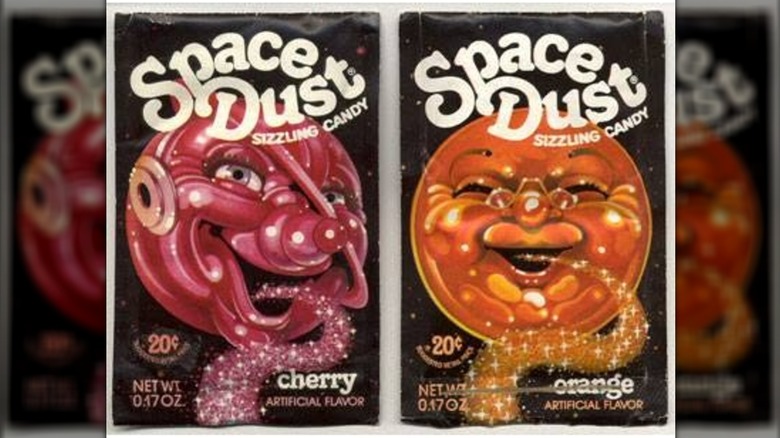
When the 1970s turned into the 1980s, there was one explosive candy at the top of the snack heap: Pop Rocks. These little candies from General Foods created a startling popping sensation in your mouth that took America by storm in the late '70s, leading to a craze that caused just about every candy company in the country to make its own Pop Rocks competitor. The best of these was Space Dust which, in a particularly clever twist, was also actually made by General Foods itself. It's easy to be a great copycat when you have the original formula!
Then things went sideways thanks to what essentially was a viral word-of-mouth misinformation campaign. First, concerned parents complained that the name Space Dust was too reminiscent of "Angel Dust," a nickname for the addictive illegal drug PCP. Facing accusations that General Foods was trying to promote drug use, the company changed the name to Cosmic Candy.
Then the company faced the especially wild (and untrue) claim that Mikey, a character in a popular TV commercial for Life cereal, had died when he mixed Pop Rocks with Coca-Cola. The bizarre story caused sales to tank, and in 1983 General Foods stopped promoting Pop Rocks. Today, you can still get Pop Rocks but unfortunately Cosmic Candy was a casualty of the exploding candy wars and disappeared despite its enduring popularity.
7. PB Max
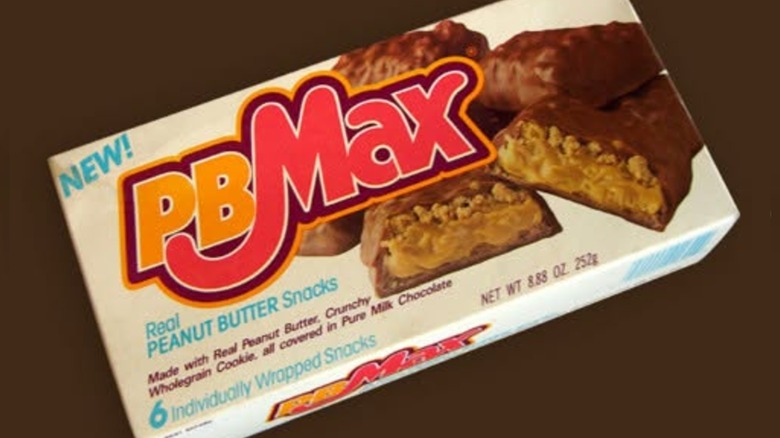
Usually when a beloved candy is discontinued by its maker there's a good reason for it, from declining sales to problems with production. But the demise of the much mourned PB Max came apparently about for a quite unusual reason: because the people who made it just hated peanut butter.
That's particularly strange considering PB Max was, as the name suggests, a candy bar that delivered a maximum dose of peanut butter. According to the book "The Emperors of Chocolate: Inside the Secret World of Hershey and Mars," Mars marketing director Alfred Poe convinced the Mars family to make PB Max in 1989 even though the family reportedly loathed peanut butter. PB Max was a hit, raking in some $50 million in sales in just its first two years of production.
Those would be its only years of production, though. Despite the strong sales, Mars discontinued PB Max apparently just because the owners personally didn't like it. For some people, money apparently isn't the only thing that matters, but the Mars family's distaste for peanut butter deprived a hungry world of enjoying a candy bar that people loved. And that love continues: in 2014, a change.org petition was started to bring back PB Max. Sadly, though, so far Mars hasn't changed its anti-peanut butter policy.
8. Marathon
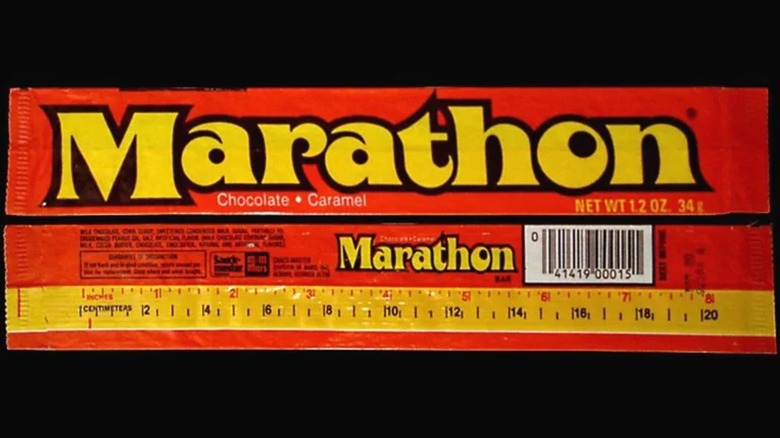
For candy bar enthusiasts of a certain age, the Marathon bar from Mars holds a unique place in their hearts. Introduced in 1973 on the backs of a ubiquitous television ad campaign featuring cowboys munching on the candy, the Marathon bar's unique gimmick was that it was extra long. Clocking in at a whopping 8 inches, the Marathon bar was two ropey strands of chocolate-covered caramel woven together for a slow, chewy experience that the brand promised would last "a good long time."
Packaging even emphasized the length of the bar with ruler marks along the sleeve so you could see just how much candy you were getting compared to a puny, regular-sized candy bar. The result was memorable enough to imprint on a generation of candy fans who still recall the Marathon bar with great fondness.
Alas, the bar was discontinued in the U.S. in 1981. Part of the reason may have been brand confusion, as in Great Britain and Ireland, Marathon was what they called Snickers bars. There is some consolation for fans of the Marathon bar, though: in the U.K., competitor Cadbury is still selling the similar Curly Wurly bar, which the Marathon bar was seemingly inspired by.
9. Bonkers
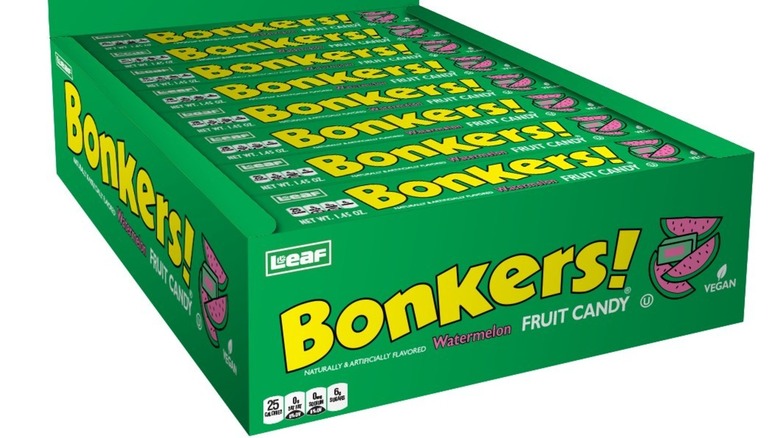
You know what's really bonkers? The fact that they don't make Bonkers anymore. Rolled out in the mid-'80s by Nabisco, Bonkers was a chewy, tangy treat. Imagine if you bit into a Starburst and there was an actual burst of amped up fruit flavor from a tangy candy center and you've nailed the appeal of Bonkers.
Bonkers also stood out from the crowd thanks to its memorable television ad campaign, which usually involved a woman going on about the candy while people behind her eating it were hit by massive fruits falling from the angry heavens. Bonkers also featured crossover marketing campaigns designed to draw in younger snackers by featuring popular characters of the time such as the Teenage Mutant Ninja Turtles, who appeared in a 1989 line of ads.
As a result, it's no wonder so many people who lived through the '80s are nostalgic for Bonkers. After Nabisco stopped making the candy it sold the rights off to Leaf, which announced in 2015 it was reviving the Bonkers brand. That promised revival never materialized, though, leaving fans to simply scan the skies for any sign of falling mega-fruits.
10. Fruit Stripe Gum
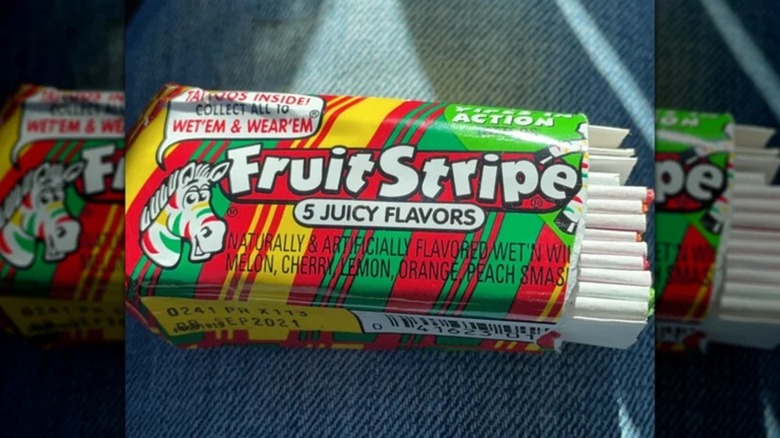
One of the most ubiquitous items at grocery store checkout lanes in the 1980s was Fruit Stripe Gum. Originally brought to market back in the '60s, Fruit Stripe Gum featured brightly colored striped gum that would give you an explosion of fruity flavors when you popped a piece in your hungry mouth.
Of course, even the most nostalgic of Fruit Stripe Gum fans would note that the flavor seemed to disappear as quickly as it hit. Still, there was an easy, age-old remedy for when you were hit with the Fruit Stripe flavor fade: just pop another piece in. Packs of Fruit Stripe, which were adorned with an image of the official mascot Yipes the multicolored zebra, came jammed with 17 sticks of gum, meaning there were always more pieces on hand to keep the flavor party going.
Unfortunately, after some six decades on the market, in 2024 Fruit Stripe Gum was discontinued by manufacturer Ferrara Candy. In a statement, the company said: "The decision to sunset this product was not taken lightly, and we considered many factors before coming to this decision, including consumer preferences, and purchasing patterns."
11. Gatorgum
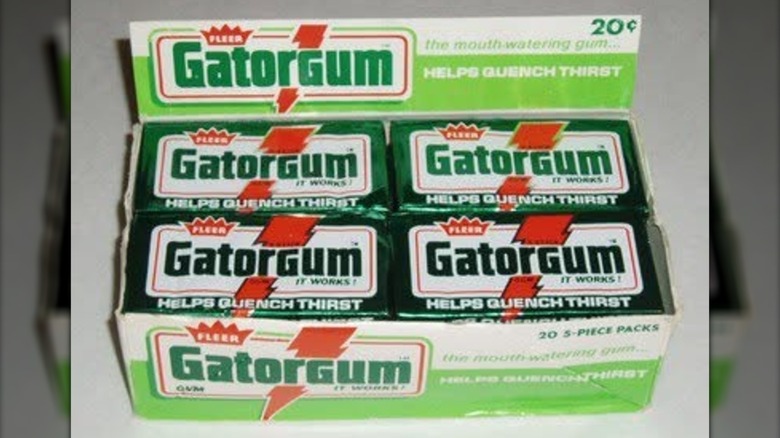
Sure, everyone loves to drink a cold bottle of Gatorade on a hot day. But what if you could chew it instead of drink it? Chewable Gatorade may sound weird at first blush — or possibly downright disgusting — but back in the '80s it was absolutely a thing thanks to Gatorgum.
The idea was simple. You're out working hard in the yard, or playing sports, or whatever it is, and you get thirsty. But there's no drink on hand! No worries, pop in some Gatorgum and a few chews will get your mouth watering again.
Of course, this wasn't really a cure for thirst; as the TV ads for Gatorgum emphasized, it merely helped with dry mouth. As a result, by the late 1980s Gatorgum had been quietly discontinued, disappearing altogether from shelves by the late '90s as supplies dried out. Still, nostalgic fans remember the gum and the ads fondly, so a return one day isn't completely out of the question.
12. Bar None
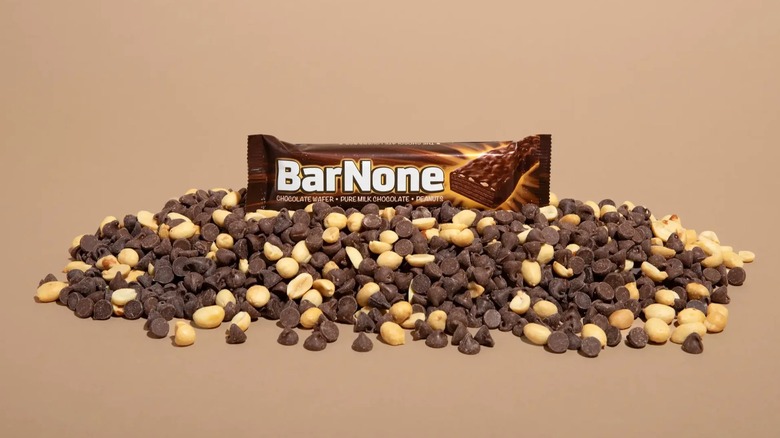
If you like Kit Kat bars, what if we told you that there once was another candy bar that was like a Kit Kat, only bigger and more chocolaty? Sounds like a dream, right? But the Bar None was a delicious reality. Introduced to the market in 1987, Bar None featured a chocolate wafer and chocolate crème coated in milk chocolate, with some peanuts thrown in just for added oomph.
Bar None was a flavor hit, but sales apparently weren't up to Hershey's standards, so in 1992 they revamped the recipe. Caramel was added to the mix and the candy was split into two bars rather than one, making the final result halfway between a Kit Kat and a Twix. Sounds good on paper, but sales tanked, and by 1997 Hershey had to pull the plug.
There's good news for hardcore Bar None truthers, though. In 2013 the rights to Bar None were acquired by Iconic Candy, which specializes in reviving nostalgic candy brands. As a result, in 2019 Bar None candy was relaunched and could be ordered via the internet — though widespread distribution still remains elusive.
13. Reggie! Bar
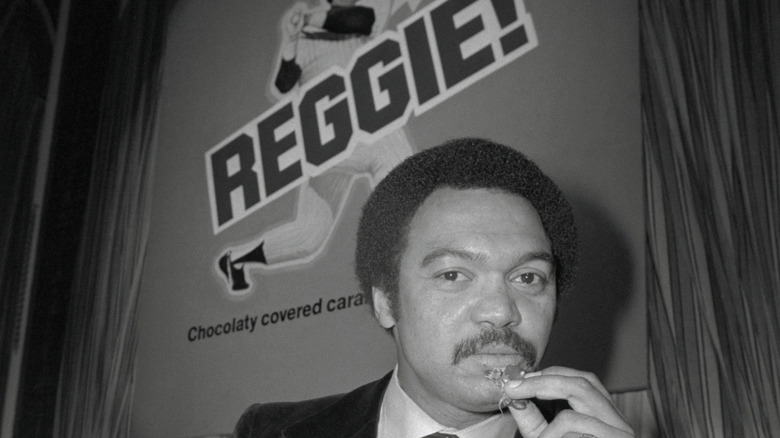
The Reggie! Bar has one of the most interesting origin stories in candy bar history. In 1976, while playing for the Oakland Athletics, baseball star Reggie Jackson joked that if he were playing in New York City instead of Oakland, they would name a candy bar after him. Fast forward two years and that's exactly what happened. Jackson started playing for the New York Yankees in 1977 and became a World Series hero that year, so in 1978 the Reggie Bar made its debut.
The bar was unveiled in characteristic larger-than-life fashion. At the Yankees home opener in April, 1978, Jackson hit a home run and the crowd — all of whom had been given Reggie! Bars at the start of the game to promote the candy's launch — chucked them en masse onto the field in a shower of Reggie! Bars.
The fame of both Jackson and his Reggie! Bar propelled sales throughout the '80s, but his retirement in 1987 essentially ended the fad. For a decade or three, anyway. In 2024, Reggie! Bars were revived, and even made available in select stores. Could a nationwide rollout be in the cards? We wouldn't bet against Mr. October.