

5 Of The Rarest Lobsters Ever Caught
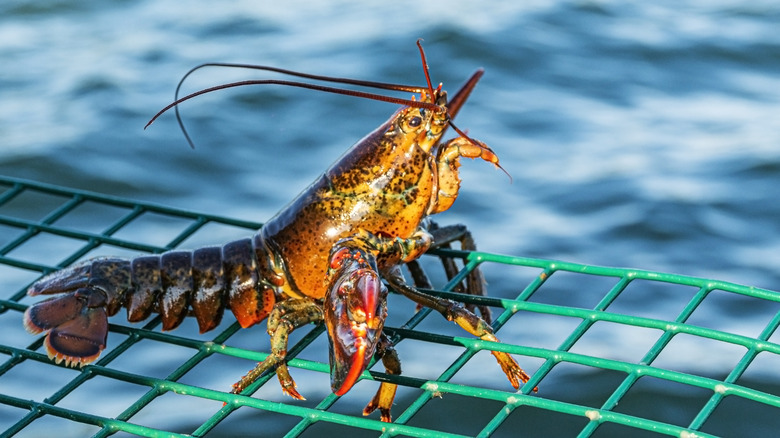
As those living near the North Atlantic coast know, Lobsters are a staple of the New England diet, where locals and tourists alike love to chow down on sweet, buttery lobster rolls and broiled lobster tails. Although American lobster is still plentiful in areas like the Gulf of Maine, there are certain lobsters you definitely don't want to see on a dinner plate. This isn't because they are poisonous or even less appetizing — eating certain types of lobster should be avoided because they are incredibly rare.
These elusive creatures swim amongst the familiar, large-clawed crustaceans in New England and other northern waters, and every once in a while, they are caught. Some lobsters are so rare that commercial fishers either return them to the water after marveling at their luck in finding one, or donate them to a marine science center where they can live out their days without worry of predators.
The unique hues and patterns on their shells are what make varieties like the calico, cotton candy, and split-colored lobsters stand out, but the scarcity with which these catches taking place adds to the wonderment. Read on to learn about five of the rarest lobsters that have ever surfaced from the ocean floor.
Split-colored lobster
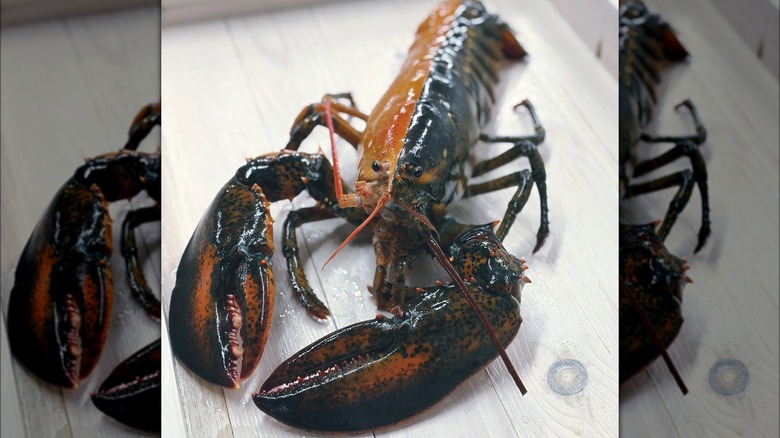
In April 2026, fishermen hauling in lobsters for the Wellfleet Shellfish Company found something truly special. Included in the catch was a 3-pound female lobster with a half reddish-orange, half dark brown shell. The colors were split perfectly down the middle of the lobster's back, and catching it was a one-in-50-million chance. Lobsters like this don't often live long in the wild because their unique colors make them stand out to predators, so the female's large size was also unusual. She was donated to Woods Hole Science Aquarium in Massachusetts to live out her life in safety.
This was not the only bicolored lobster ever caught. A similarly colored lobster was found in 2019 near Stonington, Maine. In 2023, a half-blue, half-red Maine lobster named Bowie was caught and later determined to be half-male, half-female. As Julia Studley, an aquarium biologist at Woods Hole Science Aquarium, explained to Popular Science, "Split-colorization occurs when two fertilized, unlaid eggs contact each other, causing one to absorb the other. This creates a lobster with two sets of genetic information, and the ability to store color pigments differently on either side of its shell." The rare genetic phenomenon also makes it possible for lobsters to be both male and female, split down the middle, like Bowie.
Calico lobster
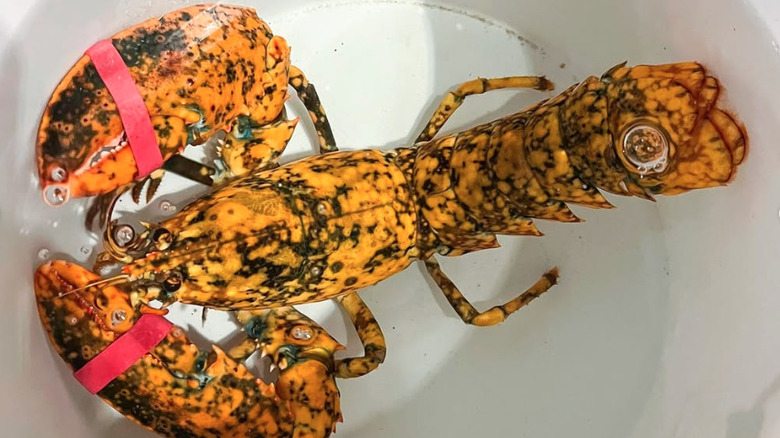
The Wellfleet Shellfish Company of Cape Cod, Massachusetts, knows a thing or two about hauling in rare lobsters. In 2022, a mottled black-and-orange calico lobster was found amongst the wholesaler's catch. The chance of catching a calico lobster is one in 30 million. Rather than throw the eye-catching invertebrate back or sell him as a curiosity, Wellfleet donated this rare lobster to the Cape Cod Museum of Natural History. One year earlier, another male calico lobster was saved from a restaurant's live seafood tank by staff at a Red Lobster in Virginia. They named him Freckles and facilitated his relocation to the Virginia Living Museum. Sadly, Freckles died a year after his rescue.
A female calico lobster caught off the coast of Massachusetts in 2025 will hopefully have a happier story. When lobsterman Mike Tufts recognized the uniqueness of his find, he contacted Northeastern University's Marine Science Center in Nahant, Massachusetts, to ask if they would take her. The answer was an enthusiastic yes! The lobster was named Jackie, short for Jack-o-lantern, due to her orange shell mottled with black. People have asked if Jackie could produce calico babies, but due to her rare pigmentation, science doesn't yet have an answer.
Cotton candy lobster
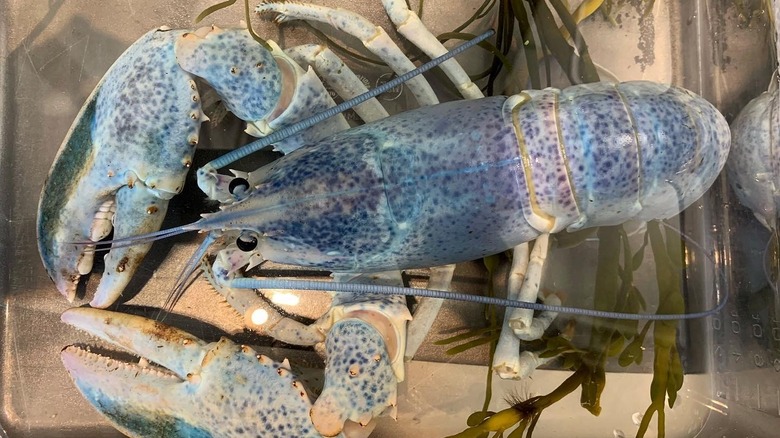
One of the absolute rarest lobsters found in the ocean is the cotton candy lobster. The chance of catching a cotton candy lobster is an incredible one in 100 million, but caught they have been. At first, they may appear to be blue lobsters (both are classified as the American species of lobster after all), but a closer look reveals their true uniqueness. A number of colors mix on a cotton candy lobster's shell, such as pink, lavender, purple, and yes, blue. "You see these beautiful creatures and just like a fingerprint or a snowflake, each one is going to be different," Seacoast Science Center aquarist Sam Rutka told Seacostonline.
Lobsterman Joseph Kramer donated a cotton candy lobster he caught in 2024 to the Seacoast Science Center, located in Rye, New Hampshire. The healthy male lobster was estimated to be between 6 and 14 years old. A few years earlier, another cotton candy lobster was caught in Maine's Casco Bay. Bill Coppersmith, the veteran fisherman responsible for the catch, named the lobster the Haddie after his granddaughter. Today, Haddie also resides at the Seacoast Science Center.
Blue lobster
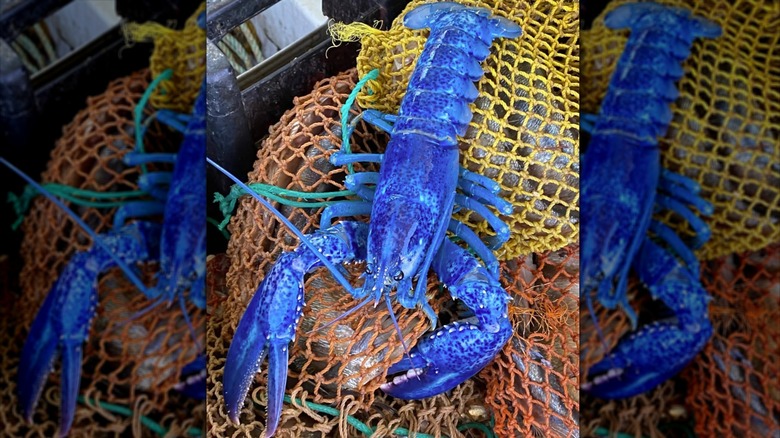
When Bowie, a bicolored, intersex lobster, was caught on the Maine coast in 2023, the sight of its half-blue shell wasn't a total anomaly. Bowie was half blue because lobsters can be blue all over. Blue lobsters are less rare than split-colored lobsters, but they are far from common, occurring only once in about two million lobsters. The unusual coloring is caused by an overproduction of the protein crustacyanin.
Some blue lobsters caught by commercial fishers are given to institutions that can care for them. In 2020, Patriot Seafoods donated a blue lobster to Boston's New England Aquarium. University of Massachusetts Dartmouth's School for Marine Science and Technology is home to another blue lobster that weighs about 1.25 pounds and is likely between 7 and 8 years old. A blue lobster named Neptune resides at Northeastern University's Marine Science Center in Nahant, Massachusetts, where an even rarer calico lobster named Jackie also resides.
Rarity is a large part of what makes blue lobsters special, but where they have been found is another. It turns out that these striking lobsters don't just stick to American shores. In 2024, a blue lobster was caught across the Atlantic off the coast of Cornwall in southwestern England.
Albino lobster
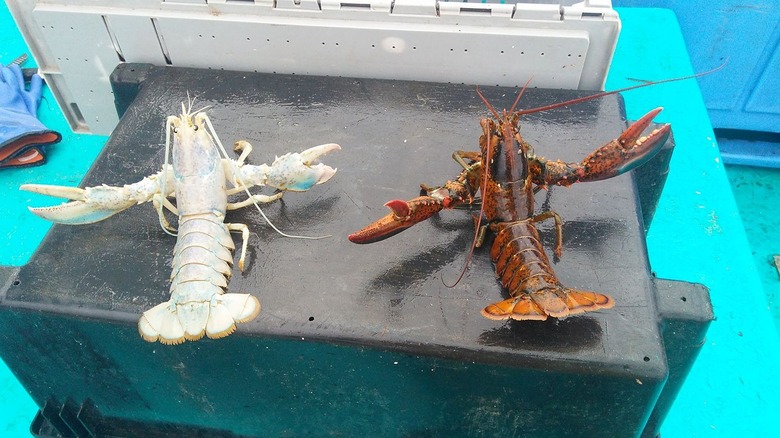
Unlike other rare lobsters that are characterized by bold colors, albino lobsters, also sometimes called ghost lobsters, completely lack pigment in their shells. Due to this, albino lobsters are the only lobsters that won't turn red when cooked. These are some of the rarest lobsters in the world, with a catch rate of about one in 100 million. When they are caught, many choose to pass them on to science centers and aquariums. Others may receive a V-shaped notch in their tails before being returned to the ocean. This mark alerts others who might catch the lobster in the future that it is considered protected and not for harvest.
A number of albino lobsters have been caught off the East Coast of North America. Fisher AJ Francis made the news after catching one in Nova Scotia, Canada, in 2020, which was donated to the Northumberland Fisheries Museum. A lobster caught in Maine by James Hook and Company in 2021 was donated to an aquarium. In 2025, an already discovered albino lobster was caught again in Newfoundland and released back into the water, proving once more that a shell that stands out to predators is not an automatic death sentence for these fascinating crustaceans.