

Panda Express VS P.F. Chang's: Who Serves The Best Orange Chicken?
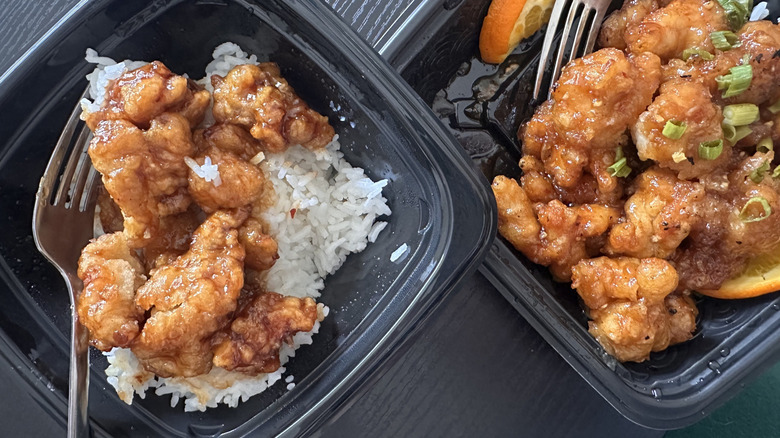
Your family's Chinese takeout night most certainly included at least one order of orange chicken. Alongside other classics like pork lo mein, spare ribs, and egg rolls, it's one of the most popular Chinese-American dishes. Don't get it confused with General Tso's, though — there's a big difference between the two kinds of chicken.
Orange chicken is a bright, citrus-forward dish consisting of crunchy chunks of battered and fried chicken smothered in a thick, sweet sauce. It's been around since the 1980s, and is a staple in nearly every Chinese-inspired restaurant in America, including the big chains like P.F. Chang's and Panda Express. In fact, Panda Express is a major part of orange chicken's origin story — an executive chef from the company is credited with being the inventor of the recipe. While you can try to make orange chicken at home, you'll probably always be chasing the standard that Panda Express created.
While Panda Express may have made orange chicken the takeout icon it is today, plenty of other chains boast their own popular variations. P.F. Chang's, for example, serves up the stuff in a more elevated setting. In a dining room with a full bar, sleek booths, and real silverware, is its orange chicken inherently better than it is from a mall food court? We're on a mission to find out.
Panda Express Original Orange Chicken
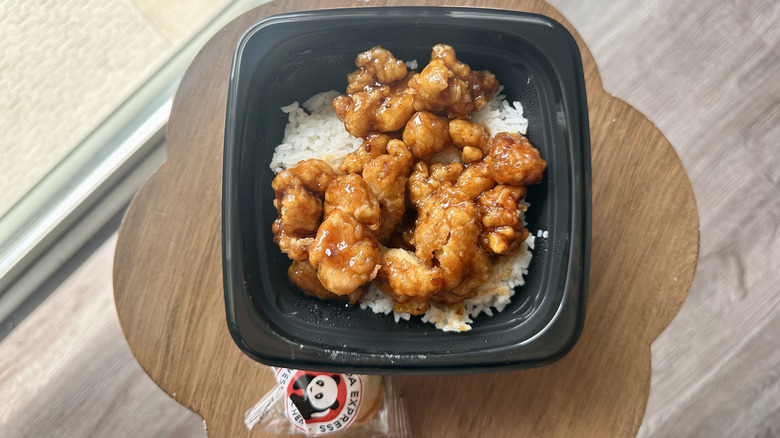
At Panda Express, the menu proudly lists this classic dish not just as Orange Chicken, but as The Original Orange Chicken. The chain invented it, and so our expectations were high — after all, it sells more than 110 million pounds of Orange Chicken annually, making it by far its most famous dish. A regular takeout serving comes as a bowl with a side of white rice. This cost $8.50 plus tax at a Chapel Hill, North Carolina location, and the serving of chicken alone weighed in at around 5.7 ounces.
The first thing that hits you is the flavor. Panda Express's orange chicken has a very deep, robust umami quality, with notes of garlic coming through alongside the caramel-like sweetness. What makes Panda Express orange chicken so good might be the inclusion of soy sauce and white vinegar, which helps explain that particularly savory backbone.
Each bite of chicken was surprisingly juicy and fresh-tasting, and wonderfully crunchy. Copycat Panda Express orange chicken recipes use flour and cornstarch for breading, which likely adds to that distinct texture. There was real flavor in the breading, and that crunch, combined with the soy- and ginger-forward sauce, gave it a distinctly nostalgic Chinese-takeout quality. And then there's the rice, which was a surprisingly important part of the experience. It was perfectly moist, fluffy, and sticky, and the ideal complement.
P.F. Chang's Orange Chicken
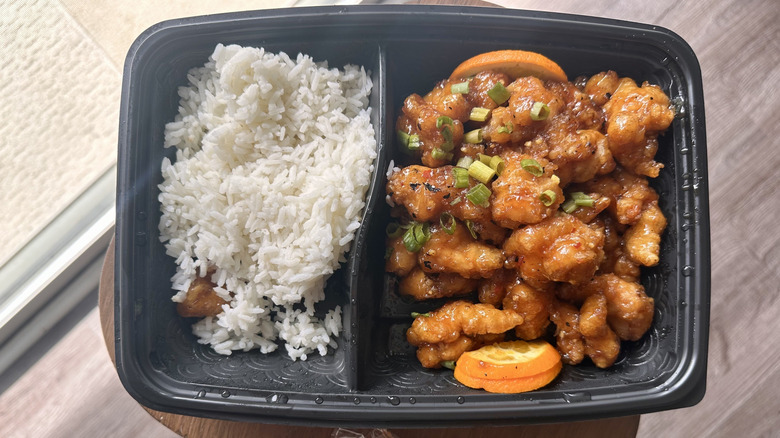
When taking the first bite of P.F. Chang's orange chicken right after Panda Express's, the most noticeable difference was the brightness. That was the first word that came to mind. The sauce had an almost syrupy, honey-like quality compared to Panda's deeply umami flavor. After mixing the chicken up a bit (we learned that this was necessary as the bottom bits were much, much saucier), each bite started to taste a little more complex.
With P.F. Chang's chicken, there's a peppery aftertaste that, after a few bites, really builds up to a decent spiciness without overwhelming the tangy, orangey, honey-like flavor. Soy is in there somewhere, too, but it's certainly not the first flavor on your tongue. Impressively, there was not a single bad bite of chicken in the entire serving. The pieces were large and fresh-tasting, with a softer, lightly battered coating that wasn't displeasing, but definitely wasn't super crispy-crunchy. Fresh orange slices and green onions on top added to an elevated, restaurant-quality presentation.
There was certainly a lot of food in this serving, but I'm not sure it was really $20-worth of food — especially considering that the rice was pretty awful, and we hardly ate it. It was cold, dry, not fluffy, and whatever the opposite of sticky is. It could be because P.F. Chang's is using long-grain rice, which isn't always the best rice for sticky rice.
P.F. Chang's wins, but not by a landslide
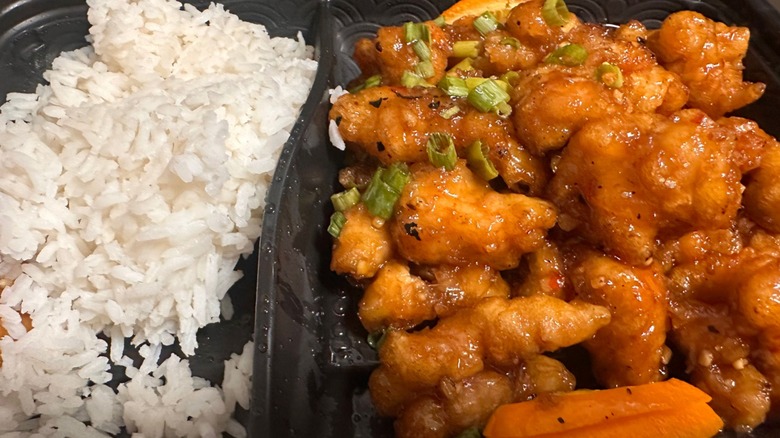
When two of the same dishes have such a drastic price difference, the one that costs more should theoretically win by a landslide. This was not exactly the case. After much deliberation and many back-and-forth bites of chicken, we ultimately decided to crown P.F. Chang's the winner of this battle. P.F. Chang's orange chicken was saucier, with more large, fresh, well-cooked chunks of chicken (not a single dry bite throughout), and we enjoyed the light, tempura-like batter overall. The more noticeable and complex level of spice helped our decision to choose P.F. Chang's as well.
The thing is, this could all very well be a matter of preference. Panda Express's orange chicken was not bad at all — it was fantastic. Super crunchy but never gristly or hard, boldly flavored, and served with rice that was perfectly moist, sticky, and fluffy, this was the exact dish you'd want if you were specifically craving a nostalgic Chinese takeout flavor. Panda would give you an ASMR-friendly bite; P.F. Chang's probably would not. But P.F. Chang's just had the more elevated dish, with slightly better chicken, nicer presentation, and a more interesting-tasting sauce.
For more than twice the price, though, we expected more. The amount of chicken was nice, but it didn't feel like enough to bridge a $10 gap, and at that price, we were hoping for a few more bells and whistles, like bell peppers or carrots. Or, some edible rice!
How do these dishes compare in nutrition, price, and overall value?
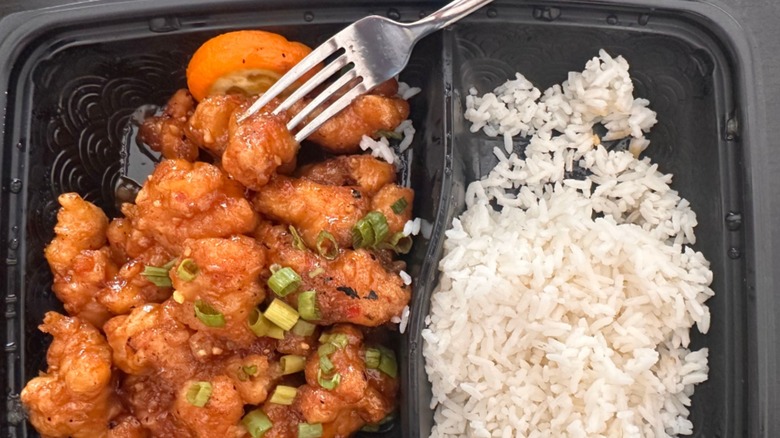
The biggest difference between these two orange chicken orders isn't the chicken — it's the price. Panda Express' entree cost $8.50 before tax, while P.F. Chang's came to $18.69, making the latter more than twice as expensive. P.F. Chang's did give us considerably more chicken: We weighed the chicken alone at 11.2 ounces, compared to 5.7 ounces from Panda Express. So, you're getting almost twice as much chicken at P.F. Chang's, although you're also paying a little more than twice as much for it. The rice portions were also roughly comparable.
Neither dish exactly qualifies as a health food, either. Panda Express's orange chicken comes in at 510 calories and 850 milligrams of sodium per serving, while P.F. Chang's packs in 1,060 calories and 1,100 milligrams of sodium per serving. P.F. Chang's gives you more food, yes, which explains the higher count in both areas, but Panda Express's smaller portion still packs a surprisingly hefty amount of salt.
Methodology
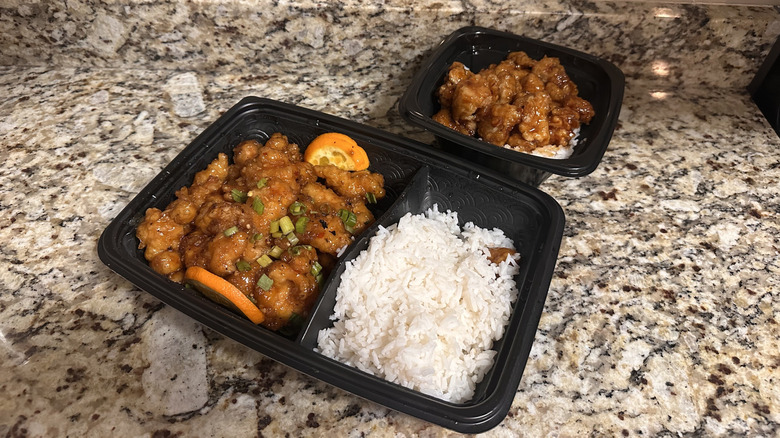
Both orange chicken dishes were ordered from Chapel Hill, North Carolina, locations. Panda Express was a standalone restaurant rather than a mall food court, which feels important to note since preparation and freshness can vary by location. Both orders were placed for takeout and eaten immediately after pickup.
We weighed the chicken portions ourselves using a kitchen scale, weighing the chicken separately from the rice. We also evaluated each dish side-by-side, bite-for-bite, for the crispiness and texture of the chicken, the size and quality of the pieces, the flavor and complexity of the sauce, the quality of the rice, and the overall value of the meal.
No customizations were made to either order. Prices were recorded before tax at the time of ordering: $8.50 for Panda Express and $18.69 for P.F. Chang's. Nutritional information was pulled directly from each company's published nutrition information and reflects the standard orange chicken serving, not the rice.