

The 6-2-2 Rule You Need For Perfectly Cooked Pork Steaks
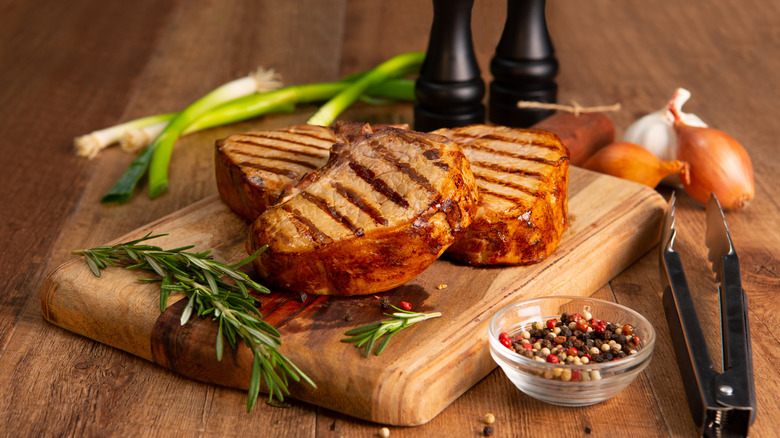
When thinking of a strategy to help your pork come out tender and flavorful, you might be doing so with a method for perfect pork ribs in mind. There's also a formula specific to cooking pork steaks that's worth a try. Pork steak is a versatile cut from a pork shoulder and an often-overlooked alternative to beef steak. Bone-in cuts are great for making slow cooker pork steaks, but if you're looking for a quicker alternative, consider cooking boneless pork steaks using the 6-2-2 method.
It's very simple: place the boneless pork steak on a preheated pan or grill and let it cook undisturbed for six minutes. Flip it and let it cook for another two minutes, then rest it for two more minutes before serving. The 6-2-2 method doesn't require any specialized equipment — just a pan or grill, tongs, and a knife if you are cutting your own steaks.
Cutting steaks yourself might sound intimidating, but it's fairly straightforward. If you buy a bone-in pork shoulder (also known as pork butt), cut along the blade bone to separate the large piece into one portion that's fully boneless (that's where you'll cut the steaks from) and one with the bone still in, which can be smoked or slow-cooked in other dishes. Cut on the bias of the boneless piece to form ¾-inch to one-inch-thick steaks. Once your steaks are cut, you're ready to proceed.
How each step of the 6-2-2 method works
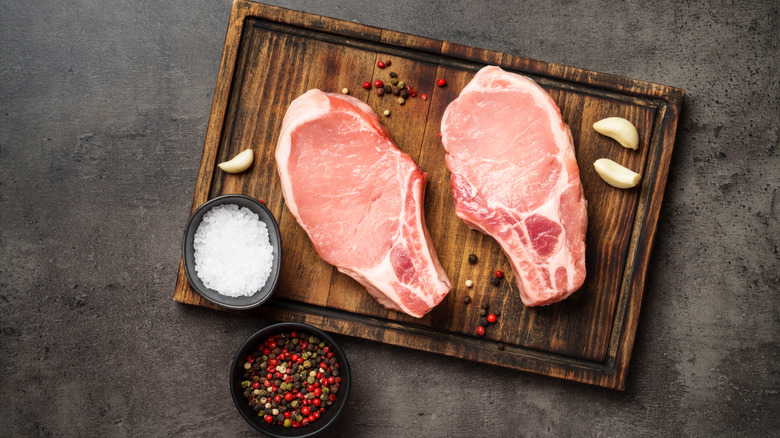
Preheat your pan or grill to medium-high heat and prepare the pork steaks by coating them in seasoning and oil. Once the cooking surface is sufficiently hot, gently place your pork steaks on it. Keep an eye on them while they cook for six minutes, but don't move or flip them. When those six minutes are up, flip each steak with tongs and cook the other side for two minutes. The meat is only flipped once, and after eight total minutes of cooking, the steaks are removed from the heat and rested for another two minutes. In 10 minutes, your pork steaks will be perfect.
Do you need to bother with the resting? Yes, but maybe not for the reason you'd think. Conventional wisdom says that resting is necessary for the meat to become more tender and to reabsorb its juices. It actually does neither. What it does is continue a process that's called carryover cooking — allowing the middle parts of the meat to continue cooking from retained heat even after it's no longer on the cooking surface. In some scenarios, the hidden downside to letting meat rest is that it results in overcooking. Here, the 6-2-2 method is built around precise timing, so those last two minutes are essential to getting the interior of your pork fully cooked but not overdone.